


Practical Sailor Gets Liftin’ and Rollin’ with Trailer Jacks
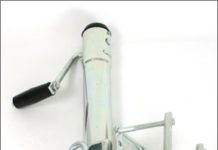
Anyone who’s ever owned a trailer sailer knows that one of the most frustrating aspects or trailering a boat can be getting the coupler to meet the trailer hitch. One trailer accessory that can make this effort easier is the trailer jack. Our favorite is the stow-away trailer jack with castering wheel. We recently tested seven: the Road Warrior Mighty Wheel and Big Wheel from SeaSense; the 6800 Dual Wheel and the Swivel Series (6850 and 6851) from Dutton Lainson, and the Swing-away XP15L and dual wheel XPD15L from Fulton. We found jacks with independent wheels like the Dutton-Lainson 6851 and those with two wheels to be the best trailer jacks.
Practical Sailor Gets Liftin and Rollin with Trailer Jacks
Anyone who’s ever owned a trailer sailer knows that one of the most frustrating aspects or trailering a boat can be getting the coupler to meet the trailer hitch. One trailer accessory that can make this effort easier is the trailer jack. Our favorite is the stow-away trailer jack with castering wheel. We recently tested seven: the Road Warrior Mighty Wheel and Big Wheel from SeaSense; the 6800 Dual Wheel and the Swivel Series (6850 and 6851) from Dutton Lainson, and the Swing-away XP15L and dual wheel XPD15L from Fulton. We found jacks with independent wheels like the Dutton-Lainson 6851 and those with two wheels to be the best trailer jacks.

Three New Anchors Throw Their Weight Into the Practical Sailor Anchor Chronicles
Practical Sailor adds three anchors to our test lineup: the Quickline Ultra and two updated versions of the XYZ Extreme anchor, the original of which we reviewed in the April 2006 issue. The three anchors were attached to rode and tested in shallow, muddy water along the Florida coastline. The anchors were rated for how well they set and how well they fared under load. Sustained holding power was recorded for all three anchors. Price, weight, warranty, and stowability were also considered in the final ratings. The shiny stainless-steel anchors were easy on the eye, but weighing the pros and cons of stainless anchors versus galvanized anchors left testers more inclined to purchase a galvanized anchor. Galvanized steel is more likely to show corrosion and so has a good warning system for metal failure.
Anchoring Rights Revisited
I don't know David Dumas, the owner of a lovely Kadey Krogen trawler named Kinship, but I like his style. Fighting against draconian anchoring restrictions on Marco Island, Fla., Dumas recently had his day in court, and the world is a saner place because of it. Dumas, his pro bono lawyer Donald Day, and local boating activists deserve credit for their perseverance. Thanks is also due to the National Marine Manufacturing Association (www.nmma.org), the Seven Seas Cruising Association (www.ssca.org), and members of BoatU.S. (www.boatus.org) whose lobbying efforts last year resulted in a new Florida law that clarifies anchoring rights in the state. Dumas anchored his boat in Marco Islands Smokehouse Bay last January with the intention of toppling a Marco Island ordinance that restricted boats from anchoring within 300 feet of a seawall for more than 12 hours. Similar ordinances, with equally shaky legal footing, are in place in many communities across the nation.

Riding Sails to Tame Those Anchor-Dancing Boats
Practical Sailor recently evaluated a radically new designed riding sail, the FinDelta Anchoring Sail from Banner Bay Marine, which uses three panels instead of the traditional single panel. According to Banner Bay, as the boat tries to swing, the sails forward fin generates a thrust vector to one side only, gently realigning the boat. By comparison, a traditional, single-panel anchoring sail still allows some degree of sailing at anchor as the sail backs and fills from one side to the other, often resulting in flogging. The FinDeltas design also reduces one of the most common complaints of traditional riding sail users: noise. The FinDelta doesn't require attachment to the backstay-an excellent conduit to transmit the vibration from flogging anchor sail-and so noise is greatly reduced. While the single-panel riding sail has served sailors well for centuries, this new design intrigued our testers, and a head-to head-comparison between it and the traditional Sailrite riding sail was launched.

Used Nylon Three-Strand Rope Faces The Ultimate Endurance Test
The nylon three-strand dock lines used for this test had weathered significantly, and chafed noticeably where the lines exited chocks and made contact with cleats. We put these lines under increasing tension in laboratory conditions and tested them to destruction. Our test shows that even when the effects of chafe were eliminated, up to 75-percent of the original tensile strength in our sample ropes was lost. These findings fly in the face of the conventional rhetoric that views nylon as such a strong material that one should always opt for thinner line due to its better elastic effect. To the contrary, within reason, this overly springy, rubberband-like function is a foe rather than a friend. We left the lab realizing the importance of taking a close look at dock lines and other nylon-line applications, noting the last time they had been replaced and why tropical storms and noreasters take such a heavy toll. A new set of dock lines is cheap insurance, and money well spent.
Mast Wire Worries
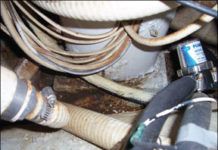
My Tayana Vancouver 42s mast wires and cables were cut when the keel-stepped mast (63 feet) was removed. The wires include those for a tri-color with strobe, DataMarine 5000, VHF radio, radar, and nav lights. I am thinking of using a terminal box for the connections when the mast is replaced, but Im concerned about bilge moisture over time as well as the multiple wires in the cables. The wires exit the mast just above the step. I tried to leave sufficient wire for a terminal box, but I don't think a box outside the bilge is currently possible without additional wire extensions. Thoughts and recommendations?
For the Grinder
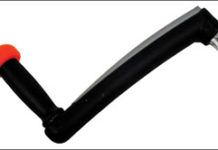
You might recall a February 2007 Chandlery review of the Lewmar OneTouch winch handle. The handles inventer, Don Steiner, has come out with his own, updated, lighter weight version, the Dax OneTouch. Steiner engineered the OneTouch and sold the license to Lewmar for the metal version, but his Dax OneTouch is made of 50 percent fiber-filled nylon, and all metal parts are high-grade aluminum or stainless. It also has a wider grab bar and higher operatng arc than the Lewmar.

Practical Sailor drops, drags, and dissects three flexible potable-water tanks.
Unlike their rigid counterparts, small flexible tanks make adding small stores of drinking water aboard a cruising boat relatively easy. But not all flexible tanks are equal in terms of ability to withstand wear and tear. Practical Sailors testers evaluated popular models from Vetuswww.vetus.com, Nauta Imtra Corp., www.imtra.com, and Plastimo Navimo USA, www.navimousa.com. The Vetus and Nauta tanks are rated to hold 14.5 gallons (55 liters), while the Plastimo tank holds 13.2 gallons. Testers took note of each tanks flexibility, weight, construction, seams, tie-down grommets or straps, valves, exterior and internal materials, capacity, and other characteristics. The smell and taste of the stored water were evaluated. The tanks also faced abrasion, seam strength, and drop tests-and thats what separated the weak from the winners in the water storage arena.
Practical Sailor Test Boat Gets Half a Refit With Powerlite PBO Rigging
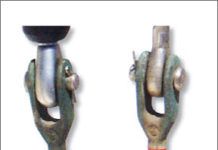
Although stainless steel wire and rod rigging are still the traditional, most popular, and economical material of choice for mast rigging, metal is rapidly giving way to a new generation of synthetic rigging material. There are a handful of companies that manufacture standing rigging using ultra lightweight high-modulus synthetic fibers such as Kevlar, PBO (polybenzoxazole), and carbon.There are many advantages of synthetic rigging. Weight savings aloft is the primary benefit, and high-modulus fiber can be up to 50 percent stronger than similar diameter rod or wire rigging, and up to 90 percent lighter. Another touted benefit is greater fatigue resistance. For the average racer-cruiser, there are three big drawbacks to PBO: It is four times as expensive as stainless steel wire, although roughly on par with rod rigging; should its cover fail, it drastically loses strength in direct sunlight; visual inspection and DIY repair is currently impossible. Until recently, the technology for high-modulus, synthetic fiber rigging was only available to deep-pocketed mega-yacht owners. As development advances and competitive pricing is sparked, this type of rigging may one day be an option for average sailors. Under the current state of technology, we can only recommend this product for the serious racer with very deep pockets.
Latest Logbook

Practical Sailor Logbook – September 2026
In September we tour the Hans Christian 48T — the offshore cruiser many sailors call the holy grail — walk the custom Antigua 60...

Video: The BEST Sailboat You Can Buy for $35,000 – Catalina...
If you’re searching for a mid-30-foot sailboat, affordable cruising sailboat, liveaboard sailboat, first sailboat, or a capable used sailboat for coastal cruising, the Catalina...



Latest Sailboat Reviews

Learning by Doing on a $5,000 Catalina 30 Mk II
When Davis’s mother started talking about wanting to do something “big” for retirement, Davis and Gloria half-jokingly threw out an idea that seemed suitably...