

Holding Tanks: Getting the Stink Out
The quality of onboard living suffers when each flush of the head becomes public knowledge within minutes, and a boat that smells bad won’t be a part of your family for long. Practical Sailor tested three vent filters for holding tanks, from makers Big Orange, Vetus, and Dometic, and tested one homemade vent filter. When sanitary wastes are allowed to biodegrade in a closed tank, particularly with poor mixing and inadequate oxygen, anaerobic bacteria dominate. These bacteria particles can make a boat unpleasant or unlivable unless they are eliminated or contained. Carbon filters are one solution to the odor problem; they are simple, dependable and absorb a wide variety of odors.
Test Setup Simulates Onboard Sewage System
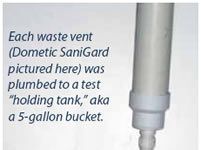
To create a real-world test, we assembled a series of miniature holding tanks containing sanitary waste generously supplied by a 20-pound, 5-foot pet iguana named Ziggy. This was supplemented with other sanitary waste as needed. Seawater flush was used because saltwater is known to contribute to odor.
Avoid Plugging with Proper Vent Installation
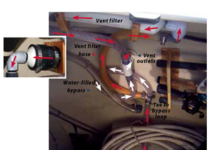
The effectiveness of activated carbon comes both from surface activity (a result of activation by partial combustion of coal or woody products) and the vast pore structure formed during this partial combustion. Anything that clogs the pores will dramatically reduce carbon life, potentially ruining it within minutes.

On a Side Note: Holding Tanks
Although none of the test tanks or the test boat’s holding tank accumulated solids sufficient to restrict pump-out, we observed significant differences. While vent filters did not increase tank solids beyond what is normal in a poorly ventilated and un-treated tank, some of the subject tanks did better than others.
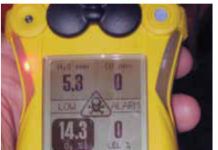
Ziggy the Iguana Puts Odor Control to the Test
For a real-world test, we created a series of small but real-world holding tanks containing real sanitary waste. The sanitary waste was supplied by a 20-pound iguana. Ziggy already poops in a tray of water and we know this mixture to be plenty foul. This was supplemented with additional sanitary waste during the start-up period each spring. Seawater flush was used, as the odor problems associated with seawater are known to be more severe, the result of bacteria-reducing sulfate into more odorous sulfide chemicals. Tank tests were supplemented with field testing aboard a test boat on the Chesapeake Bay.
Real-world Advice from Holding Tank Makers
Before beginning a series of tests, we always involve the manufacturers. They have a wealth of information they are happy to share, in the interest of reducing problems with their products. In general, their advice forms a consensus.
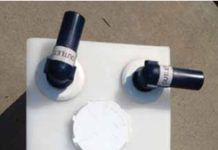
Marine Holding Tanks Go Head-to-Head
In our 2002 holding tank test, SeaLand emerged as the winner. The material of choice for holding tanks continues to be rotationally molded linear polyethylene, which is light in weight, doesn’t corrode, allows for seamless tank construction, is relatively inexpensive, and won’t allow odors to permeate. This new test compares a pre-2009 model SeaLand tank to a new holding tank from Trionic Corp. The holding tank test looked at the tanks’ construction materials, price, size, valves, inlets, outlets, leaks, inspection ports, vent size, warranty, and performance-based panel deflection. Preventing threaded fittings from leaking was the hardest part of the test.
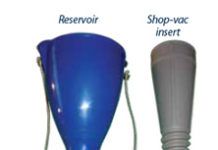
Sea Flush Eases Winter Woes
For those in colder climes, the only drag bigger than the end of the sailing season is the need to winterize engines, generators, and air-conditioning units in preparation for their long winter’s nap. Wandering the docks at the 2011 Annapolis Boat Show, we came across the Sea Flush, a new product designed to make the process relatively painless, eliminating the struggle to pull a cooling-system hose end or installing a “Y” valve in order to flush and winterize “raw water” cooling systems or the open side of a closed cooling system.

Engine Maintenance: Keeping Your Fuel Clean
No good ever comes of fouled diesel fuel. One of the best ways to keep fuel free of contamination issues like condensation buildup—and the bacteria growth it promotes—is fuel polishing. Fuel polishing in its most basic form is the act of circulating the diesel in your tank through a filter. The Parker FPM-050 diesel fuel polisher is designed to be plumbed into the fuel supply line between the existing primary fuel filter and the engine. Testers plumbed the FPM-050 to recycle fuel into a container for several days. Testers looked at flow rates, contamination, sludge, ease of installation, and price.
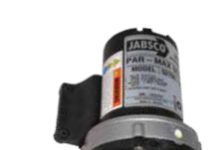
Deck Washdown Pumps for Boats
Practical Sailor evaluated washdown pumps capable of performing high-pressure cleanup chores on boats ranging in size from a weekender to a mid-size cruiser. We looked at eight pumps from four manufacturers: the C-60 Deck Wash Kit from Groco Marine; two pumps from Jabsco / ITT; two from Shurflo; and three from Johnson Pumps. With gallons-per-minute ratings ranging from 3.5 to 7 GPM, the pumps were evaluated on their free-flow and restricted outputs, outflow distance and pressure, power draw, price, warranty, design, and construction quality.
Latest Logbook

Practical Sailor Logbook – September 2026
In September we tour the Hans Christian 48T — the offshore cruiser many sailors call the holy grail — walk the custom Antigua 60...

Video: The BEST Sailboat You Can Buy for $35,000 – Catalina...
If you’re searching for a mid-30-foot sailboat, affordable cruising sailboat, liveaboard sailboat, first sailboat, or a capable used sailboat for coastal cruising, the Catalina...



Latest Sailboat Reviews

Learning by Doing on a $5,000 Catalina 30 Mk II
When Davis’s mother started talking about wanting to do something “big” for retirement, Davis and Gloria half-jokingly threw out an idea that seemed suitably...