To provide the best experiences, we use technologies like cookies to store and/or access device information. Consenting to these technologies will allow us to process data such as browsing behavior or unique IDs on this site. Not consenting or withdrawing consent, may adversely affect certain features and functions.
The technical storage or access is strictly necessary for the legitimate purpose of enabling the use of a specific service explicitly requested by the subscriber or user, or for the sole purpose of carrying out the transmission of a communication over an electronic communications network.
The technical storage or access is necessary for the legitimate purpose of storing preferences that are not requested by the subscriber or user.
The technical storage or access that is used exclusively for statistical purposes.
The technical storage or access that is used exclusively for anonymous statistical purposes. Without a subpoena, voluntary compliance on the part of your Internet Service Provider, or additional records from a third party, information stored or retrieved for this purpose alone cannot usually be used to identify you.
The technical storage or access is required to create user profiles to send advertising, or to track the user on a website or across several websites for similar marketing purposes.


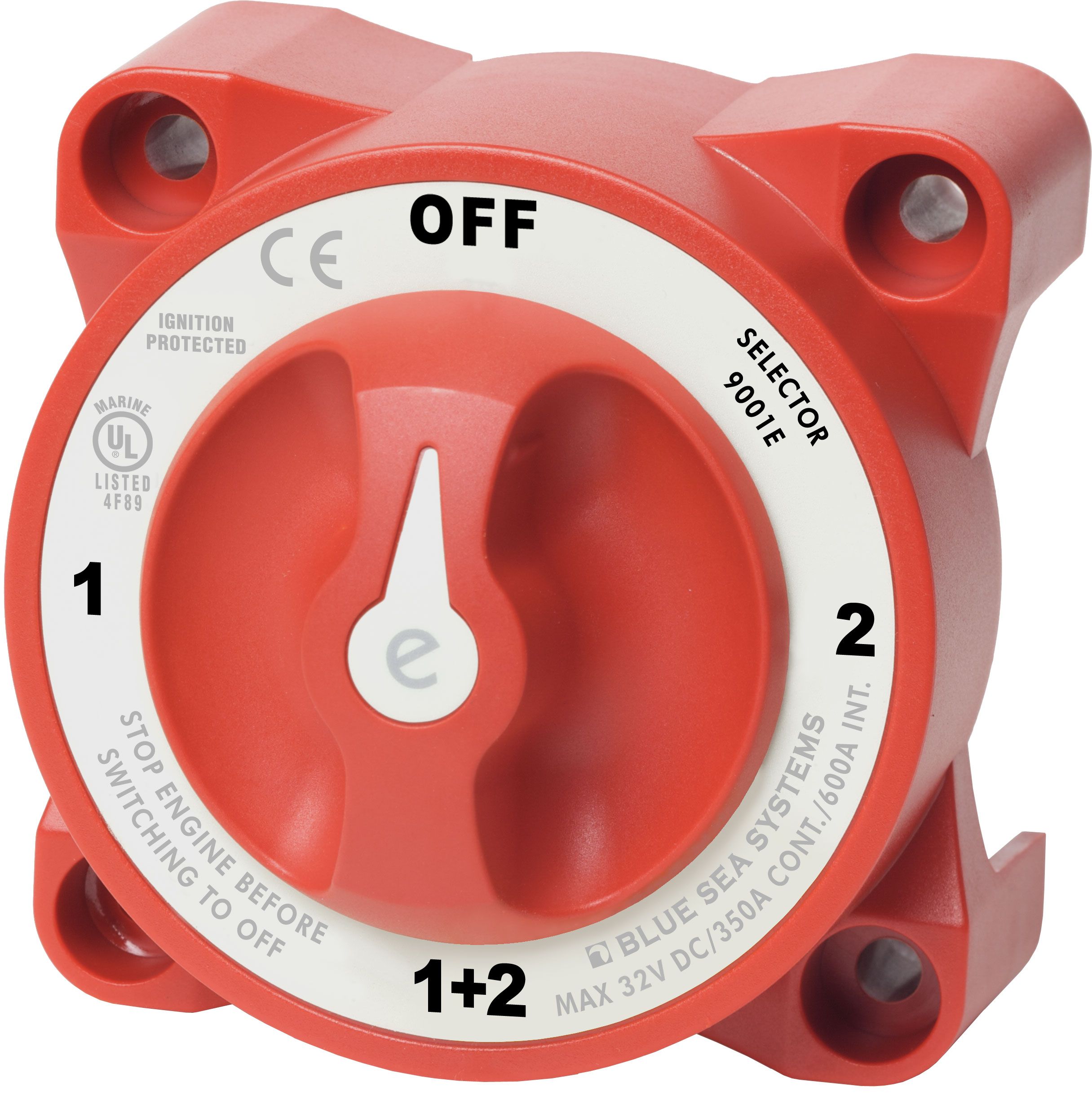














I like these switches the way I like a manual transmission in a car. It lets me be in control.
Log in tab does not work
I am buying a boat with a newly installed electric engine. I am totally clueless — don’t even know where to start. Don’t know how systems interact. Switches??? hmmmm
Log in tab not working for me either
“If you deliberately or inadvertently rotate that switch to the OFF position while the engine is running, which is very easily done, the alternator suddenly loses its connection to the battery.”
I have to take issue with this claim that it is “very easily done.” Who goes down to their battery switch while the engine is running, looks at it and decides, “What the heck, I’m going to turn this to the OFF position?” Why would that ever happen?
I’m glad my mid-80’s Ericson still has such a simple two-battery setup that is easily controlled with this battery switch. Two batteries, and every day when we’re away from shore power I know which one is being used for the electrical load, and which is lying in wait to be used as a starter just in case. It’s been a flawless system.
It’s unlikely that switch could get bumped out of position. Usually these things happen during unsual operations like maintenance or troubleshooting. Chernobyl was just fine until they strated some unsual ops…
Like Drew, I’m on team “Both”. It aslo gives you get an effectively higher capacity leaving them combined. At first read, that doesn’t seem possible, but Nigel Calder explains the math behind leaving the two batteries combined in his book Boat Owner’s Mecahnical and Electrical Manual. I’ve forgotten the logic, but have left them combined ever since.
NOCO makes an improbably small jump pack that fits in your hand. It’s started a few cars with ease. I’ve never had to use it on the boat but keep one on board ever since a close call without it. The old batteries didn’t have the capaicity I expected so when our Victron battery monitor low voltage alarm went off, the batteries had just enough juice to sloooowly start the engine.
^^ Easily, perhaps not. But a lot of boaters have fried diodes and other electronics (voltage surge) that way, so the warning is appropriate. How else would they learn of the risk? BTW, the warning extends to Lithium batteries, where the BMS can disconnect automatically (a longer story).
Personally, I’ve always left the switch on “both” for the life of the boat with several boats. I’m careful not to run the batteries flat.