




Converters and Connectors Round Out the Expenses
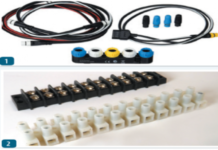
Although wireless systems have gradually made their way aboard modern cruising boats, hard-wiring remains an essential part of most systems, especially when you are matching old and new gear, or using converters. One of the biggest challenge for those of us with terrible fine motor skills is dealing with the tiny wires. Stripping, splicing and connecting these wires isn't neurosurgery, but definitely not the sort of thing you want to deal with on a rocking boat. But like any installation, it is a job you want to get done the first time-especially when you consider the challenges of troubleshooting electronics faults.
Preventing Electric Shock at the Dock
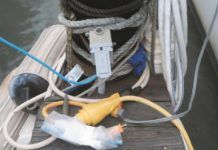
The human body runs on electricity and if you overload the nervous system with an external field, everything goes haywire. Every year several people die because they go swimming near a dock, a wiring fault creates an electric field in the water, and their muscles freeze. It is called Electric Shock Drowning (ESD).

Wireless Boat Monitoring
Most of us spend a great deal of time away from our boat. Whether shes on the hard, moored in our home harbor or anchored in a foreign port, we want to know whats going on with critical systems. Is my vessel where it should be? Has someone disconnected a power source or tried to gain access? Is the bilge pump cycling more frequently? Is the house bank okay? Is the freezer holding its set-point? If your boat was struck by another vessel, wouldnt it be helpful to have photos?

Deck-level Wind Vanes
There are two primary wind indicators on a sailboat. First, we watch the sails. Sailing to windward we watch the jib for luffing and for flow on telltales.
Crimping and Sealing for a Life Offshore
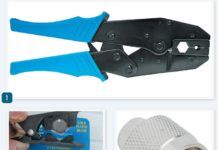
Mast antennas, like all electrical components, are particularly vulnerable to water intrusion at connectors. In the extreme, corrosion at unions or terminals can damage a transmitter.

Register Your VHF Radio
The U.S. Coast Guard continues be concerned about the misuse (or lack of use) of VHF radios for distress calling. Many boaters, it seems, don't understand the importance of registering their radio equipment, and how to properly use Digital Selective Calling (DSC) feature. Here we offer a brief overview of the most frequently asked questions regarding DSC. More information can be found at the Coast Guards Navigation Center website, www.navcen.uscg.gov.
Testing VHF Coaxial
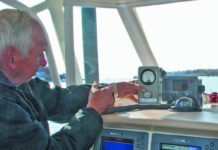
The loss in RF coaxial cable increases substantially and quickly, when there is water intrusion. Coax that uses foam dielectric, like RG8X and LMR type coax, is particularly prone to this problem because the water can quickly propagate along the foam dielectric used in these type coaxes.
Antenna Gain and VHF Transmission Range
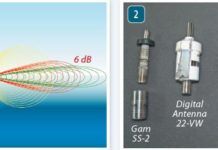
Recreational marine VHF antennas are usually broken down into three categories: 3- and 4-foot sailboat antennas (3dB gain), 8-foot powerboat antennas (6 dB gain) and 16-plus-foot, long-stick antennas (9+ dB gain) that are popular on larger, long-range craft. Antenna gain is a ratio related to an antennas effective radiated power (ERP) instead of a fixed quantitative value.
Heat-Seal Connectors
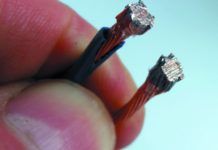
A typical cruising boat has thousands of electrical connections. The consequence of failure range from a light that doesn't work to a fire that can cost lives.
Mailport: Low Budget Navigation
Regarding the article on recycling gear for cruising in the September 2018 issue, I found that an old Windows laptop, with an external GPS puck and running OziExplorer, makes a fabulous chartplotter. The software is just a hair over $100 and is capable of using NOAA charts, USGS topo maps, aerial photographs, and any other map that can be put in registration, using only latitude and longitude of a couple of points on the map.

Lithium Batteries on Sailboats: The 3 Mistakes Everyone Makes
Lithium batteries are one of the most popular sailboat upgrades today—but they’re also one of the most misunderstood. In this Practical Sailor Saturday episode,...



Latest Sailboat Review
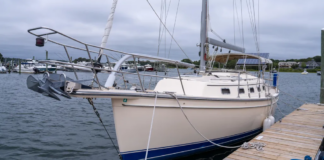
Island Packet Estero Used Boat Review
Florida-based Island Packet targets a relatively narrow niche, so the toughest competitors to its new boats are often older Island Packets. Introduced in 2010, the 36-foot, shoal-draft Estero is the company’s latest attempt to introduce a distinctive model that doesn’t stray too far from the company’s proven formula for success: moderate displacement, full-keel cruisers designed to be lived on, sailed far and in comfort, and endure the bumps, scrapes, and storms that cruising boats inevitably encounter. After sailing the Estero on Florida’s Sarasota Bay and inspecting its interior, construction, and systems, Practical Sailor testers noted that the shoal-water cruiser will appeal strongest to Island Packet fans who’ve been waiting for a shoal-draft, easy-to-sail boat that compares to the IP37 in terms of interior space. These strengths will be most apparent on intracoastal or riverine adventures like the Great Loop.