

Top Whipping Twines
The term whipping twine is somewhat misleading, suggesting a single purpose for a product with seemingly endless uses. These are the thin-woven strands that all hand-sewing projects depend upon, and in the process of exploring various stitching projects, weve gone through spools and spools of it.
Higher Loads Call for Careful Installation
Rope clutches are a great innovation that can help sailors better control the lines that lead aft to the cockpit and those that cluster around the mast base. But as with many good things, there is the risk of over-doing the benefit.
Break and Break Again
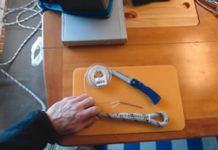
All lines were broken once to determine approximate breaking strength without a stitched eye. A simple chain fall and load cell provided a means of pulling test samples up to 5,000-pound loads. The samples were then sewn or knotted into dog bones 6 to 8 inches long with an eye on each end, and the load was again applied until failure. This allowed the testers to compare breaking strengths with and without a stitched eye or knot. The test was broken into two parts, laboratory and field testing.
Other Stitching Techniques that Work Well
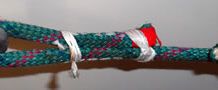
We principally looked at three means of seizing an eye without splicing-basting, round-stitching, and seizing-used alone and in combination. Round stitching is described in the accompanying main article. Here are some of the other stitching patterns we tested.
Getting to the Top
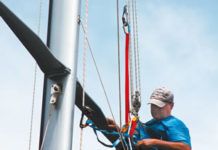
There are times when getting to the top of a mast is a far easier solo proposition than hunting for help. The first time I saw a middle-aged man go it alone, he hoisted a 3:1 block and tackle, rigged with 5/8-inch line, up a jib halyard. At the bottom end of the rig, he attached a bosuns chair. He simply pulled on the haul line, hand over hand, to the elevation he needed, then doubled the haul line through a convenient part of the chair and tied it off. With the 3:1 purchase, he was muscling one-third of his weight.
Chandlery: October 2014
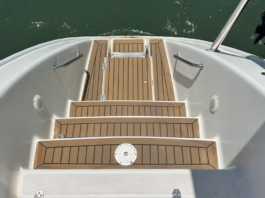
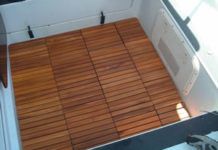
The typical production sailboat comes with a molded fiberglass tub for a cockpit well, complete with an uncleanable nonskid sole. It looks dirty an hour after cleaning and debris grates under foot. Some boat owners install Dri-Deck or something similar, which can be torture to barefeet and makes the cockpit look like a shower stall. A more attractive option is beautiful owner-built teak grating; unfortunately, fabricating one of these requires considerable effort and skill. We found a more practical solution for us non-carpenters: do-it-yourself decking that costs about $7 per square foot and takes about an hour to install. The DIY Patio Deck company sells pre-assembled, snap-together tiles that resemble traditional grating. For our test boat, we chose eight-slat acacia plantation hardwood exterior tiles; many wood types and styles are available.

Mainsail Halyard Shackles
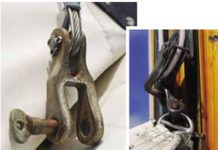
A mainsail halyard shackle needs to be as reliable as an on/off switch on a table saw. Its a one-act pony thats counted on to perform perfectly each and every time. These essential shackles fly under the radar and have become so much a part of every sailors routine that they are simply taken for granted. They terminate mainsail, mizzen, and foresail halyards aboard sailboats ranging from dinghies to mega yachts. We become so familiar with the hardware, that idiosyncrasies like a slightly bent clevis pins, damaged threads, or a misshapen stamped fork opening are tolerated.
A Look at Silicon Bronze Versus Stainless Steel
Brass is a pretty poor marine metal. An amalgam of copper and the much less costly and corrosion-prone zinc, brass reign afloat, at least in load bearing hardware, was short lived. But when copper is alloyed with less corrosion-prone metals, the result can be quite different. And although brass and bronze sound confusingly similar, their attributes tell very different stories.
Reasons to Stick with Teak
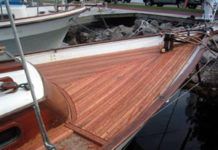
About two miles up the Lumut River in western Malaysia, a local entrepreneur known simply as Mr. Chan ran a small mooring field with a tin-roof club house and a railway slipway. It was inexpensive, and Chans hospitality was renowned. People went to Chans for the camaraderie, for the potlucks, for a haulout . . . When we were cruising, we went for the teak. A modern teak plantation is like an M.C. Escher painting; you stare, mesmerized, down the rows of evenly spaced trees that seem to stretch forever. The ground sponges under your feet, and the branches overhead seem pruned to cast identical shadows on the ground.
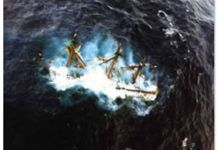
The Media on the Bounty
The Oct. 29, 2012, sinking of the HMS Bounty off the coast of North Carolina during Superstorm Sandy left 14 crewmembers injured and shaken, one crewmember dead, and the captain missing, presumed dead. The 108-foot ship, designed and built for the 1962 movie Mutiny on the Bounty, sank before dawn about 130 miles southeast of Cape Hatteras, N.C., after being battered by Sandys 30-foot seas and 100 mile-per-hour winds. Several hours after the sinking, Coast Guard helicopters rescued the crew members.
Latest Logbook

Practical Sailor Logbook – September 2026
In September we tour the Hans Christian 48T — the offshore cruiser many sailors call the holy grail — walk the custom Antigua 60...

Video: The BEST Sailboat You Can Buy for $35,000 – Catalina...
If you’re searching for a mid-30-foot sailboat, affordable cruising sailboat, liveaboard sailboat, first sailboat, or a capable used sailboat for coastal cruising, the Catalina...

Latest Sailboat Reviews
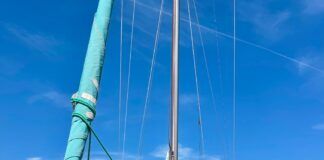
Learning by Doing on a $5,000 Catalina 30 Mk II
When Davis’s mother started talking about wanting to do something “big” for retirement, Davis and Gloria half-jokingly threw out an idea that seemed suitably...