


Ground Tackle
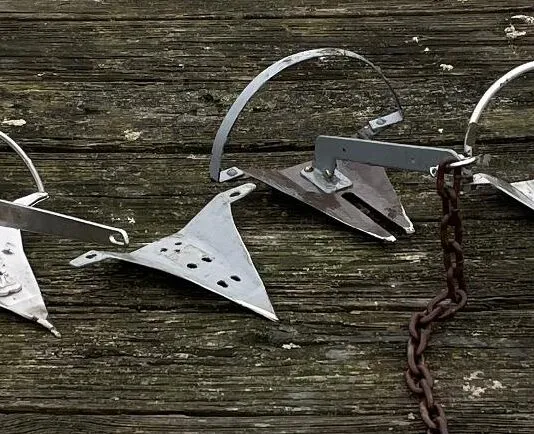
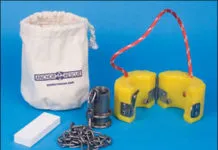
As Practical Sailor prepares for a new round of anchor tests, weve been on the hunt for new anchors, as well as new accessories. One of the most interesting devices to come our way is the Anchor Rescue developed by Richard Provonchee, a sailor and principal in Boxer Marine Inc., based in Cushing, Maine. The most common complaint about anchors is their lack of holding, but an anchor that refuses to budge-can also have serious consequences. The Anchor Rescue uses an innovative two-part system to free fouled anchors. The typical antidote to fouling is to attach a buoyed line to the anchor crown so that it can be hauled backward out of its snag. Most anchors have an eye at the crown for attaching a buoyed retrieval line. (Danforth-style anchors are an exception).
Mooring Anchors for Sensitive Seabeds
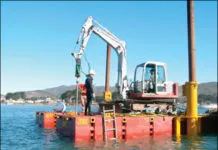
Mooring anchors fall into two general categories: those that rely on sheer weight and mass to provide holding and the embedment types that penetrate the sea floor. There are also some hybrids that rely mostly on their weight, but also embed themselves in the sea floor over time. BoatUS projects and municipal tests on Sarasota Bay, Fla., support helical screws as the best option when it comes to choosing mooring tackle, particularly in sensitive areas. Practical Sailors evaluation of mooring anchor types includes the Helix screw, Manta Ray, Dor-Mor, Mushroom, and concrete blocks.
A Look at the Latest Generation of Genoa Furlers
To get an idea of whats on the market and see how the newer products fare against the simpler, tried and true furling systems, Practical Sailor rounded up 11 new headsail furlers suited for 30- to 35-foot sailboats. This, the first of a two-part report on the evaluation, focuses on the seven products that use a head-swivel design and range in cost from $950 to $3,200. (The report of integral systems will follow in an upcoming issue.) The following furlers were reviewed: Facnor LX 130, Harken MkIV and Cruising 1, Profurl LCI32, Schaefer 2100, Furlex 200S (Selden Mast), and US Spars (Z-Spar) Z-780.

Synergy Dock Line Stands Up in Tests
In July 2008, Practical Sailor looked at products for docking, anchoring, or mooring in a storm. Among those mentioned was the Synergy docking line, an abrasion-resistant polyester braid with a short length of industrial-grade rubber in the core. Synergy also makes a stretchy, floating tow-rope for dinghies. We put Synergy dock lines into use for six months on a fixed dock and during a two-week Mississippi River delivery cruise. They held up as well as similar braided lines and proved to be more convenient to use than its nearest comparison, a dock line with a rubber snubber. One drawback noted was that the woven cover was more prone to snagging than more tightly braided lines.

Winch Makeover
The Winchmate is one answer for sailors who are considering upgrading to self-tailing winches but find the price tag too intimidating and have otherwise perfectly functional non-self-tailing winches that are too good to toss out. Now theres another option: Older Barient or Barlow winches can be retrofitted with a carefully machined upper drum assembly that adds a rugged and reliable self-tailing feature. To test the concept, we retrofitted a set of near museum-aged Barlow two-speed 28s with the easy-to-install Winchmate system. Combining the upgrade with normal annual cleaning and maintenance makes the changeover quite simple and straightforward. The process can be "e-assisted" with Winchmates step-by-step online installation video.With the drum removed and bearings, gears, and pawls cleaned, greased and reassembled, a spindle extender is threaded to the top of the winch spindle. A Delrin spindle extension bushing is added, and attention is then turned to the drum itself.

Furling-friendly Storm Sails: Are They a Sensible Solution?
The advent of roller-furling headsails has generated a new area of concern for sailors: the inability to hank on a storm jib when the need arises. Practical Sailor prefers a dedicated storm jib on a staysail stay or a storm sail on a solent stay, over any over-furling storm sails. That said, Practical Sailor did evaluate two products that claim to restore the missing storm jib capability on vessels with roller-furling headsails. Testers compared the ATN Gale Sail and the Storm-Bag from Banner Bay Marine, two very different products. The evaluation compared basics such as cost, quality of construction, ease of use, and other characteristics related to each particular sail design.
Boat Deck Hardware: Rope Clutch Test Update
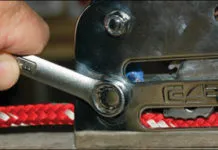
Practical Sailor testers compared the new Garhauer rope clutch to rope clutches from Lewmar and Spinlock, which were tested in March 2009. They rated the line handlers’ ease of threading, loads, slippage, load loss, and line pull, along with price, warranty, and weight.
Practical Sailor Tests and Reviews the Latest in Boat Ratchet Blocks
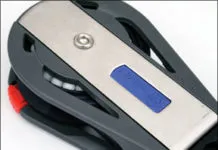
The racket block is one of the most recent innovations in the world of line-handling blocks. The most common use of a ratchet block is on smaller racing boats, where you are adjusting a spinnaker sheet or mainsheet by hand, without using a cleat. Uses on larger boats include running a line through a ratchet block when releasing the control line on a headsail furler, and for traveler control lines and genoa lead adjusters. In a search for the best ratchet block, Practical Sailor tested four ratchet blocks with on/off switches; three ratchet blocks with auto-sensing that will automatically flip the ratcheting on or off; and one ratchet block that has both an on/off switch and an automatic sensor. The head-to-head ratchet block comparison included products from top marine hardware makers Selden, Wichard, Ronstan, Holt Allen and Harken.

Shopping Sail Shape
Sailmakers put spin into more than their spinnakers, and when all is said and done, their art lies in turning flat material into a carefully controlled curved shape. The best-shaped sails-and the most expensive to build-are tri-radial shapes that are made from many smaller panels radiating from each corner of the sail. These sails have many more seams and require more sewing but allow the bias, or strength axis, of the cloth to be critically aligned. Most racers and performance-oriented cruisers opt for the cut because the sail shape can be better developed with this approach. A cross-cut and a miter-cut are both valid but simpler approaches to sailmaking. They lessen the number of panels and consequently the labor involved with manufacture. As long as the material used affords appropriate load handling characteristics associated with panel alignment, all is fine, especially for a cruising application where lighter weight and the final nuance of shape are less critical. More important than whether the sail is cross cut or miter cut is how well it fits and sets on your boat, and the sailmaker to choose is the one who will come aboard and make sure that his or her handiwork actually fits properly. If they both agree to do that, then take a close look at the detail work in their sails. Is the area around pressed-in rings well-reinforced? Are leech lines easy to operate? How is UV protection handled?
Practical Sailors 2009 Rope Clutch Review
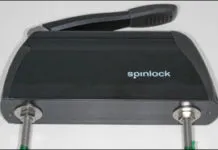
Testers put six rope clutches through their paces on a test jig that measured line tension, line slippage, and the clutches holding ability over a long period of time. In terms of overall value and performance, the units tested were a tightly grouped field of competitors. Practical Sailor testers evaluated rope clutches from Euromarine Trading (Antal), the Antal V-cam 814 and Antal V-grip Plus; Lewmar D-1 and Lewmar D-2; Spinlock XCS and Spinlock XTS; and a prototype clutch from California-based Garhauer Marine Hardware. The search for the best rope clutch took a look at the pros and cons of employing a rope clutch for specific tasks as knowing when to clutch and when not to clutch is imperative for efficient line handling and safety.
Latest Logbook

Practical Sailor Logbook – September 2026
In September we tour the Hans Christian 48T — the offshore cruiser many sailors call the holy grail — walk the custom Antigua 60...
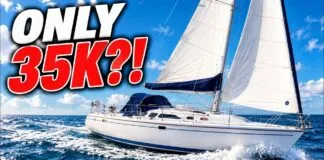
Video: The BEST Sailboat You Can Buy for $35,000 – Catalina...
If you’re searching for a mid-30-foot sailboat, affordable cruising sailboat, liveaboard sailboat, first sailboat, or a capable used sailboat for coastal cruising, the Catalina...


Latest Sailboat Reviews

Learning by Doing on a $5,000 Catalina 30 Mk II
When Davis’s mother started talking about wanting to do something “big” for retirement, Davis and Gloria half-jokingly threw out an idea that seemed suitably...