To provide the best experiences, we use technologies like cookies to store and/or access device information. Consenting to these technologies will allow us to process data such as browsing behavior or unique IDs on this site. Not consenting or withdrawing consent, may adversely affect certain features and functions.
The technical storage or access is strictly necessary for the legitimate purpose of enabling the use of a specific service explicitly requested by the subscriber or user, or for the sole purpose of carrying out the transmission of a communication over an electronic communications network.
The technical storage or access is necessary for the legitimate purpose of storing preferences that are not requested by the subscriber or user.
The technical storage or access that is used exclusively for statistical purposes.
The technical storage or access that is used exclusively for anonymous statistical purposes. Without a subpoena, voluntary compliance on the part of your Internet Service Provider, or additional records from a third party, information stored or retrieved for this purpose alone cannot usually be used to identify you.
The technical storage or access is required to create user profiles to send advertising, or to track the user on a website or across several websites for similar marketing purposes.


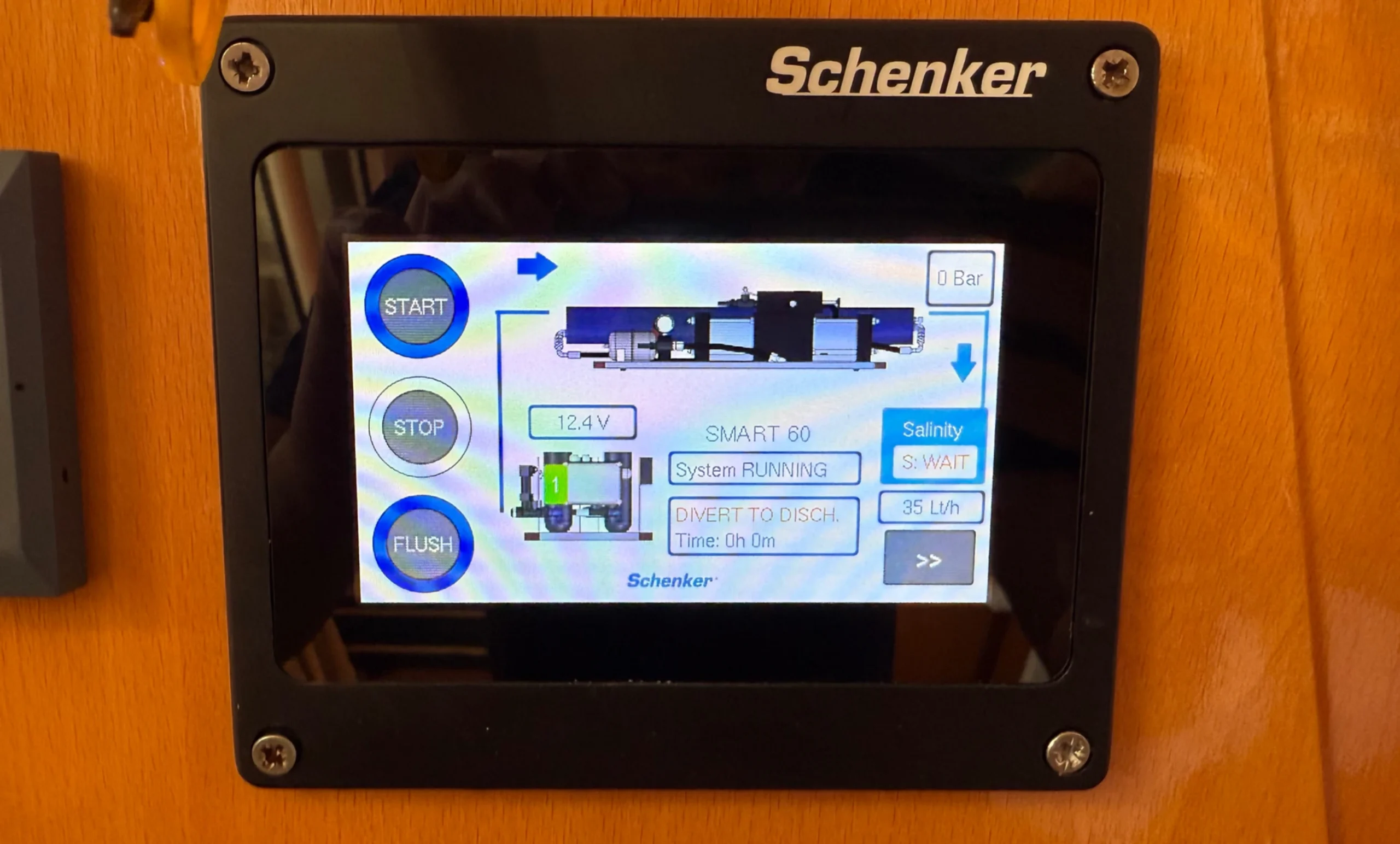










I would love to see results from your schenker RO where the quality of the output at one pump is compared to a sample in two pump mode. My LIMITED understanding of how RO membranes work would suggest that lower flow should produce a better product if any difference at all. But I am not expert in this field. But I do think the Watts per Litre is an important metric.
This is the first I’ve read on ER water makers. Your comments on noise resonate (Ha!) with me but in addition to the noise of the genset, our Rainman water maker is pretty noisy all on its own. How noisy is your system with one pump? With two?
There are ways to reduce noise of a conventional system – I suggest using rubber feet to mount, and isolating the pump and motor from the inner hull for starters.
We’ve had guests ask us about the phantom noise that they’re hearing in the background. They can’t quite make out. Do we have a water pump running? Is that a problem? When I tell them that it’s the watermaker, they’re often quite surprised.
The ER watermakers do have a bit of a “heartbeat” sound as the clark pump (or variation) does its thing. I likely wouldn’t want to sleep above one.
Ours is in our engine compartment, which has sound dampening foam, and it’s really not all that noticeable. Angie is more bothered with the sound of the water filling up an aluminum tank than the watermaker itself.
I have the same interest as Carl. Be interested to know if the competitor company exec’s opinion is true. Is there a difference in the quality of the water output using Schenker’s one pump compared to using the two pump output. Thanks Adam for the article. I agree, automation is the way to go.
First off, I’m a Seawater Pro dealer, and have had one of their units on board my boat now for over six years. With that out of the way, the entire discussion of saving energy is a bogus one in my opinion. A proper cruising boat should be set up to accommodate all of the power demands of its equipment, and do so at a reasonable – dare I say “rational” – cost?
Paying from 2.5 to 4 times as much for less than half the production doesn’t say efficiency at all, it means more than twice the wear and tear on the gear – AND your wallet. Energy efficiency ONLY has value when energy is scarce, and for most modern cruising boats, energy is no longer the scarce resource it once was.
Furthermore, and the article doesn’t address this – where are you going to store all of this wonderful spare energy you suddenly have? Last I heard, ohms didn’t fit will in most lockers, watt every else you might claim.
For example – the Seawater Pro 40 gph unit runs at 970 watts, so in two hours of watermaking, you’re 1900 watt-hours, or roughly 140-160 amp-hours depending on charging voltage. If you’ve designed your solar at 900 watts – easily achieved these days on most cruising boats – and run from 10 am to noon, you’ll be down 25 – 35 amps, which is no problem for a lithium battery bank at all, and easily recovered on a lead acid bank.
Since you’ve already made the investment in solar power and batteries for the rest of your boat, does it make sense to spend a huge amount of money to save – nothing?
To put this another way, for the cost of an ER watermaker, you could buy a conventional watermaker, 800 – 1200 amp hours of LiFePo4 battery bank, and 1200 watts of solar. Then, instead of spending your entire day babysitting your watermaker (I don’t believe in letting gear run unattended), you can make your 40 gallons during breakfast and spend the rest of the day snorkeling or exploring.
If I’ve left you with the following question, I’ve made my point – Would I rather have an ultra-efficient watermaker… or a huge electrical system that benefits every appliance on the boat?
Hi Wally. Appreciate different perspectives and everyone’s mileage will vary. On Connie, we’ve got 2100 watts of solar. In the summer months, we’re often spoilt for choice with power. But, in the winter months in the Caribbean, we’re often blowing through it all. On the way down from the Chesapeake this year, we’re rationing our power budget. If we have 2 or even 4 guests that are using our systems and charging all of their devices, power gets even tighter.
I’ve tried my best to write the article in a way that balances the power consumption, added complexity, generator discussion, and progress made in ER systems in a way that folks can make decisions on what’s right for their situation.
We have the 30 litre an hour Schenker running from solar and lithium batteries, and if that is low charge, then the alternator. It is efficient and provides all that we need. If we need more fresh water we just run it for an extra hour, so can see no point in having a larger unit and running it for shorter time or on half power. We only run it when we know the seawater is clear and clean. I would never run it when leaving the boat, as most places where we can dock or anchor are somewhat murky. If mounted away from the salon, with vibration isolation the noise is not a problem. Ideally I run it on any part of a passage where we are motor sailing, which is more often than we want. Typically too much wind or not enough.
I agree that the Schencker is really not very loud. We’ve had guests over the boat and very surprised that the phantom noise they’re hearing is actually the watermaker running. The only thing that annoys Angie is the sound of the water dropping into a near-empty aluminum tank!