
Four-Stroke, 9.9-hp Outboard Motors Test 2009
Practical Sailor last tested four-stroke, 9.9-horsepower outboards in the June 2007 issue, with the Mercury 9.9 coming out the clear winner. These engines are well-sized for large, rigid dinghies or as auxiliary power for smaller keelboats, but their weight can be an issue. This report compares the Suzuki 9.9-outboard and the Yamaha 9.9 to the Mercury. Both the Suzuki and the Yamaha are carbureted, water-cooled engines. On-the-water engine performance tests found the Suzuki to be the loudest and the heaviest 9.9 we tested. The Yamaha is more compact, but at 91 pounds, it is no lightweight.
Practical Sailor LED Lightbulb Test
In this LED cabin light test, Practical Sailor looks at 17 light bulbs from seven manufacturers. The LEDs were tested to see which was the most worthy replacement for a 20-watt xenon bulb in a bulkhead-mounted reading light. Testers measure LED beam angles and intensity, LED power consumption, LED color temperature, LED radio frequency interference, and LED reading and cabin illumination. The LED lights tested include: Alpenglow TR LED complete brass fixture; three lights from Cruising Solutions; three lights from Doctor LED; four from Imtra; two from Opto Technology, two from Daniel R. Smith & Associates (DRSA) manufactured by Mast Products; two of Scad Technologies (Sailors Solutions) Sensibulbs; and one LED light from West Marine.
Practical Sailor Sea-trials 1,000-watt Honda Gas Generator
Bluewater voyagers and Practical Sailor contributors Evans Starzinger and Beth Leonard put the Honda EU1001 gas-powered generator, Hondas smallest super quiet four-stroke generator, through its paces during an extended cruise of Southern Chile. They report that the 1,000-watt generator is well engineered and essentially maintenance free. Wanting to go months without running the engine and unable to depend on wind and solar power in Chiles Beagle Channel, the couple chose the lightweight generator to feed their onboard battery-charging needs. The Honda will run for approximately eight hours on less than a gallon of gas, and its noise level was measured at a mere 59 decibels, quieter than normal conversation.
Best Ethanol Fuel Treatment for Boat Engines
Since the introduction of ethanol fuels at dockside pumps, weve had a slew of reader inquires about the effects of E-10 on fuel lines, fuel tanks, two-stroke engines, and four-stroke engines. We recently tested some products designed to address these issues, specifically those that claim to combat the problems associated with phase separation in E-10. Practical Sailor tested: E-Zorb from Marine Development Research Corp. (MDR), Sta-bil Marine Formula Ethanol Treatment from Gold Eagle, PRI-G from Power Research Inc., Star Tron from Star brite, and Techron from Chevron. The claims of each product varied, but the test products fell into one of these general categories: conventional fuel storage additives, ethanol fuel storage additives, and restorative gas additives. Our tests looked at whether the additive itself would leave ash deposits, gum deposits, or residue that might cause contaminated lubrication oil; whether an additive had a tendency to emulsify, suspend, or absorb free water; and whether the additives could delay the onset of cooling-induced phase separation.
The Hunt is on for a Quality, Well-placed Emergency Tiller
A decade ago, Practical Sailor editors began scouring boat shows for the perfect emergency tiller and an ideal stowage system for it. Little more than a simple lever arm that attaches to the head of the rudder stock, the emergency tiller is the device a sailor relies on in the event a steering cable parts or theres some other steering system failure. Our seemingly simple search turned out to be a nearly fruitless enterprise. Boat after boat fell far short of delivering even an average emergency tiller. Heres a look at our favorites and favorite offenders as well as our criteria for a good emergency tiller and where to keep it.

Wanted: A DC-DC Converter
Ive created a 24-volt system by connecting two 200-amp-hour 12-volt batteries in series to drive an electric outboard as auxiliary power for our 25-foot sailboat. The 24-volt bank will be charged using a 24-volt charger on shore power and by a 24-volt series of solar panels when mooring. I would like to eliminate the 12-volt batteries. I bought a 24- to 12-volt converter to stand in place of the 12-volt batteries, but I learned that the converter is not compatible with driving any kind of motor due to the back-voltage created by the collapsing field when the motor stops. I have a freshwater pump and a motorized outboard-motor bracket, so this particular converter is out of the question. Do you have any suggestions? Must I maintain a 12-volt battery for all the 12-volt equipment or is there a step-down technique?

S/V Balaena Skipper Andy O’Grady Offers Advice on Extending the Life of Wet-Cell Batteries
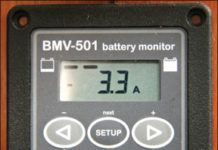
S/V Balaena Skipper Andy O’Grady has taken his double-ended cutter rig to every climate between the Southern Ocean and the Artic. O’Grady explains that imperative to onboard power management and extending battery life is keeping batteries charged and avoiding deep discharges. His tips for long-lasting batteries include keeping the discharge above 50 percent, tracking sulfation, and equalizing the battery bank. Equipment O’Grady uses are Trojan 6-volt T105 batteries, Xantrex XAR Smart alternator regulator, 85-amp Bosch alternator, BEP voltage sensing relay, a Solarex 55-watt solar panel, 75-watt Shell solar panel, and a Rutland wind generator.
S/V Balaena Skipper Andy OGrady Offers Advice on Extending the Life of Wet-Cell Batteries
S/V Balaena Skipper Andy O’Grady has taken his double-ended cutter rig to every climate between the Southern Ocean and the Artic. O’Grady explains that imperative to onboard power management and extending battery life is keeping batteries charged and avoiding deep discharges. His tips for long-lasting batteries include keeping the discharge above 50 percent, tracking sulfation, and equalizing the battery bank. Equipment O’Grady uses are Trojan 6-volt T105 batteries, Xantrex XAR Smart alternator regulator, 85-amp Bosch alternator, BEP voltage sensing relay, a Solarex 55-watt solar panel, 75-watt Shell solar panel, and a Rutland wind generator.
Electric and Hybrid Propulsion for Sailboats
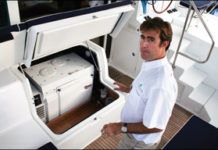
How soon will electric auxiliary engines be available to all sailboat owners? Opinions differ on what type of drive system could surge to the forefront and whether the concept of electric propulsion itself is viable in recreational sailboats. Opinions also differ as to what system is best: a pure diesel-electric drive train with a hybrid-electric drive with a diesel generator as a back up or a pure electric drive with regeneration capability. Practical Sailor talks with companies developing DC motors, including ASMO Marine, Above the Waterline, Vetus Marine, Electric Marine Propulsion, Glacier Bay, Re-e-power, Polar Power Inc., Fischer Panda, and Solomon Technologies. Glacier Bay is concentrating on diesel-electric drives using Ossa Powerlite technology, and ASMO Marine is developing the Thoosa line of DC motors. Much of the movement toward electric motors is taking place in the catamaran world, with Lagoon Catamarans leading the push. Corsair Marine is working on a diesel-electric catamaran, and Maine Cat has also experimented with electric engines. Duffy Electric Boats has for years been building electric-drive-only auxiliary engines. One major issue in developing these systems is the safety of high-voltage DC. ABYC has yet to set a standard for high-voltage DC safety aboard a vessel, and Jim Nolan of BoatUS said there is no clear-cut guidance regarding insuring boats with electric propulsion.
Practical Sailor Puts Monster-Sized Coolers Through a Melt Down
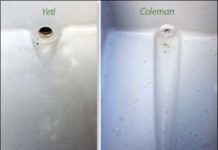
Ice chests come in all shapes and sizes. And often times, sailors and fishermen will prefer keeping a large cooler aboard to installing a marine refrigeration system. So for this test, we narrowed the field to portable 65-quart coolers and a 70-quart cooler from Yeti, Engel, and Coleman. The three test products were the Engel ENG65, Yeti Tundra, and the Coleman Ultimate Extreme Marine. Testers compared the effectiveness of each cooler at keeping ice during a meltdown test: A six-pack of soda was covered with 16 pounds of ice and checked at 12-hour intervals. The top performer was the Engel, but testers deemed the Coleman a bargain as it was less than half the cost of the others.
Latest Logbook

Practical Sailor Logbook – September 2026
In September we tour the Hans Christian 48T — the offshore cruiser many sailors call the holy grail — walk the custom Antigua 60...

Video: The BEST Sailboat You Can Buy for $35,000 – Catalina...
If you’re searching for a mid-30-foot sailboat, affordable cruising sailboat, liveaboard sailboat, first sailboat, or a capable used sailboat for coastal cruising, the Catalina...



Latest Sailboat Reviews
Learning by Doing on a $5,000 Catalina 30 Mk II
When Davis’s mother started talking about wanting to do something “big” for retirement, Davis and Gloria half-jokingly threw out an idea that seemed suitably...