






Skipper Recounts Capsize 57-foot Atlantic Cat
Charles Nethersole has been a professional sailor for decades, and in addition to racing commitments and deliveries, hes accrued 14 years of sea time as a professional captain aboard 55- and 57-foot, Chris White designed, Atlantic catamarans.

Multihull Special Report
In Part 1 of our special report on multihulls we scrutinized the implications of stability and the benefits derived form a wide stance, buoyancy and hull shape of multihulls. This time well look at structural issues and the energy transfer that takes place due to a multihulls impressive initial resistance to heel. We will also delve into what all this means for the rig, rigging, hull structure and hardware interfaces.

Controlling Jibes With Boom Brakes
Ten years ago, you may recall having seen the Walder boom brake demonstrated at sailboat shows. There wasn't anything quite like it. The device caught on for a time with single-handed racers, who liked the way it slowly eased the boom across during jibes. (Philippe Jeantot had one on Credit Agricole when he won the first BOC Challenge.) When your hands are full with jib sheets and the wheel or tiller, there's too often the tendency not to pull in the mainsheet to minimize the shock load on the gooseneck when the boom slams across to the new tack.

Strategy to Fight Seasickness
Getting over seasickness as quickly as possible must be the focus and responsibility of all on board. Having dealt with 400 seasick sailors (out of 1,200 sail-training students) on ocean passages over the past 42 years, I have become very experienced at prevention and treatment. The following steps to avoid or lessen the severity of seasickness has served well over those years.

Tools to Tame the Jibe
The loads of a flying jibe in late summer squall are enough to shred sails, rip out deck or boom fittings, bend or break the boom gooseneck, or even bend the boom itself. The novice sailor learns very quickly to be wary of an unintentional jibe.

The Best Prevention is a Preventer
Ideally, you don't put yourself in a position where an accidental jibe can happen, but even an experienced sailor can get caught off guard by sudden, violent wind shifts in mountainous coastal areas or in night-time squalls. The most common way to take the fright out of an unintentional jibe involves a preventer, something weve examined in a number of previous reports. Preventers are especially useful when sailing deep downwind in rolly conditions, when exaggerated yawing lets the wind sneak behind the mainsail.
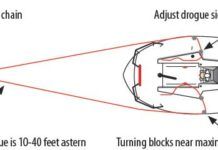
Ideal Drogue setup will require experiments
For maximum maneuverability, the control lines-one port, one starboard-should attach at the widest part of the boat. This maximizes leverage and places the effort close to the center pivot point. On a catamaran, closer to the transom works because of the wide beam, but for monohulls, attaching near the pivot point at the keel will be more responsive. For maximum responsiveness, the drogue should be as close to the transom as practical-this results in more responsive steering and minimal drag. We found the best compromise to be around 65-80 percent of the way aft, where there is still enough beam, but less risk of the control lines fouling.

Cruising Guides
Since our last review of cruising guides for the Atlantic Intracoastal Waterway and the Bahamas, weve come across a few more resources worth adding to the list, and one of our top-pick cruising and anchoring guides has ceased publication. Heres the latest on cruising guides and resources.

Resources for Cruising to Cuba
Although Cuba is terra incognita for many Americans, it has been a popular destination for Canadian and European cruisers for more than a decade. Here, we look at some resources for cruisers planning-or dreaming of-a cruise to Cuba.

Top Cruising Guides for the Bahamas
The Bahamas are often viewed as the Holy Grail of East Coast cruising due to their beauty and proximity to the Florida coast. Although they appear tantalizingly close (particularly when viewed on those nautical chart-themed placemats down at the Oyster Shack), make no mistake about it: A cruise to the Bahamas is an open-water passage that demands both attention to detail and proper safety precautions. Planning and executing a successful cruise to the Bahamas can be an extremely rewarding experience, one that provides ample opportunity to test preparedness of both boat and crew, while offering a reasonably do-able taste of bluewater cruising.
Latest Logbook

Practical Sailor Logbook – October 2026
This month leans into used-boat value and hands-on maintenance: Tim Labute tours the traditional, shoal-draft Bayfield 32, Nick Nicholson revisits the much-requested Morgan 38/382,...

Video: Catalina 356 Review – The First Boat of the Comeback
Catalina Yachts is BACK! After a change in ownership and a pause in production, Catalina has returned to building sailboats in America, and we're...



Latest Sailboat Reviews
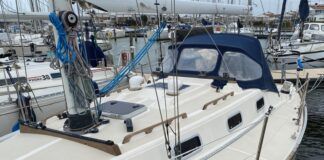
Tartan 31 Piper: Used Boat Review
The Tartan 31 is one of the new line of performance cruising yachts from the venerable-and durable--Grand River, Ohio boatbuilder. In the last few years, Tartan Marine has come out with a range of new models, including the T-28, the 3500 and the 4600. A 41-footer is in the works. Both the 28 and the latest version of the 31 are part of the new Piper series, which are marketed in sailaway condition. Tartan has a reputation for solid construction and good workmanship and that's what the 31 is: solid and well put together. The hull is hand-laminated with alternating layers of chopped strand mat and unidirectional E glass. Behind the NPG/ISO gelcoat there's a layer of vinylester resin, which so far appears to provide the best osmotic blister protection available.