Practical Sailor

  • Subscribe
  • Free Waypoints e-letter
  • Customer Service


Forgot Your Password?

  • Home
  • Sailboat Reviews

    Articles

    Boat Review: Marshall 22 Catboat

    Funding the Dream

    New Boat Review: Beneteau Oceanis 41

    Building a New Beneteau

    Sailboat Reviews

    Unbiased, detailed reports on dinghies, daysailers, racer-cruisers, cruising sailboats, and multihulls. Insights into boat construction and design. Solid advice on buying a sailboat.

    Sailboat Reviews - Index

  • Marine Electronics

    Articles

    Lighting the Way

    Useful and Fun Nautical Apps for iPad

    PS Reviews Cheap and Free iPad Nav Apps

    PS Sea-trials the iPad and Nav Apps

    Practical Sailor Reviews Iridium and Inmarsat Satphones

    Marine Electronics

    Extensive tests of GPS chartplotters, fishfinders, VHF radios, radar, AIS, navigation software, and handheld gadgets. Professional guidance on installing and operating high-tech sailing gear.

  • Sails, Rigging & Deck Gear

    Articles

    Of Safety Tethers and Comfy Cockpits

    Anchor Testing and Rode Loads

    DIY Trysail Track Retrofit

    Adding Some Zing To Anchor Testing

    A Practical Look at Sailboat Cockpit Design

    Sails, Rigging & Deck Gear

    Independent tests of halyards, sheets, furlers, anchors, snatch blocks, shackles, ropes, winches, vangs, cleats, booms, masts, and standing rigging. Expert guidance on choosing a mainsail, jib, or spinnaker.

  • Systems & Propulsion

    Articles

    Worthwhile Advice from Hose Manufacturers

    Y-valve Installation Advice and Troubleshooting

    Y-valves Under Pressure

    Marine Sanitation Hose Test

    Installing Hoses Highlights Their Differences

    Systems & Propulsion

    Comprehensive comparisons of pumps, batteries, solar panels, wind generators, inverter-chargers, watermakers, propellers, toilets, engines, and other marine systems. Tips on ship-shape installations.

  • Boat Maintenance

    Articles

    Mailport: April 2012

    Antifouling for Aluminum Boats

    Mailport: May 2012

    Product Updates

    Where Credit is Due: May 2012

    Boat Maintenance

    Bottom paints, topside paints, varnishes, waxes, protectants, cleaners, metal polishes. If it comes in a bottle or can, PS has tested it. Proven methods to protecting your floating investment.

  • Belowdecks & Amenities

    Articles

    Clean Bottom, Fast Bottom

    Grill Griddle Faceoff

    What’s Cooking Now?

    Mailport: March 2012

    Showers

    Belowdecks & Amenities

    Our top picks in galley stoves, cookware, cabin lights, refrigeration, and entertainment systems can help turn your cruising boat into a home. Creative solutions to the challenges of living aboard.

  • Personal Gear & Apparel

    Articles

    PS Tests Padded Sailing Shorts

    Testers Search for an All-star LED Spotlight

    Testers Check Beam Patterns and Illumination

    Personal Gear & Apparel

    Thorough test reports on binoculars, boat shoes, foul weather gear, hand-bearing compasses, sailing knives, flashlights, headlamps, sunglasses boots, and anything else that belongs in a skipper's seabag.

  • Safety & Seamanship

    Articles

    PS Analysis: The 2011 WingNuts Capsize

    Safety at Sea Part III: Rambler 100 capsize

    US Sailing Investigator’s Recommendations

    Lessons learned

    Rambler 100 Recommendations

    Safety & Seamanship

    Our testers evaluate life jackets, flares, life rafts, harnesses, man-overboard strobes, medical kits, seasickness aids, and emergency devices. Tips on marine safety gear, boat-handling, and emergency procedures.

  • Mailport & PS Advisor

    Mailport & PS Advisor

    Insightful letters from sophisticated sailors. Do-it-yourself projects and reader feedback on a wide range of boats, marine manufacturers, and sailing products.

  • Inside Practical
    Sailor Blog

Features

Story Tools

  • Share |
  • E-Mail to a friend
  • E-Mail to the editor
  • Post a Reader comment
  • Printer Friendly

Design For: Stern Rail Mount Work Surface

For those who enjoy fishing or char­coal cooking, here's a design for a stern rail mount work surface useful for fish cleaning and meat cutting, and big enough to hold a hibachi when moored. I got the idea from yacht designer C.W. "Chuck" Paine, and Chuck got the idea from some Caribbean charter boats. You could also clamp a vise to the work surface and thus have a handy little work bench for onboard repairs and modifications. Mounted as it is on the stern rail, it is at a useful height, and offal and mess are easily cleared over­board. A hibachi used on the surface demands careful use, of course — as with any open flame on a boat — but it's about as far outboard a position as can be found. It's also a lot cheaper than those charcoal grills designed to be clamped to the stern rail.
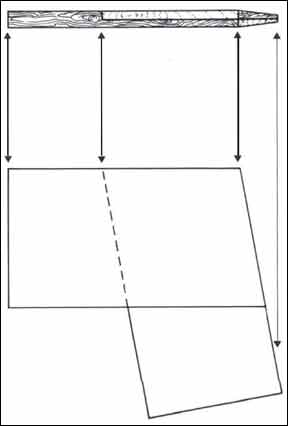
Lay out the desired angle at the corner of the stern rail before cutting the halflap joints.

The illustrations are essentially self- explanatory. You'll have to decide on a size to suit your boat and needs — the illustration shows a unit on a 30-footer in which all dimensions run between 12" and 24". You'll also have to measure the angle of the corner between the side and stern of the top tube of the stern rail. This is most easi­ly done with an adjustable bevel, but lacking this tool, you can get the angle by placing a sheet of cardboard over the corner and running a pencil along the tube around the corner.

Sheet plywood isn't particularly good for this application; the exposed edges would look tacky; the top veneer would rapidly become hacked up; and, if painted or varnished, the finish would quickly be destroyed.

For this job, the only proper material is a hardwood which can be left unfinished to weather by itself; teak is the best choice, but a really hard "Philippine mahogany" would do. Philippine mahogany is actually any number of different woods, some soft and punky, some hard and tough with interlocking fibers. It's the latter sort which is needed for this job.
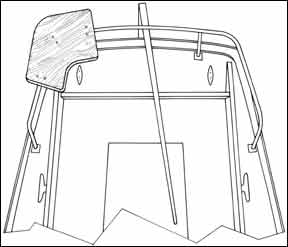
Use stock about 1 1/2" thick — the thickness isn't critical. Since you won't be able to find a plank of solid wood wide enough from which to cut the work surface (and if you could the grain would run badly along one of the arms), you'll have to join the two arms.

The best way to join the two arms is with a "half lap" joint. This is one of the simplest joints used in boat- building. Happily it's also one of the best because the expansion and con­traction of the wood minimally af­fects the joint.

If you've never made a half lap joint, now's a good time to try one. They're simple to make As can be seen from the illustration, the name, half lap, comes from the fact that you cut away half the thickness of each of the planks, so when they're lapped or joined the two together have a thickness equal to that of a single plank.

The first step in making the joint is to mark the edges of the joint, and, in this case, the easiest method is to lay the planks at the appropriate angle one over the other and mark the edges of the intended joint. Note that the illustration shows the planks with a straight outline. You can cut the curved outlines — if you desire them with a saber saw after the joint is finished.

In addition to the edges of the joint, while you've got the planks lying at the proper angle, also mark the parts of the planks to be cut off, ie, those little triangular parts which extend beyond the edges of the opposite plank. Cut off this excess material, and you're ready to begin work on the joint.

Make a series of closely spaced saw cuts across the grain and parallel to the edge of the joint — say 1/8" apart. These cuts should be exactly half the depth of the wood, and the first one should run exactly along the edge of the joint. You can cut these with a hand saw, but, if you've got one, a portable circular saw is quicker and easier. If you do choose to use a cir­cular saw, be sure to make some ex­perimental cuts in a piece of scrap; even experts have trouble setting ac­curately the depth of a circular saw cut. Experiment until you get the bed-tooth adjustment exactly right, then make the parallel cuts on your planks.


Read More on These Topics
  • DIY Projects
  • Sails, Rigging & Deck Gear

Comments (0)

Be the first to comment on this post using the section below.


Add your comments ...

New to Practical Sailor? Register for Free!

Already Registered? Log in

Forgot your password? Click Here.

Advanced Search

Current Issue

Cover Image

May 2012

  • Y-valves Under Pressure
  • Anchor Testing and Rode Loads
  • Funding the Dream
  • Safety at Sea Part III: Rambler 100 capsize

Subscribe Today

Back Issue Archive

Resources

  • Practical Sailor Dinghy Survey Results
  • DIY Boatyard Survey
  • Sailboat Reviews - Index
  • DIY Projects
  • Bookstore
  • Issue Archives
  • Other Resources
  • Customer Service
  • About Us
  • Home
  • Subscribe
  • Give a Gift
  • Renew
  • Products
  • Customer Service
  • Privacy Policy
  • About Us
  • FAQs
  • Contact Us
Practical Sailor

© 2012 Belvoir Media Group, LLC. All rights reserved.