


Anchoring in clean sand and mud is easy. But cruising takes you places where anchoring isn’t easy.
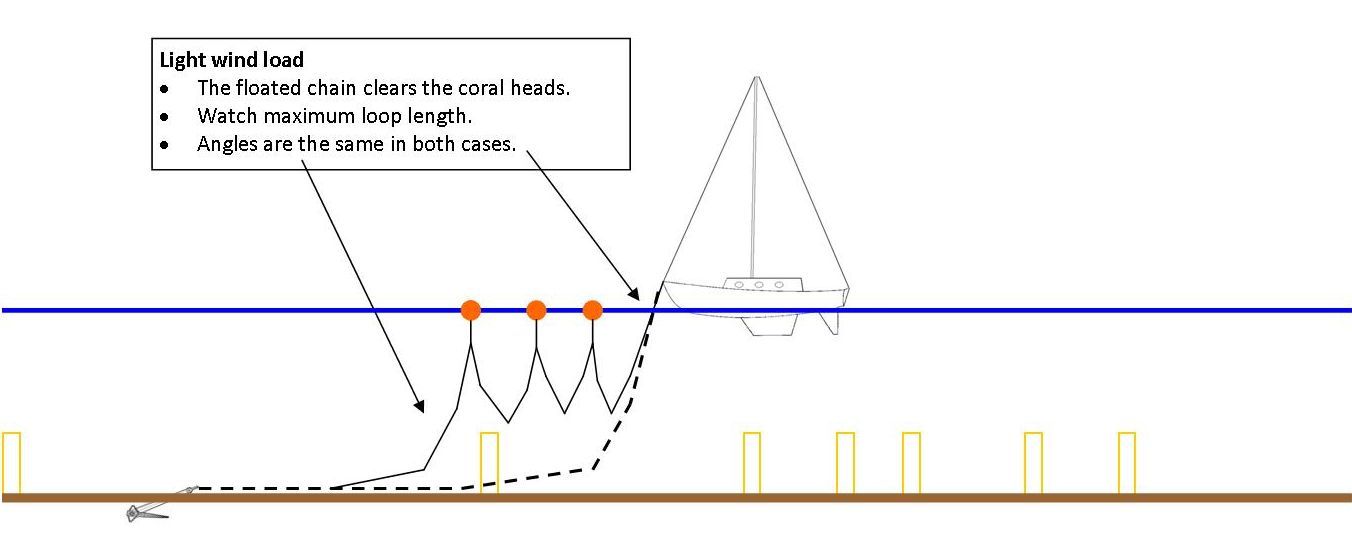
The golden rule with coral, grass beds, jumbled rocks, and snags is to go somewhere else. Chains dragging to and fro do lasting damage to coral and grass beds. The rode can wrap around coral heads or catch under rocks and logs, making anchor recovery nearly impossible. Often, there are sizable patches of good sand or mud between the coral, grass beds, and snags, but not enough for the rode to lie in light winds. The solution, long practiced around coral islands, is to pick a clean spot, lower and lightly set the anchor in the center, and then add floats to the rode as needed to keep it above the surrounding coral heads as the boat swings. The method is also applicable to grass beds and areas with patches of rocks or other snags.
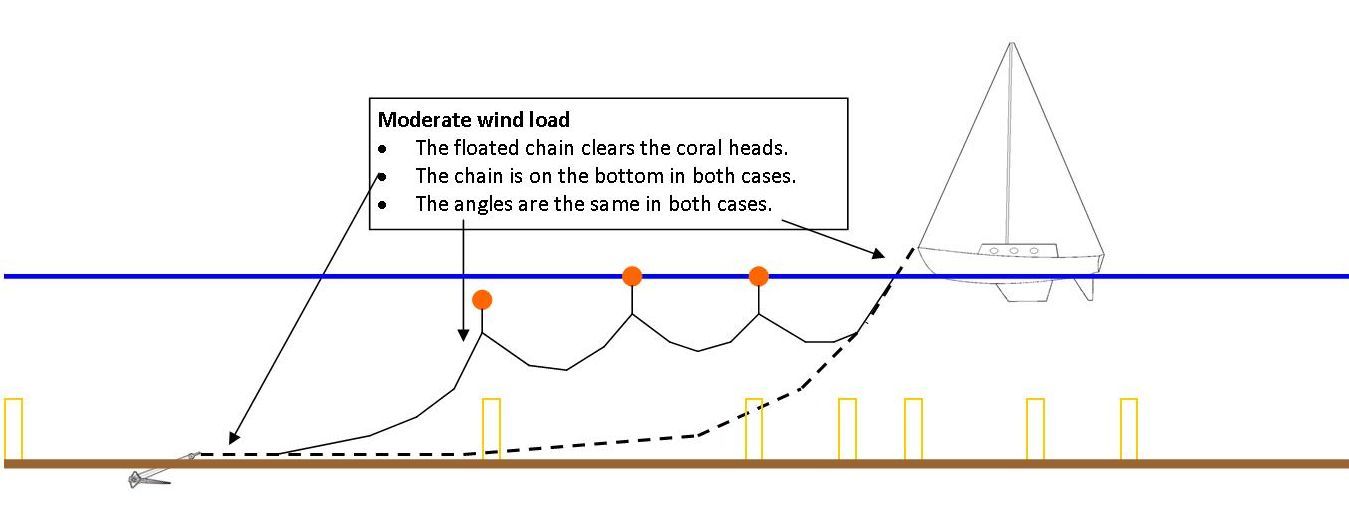
“Don’t the floats reduce holding capacity versus letting the whole weight of the rode work for you?” Yes and no. In all but the most violent conditions, the first bit of chain will still be on the bottom, the same as without floats. The rest, like a nylon rode, will be close to neutral buoyancy, and you can compensate for that by adding just a little more scope. I think it is simplest to break the rode behavior down into stages.
Engagement
The first 25-40 feet of the rode is not buoyed. When the first pull hits the anchor, the chain is still on the bottom, floats or not, and the anchor engages.
Setting
As the rode tension increases, the first few floats submerge and the rode pulls down. The curve is a little higher than without floats, but some chain stays on the bottom right through moderate power setting.
High Load
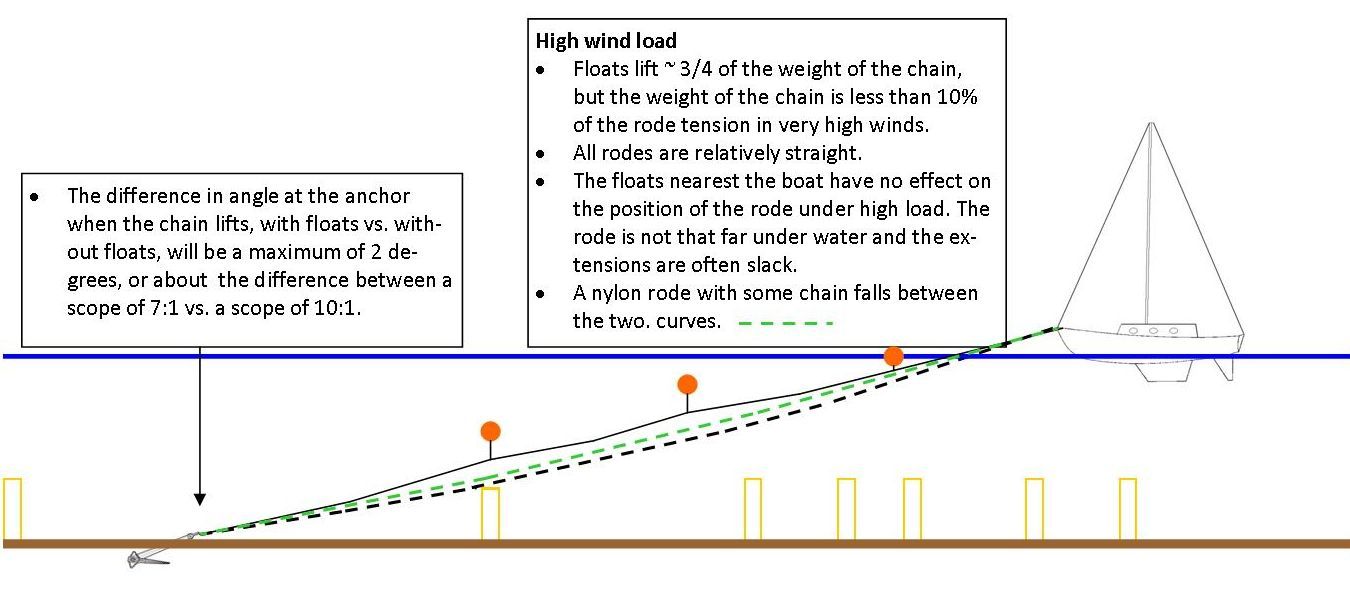
Unless the water is very deep—not when this method is typically used—the rode becomes basically straight before the anchor reaches its ultimate holding capacity. This is true whether there are floats or not.
This does mean that you cannot take advantage of the weight of chain to use short scope to reduce your swing circle, but it turns out that isn’t a problem. In very light winds, when bumping into other boats is a concern, the floats pull the chain into loops, reducing your swing circle. When the wind blows, all of the boats will swing in unison anyway, and long scope becomes a minor issue.
The use of floats also means you can deploy long scope without dragging your rode all over coral and snags. Deploy just a little more scope than you would if the rode were not buoyed; perhaps 7:1 instead of 5:1, for example.
Shock Absorption
Because the rode does not hang in a clean curve, the shock absorption will be somewhat less. Instead of lifting rode during surges, you will be pulling floats down. Also, the loop between each float is a catenary —though much easier to straighten. About half of the surge absorption will still be there. In very high winds, the rode will straighten a little sooner; a nylon snubber is the answer. See “Rethinking Anchor Snubbers,” and “Yawing and Anchor Holding.”
Positives
- You won’t damage coral as long as the clear patch is large enough. Damage to grass beds is reduced, but there is still some chain swing.
- You won’t chafe the chain or rope on coral or other snags.
- In light winds the floats draw the chain together in loops, much as catenary pulls the boat forward. Your swing circle is less than without floats.
- Reduced downwards pull on the bow in waves (chain) means less bouncing.
Negatives
- Yawing will increase. This can’t be helped, of course, because dragging chain across the bottom where there is coral or weed is not acceptable. Yawing can be mitigated through other means, including proper balance, riding sails, and drogues.
- You will need more scope if severe weather is expected. However, since everyone will be swinging in unison, and because the rode cannot snag, this is not a problem.
- Catenary shock absorption is reduced. Use a snubber in shallow water.
- Vulnerable to snagging by passing boats. Use brightly colored floats. Yellow is best and black is bad. Use drop lines between the floats and rode. In areas where this practice makes sense, you won’t be the only one and the situation should be known.
- The floats can drift around the boat in light winds. Tangling is rare but not impossible. For rope rodes, keel wraps are not a serious problem because the rope is floated up nearer the surface.
Details to Note
Placement
The floats should have just enough buoyancy to float the rode and little more. The first float is typically 25-30 feet from the anchor. If the weight of the chain pulls the first float down a short ways—not uncommon in deep water—that is OK as long as the chain clears the heads. They should be placed just close enough together so that the loops between them cannot reach the snags, typically 15-20 feet.
Chain Rode
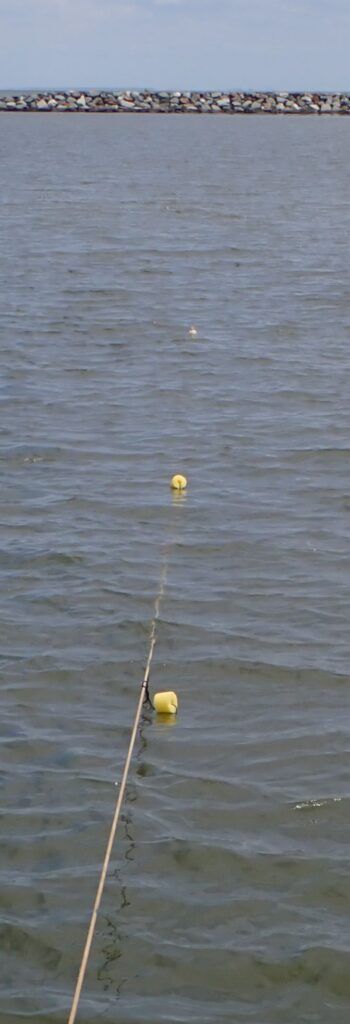
In the case of chain rode, rigid plastic fishing floats (sometimes called pearl farm floats) about 8-12 inches in diameter are most common ($15, about 20-40 pounds of buoyancy). They attach to the rope with a 4- to 6-foot drop line and a carabiner that fits through the links. Size and space the float so that they are about 75-80 percent submerged by the weight of the chain.
Fenders
Fenders are not recommended, except for the floats nearest the boat; the flotation will be too great and they will compress, losing buoyancy, as they are pulled down. But using a few can reduce the number of floats you need to store for an uncommon use.
Rope/Combination Rode
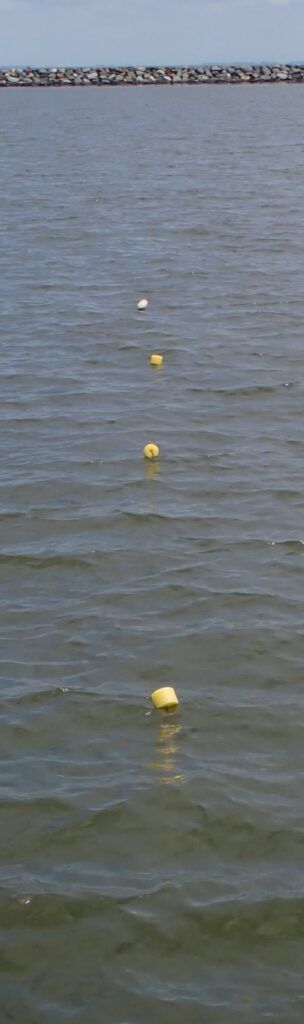
Rope/combination rode requires less flotation. Rope floats, like those used in swimming pools ($4, about 0.5 pounds buoyancy), are enough. Because the rode will be more vulnerable to passing boaters, use bright yellow floats and use 3- to 6-foot drop lines to keep the rode below dinghy prop level, attaching them with light cord and a rolling hitch or luggage tag.
If the wind will not drop to zero and the tide will not reverse (the rope will keep a straight line), a single very small fender about five feet up the rope from the rope-chain connection can be enough (3 in. x 12 in., 2-lb. flotation); it will lift a few feet of chain, but no more, and will pull under easily. Otherwise, floats every 10 feet are smart, to keep the rope bunched up and away from the keel.
Attach via Dinghy When Necessary
The floats are easy to attach on a cat, where the rode is commonly deployed from the center. With a monohull, it can be simpler to attach them from a dinghy.
Not for flat shale rock
You need all the weight on the bottom you can get. You really need all-chain rode and perhaps in-line tandem anchors with the chain lying on the bottom (link—I submitted an article a few weeks ago).
Polypropylene
Don’t use floating rope (polypropylene) for the rode. Compared to nylon it has poor energy absorption and fatigue characteristics. It does not float strongly enough to have the desired effect. It degrades rapidly in the sun (UV), so floating on the surface is bad. It loves to get sucked into props.
Not an everyday method
It’s a little complicated to deploy and you have to use more scope. It’s also a tool we have used when surrounded by grass, snags, or coral heads. The goal is to float the rode above snags and no higher, but below boat traffic, using no more flotation than needed.





The float could have a pulley under it, & or elastic, stretchy line, for more ‘tide allowing’, length, with weight down to, (& or towards) the bottom. ‘B J’.
The idea is to use a float that just barely floats the line. With just a little tension, it sinks. That’s your stretchy line.