In January 2009, Practical Sailor tested 14 mold and mildew cleaners, and two household products stood out: the super-chlorinated Klean-Strip Mildew Stain Remover and Spray Nine, a chlorine-free household cleaner. After that test, several readers asked about products to prevent mold. One product in particular, Concrobium Mold Control, was repeatedly suggested for testing.
We found Concrobium at Home Depot, and to make things interesting, we included two other mildew preventers that readers suggested: 3M Marine Mildew Block, a treatment formulated to follow the 3M Mildew Cleaner tested in January, and Mold Off, a product billed as an eco-friendly commercial-grade cleaner and protectant.
Keeping mold and mildew at bay on a boat is a never-ending battle. Once mold spores land on a moist surface that offers some nutrients, they can begin to colonize. By the time mildew is visible, it can produce enough spores to spread throughout your boat. Preventative measures are the best course of action. Weve posted some on our blog, www.insidepracticalsailor.com (search “mildew”).
How We Tested
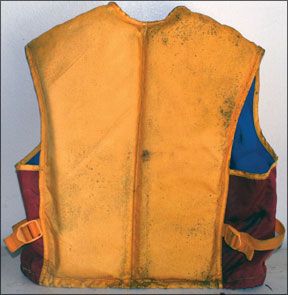
Rarely does a boater start to aggressively attack mold or mildew until it becomes a problem. For this reason, we decided to conduct a real-world test on materials that had already been contaminated with mold or mildew. First, the two products that were advertised as both protectants and mildew cleaning agents-Concrobium and Mold Off-were used to clean sections of a mildew-stained life jacket. Cleaning ability was compared to that of Klean Strip Mildew Stain Remover, which was also used on the jacket.
Next, each product was tested for its ability to keep mold from returning. Each product was applied to taped-off sections on two life jackets and three padded, vinyl berth cushions, for a total of five test panels for each product. All surfaces were cleaned and prepared as directed, and the prep and application process was repeated three times over the course of five months. For control purposes, sections were left untreated on each of the test items.
One PFD was stored in a dry locker on our test powerboat, the other in the typically damp bow locker of an Oday Javelin. The vinyl cushions were kept in the humid cabin of our test powerboat. Temperatures during the test period ranged from 30 to 80 degrees, and humidity was usually above the threshold for mold growth (about 60 percent). The life jackets were not used during the test.
Concrobium
Concrobium is liquid spray that is registered as a fungicide with the U.S. Environmental Protection Agency. A product that flies under the EPA radar by claiming to block or clean mildew, but not eliminate it, does not have to go through this expensive and time-consuming testing and registration process.
Concrobium contains no toxins, ammonia, acids, bleach, or volatile organic compounds. The material safety data sheet for the product does not call for any special clothing, masks, or goggles for protection during spray-bottle application. When applying with a fogger, a mask is recommended, but only to avoid breathing the excessive moisture from the fog. According to the maker, the product is food grade, although we opted not to taste it.
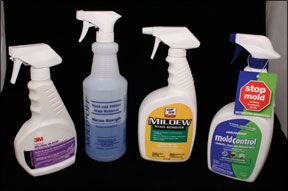
Concrobium purportedly works by forming a physical barrier over the mold, which crushes the mold spores and kills them. This also forms a protective layer to which mold cannot attach and grow. It can be applied to a variety of surfaces, including fabrics and wood, without staining, although the maker advises testing on a small area first.
To apply inside a large boat being put into storage, a fogger is the most effective means of application. Foggers can be rented at Home Depot stores for $25 per day. The fogger applies the Concrobium in a fine mist that penetrates hard-to-reach areas. The Concrobium must dry in order to work properly. Pre-cleaning with bleach will inhibit performance, so any surfaces that have been cleaned with bleach must be well rinsed and dried before applying Concrobium.
In our testing, the Concrobium was not a great cleaner. Difficult stains will require scrubbing and you must let the Concrobium dry to do its work. We left it on the life jacket overnight before cleaning with a soft brush. It cleaned minor stains with scrubbing, but on tough stains, it did not match the fast-acting cleaning of the Klean Strip.
As a protectant, it stood out as the most effective against mildew on all the tested surfaces. The bottle calls for reapplication on a weekly basis, although one of the vinyl panels of our test panels showed no noticeable growth at 30 days. On one cushion that got wet, mold did return, as it did for every protectant on that same cushion.
Bottom line: We recommend Concrobium as part of a mold-prevention strategy. It is not a cure-all, and will need to be applied regularly to products that see a lot of moisture or abrasion, like seat cushions.
Mold Off
Mold Off is advertised as an environmentally friendly commercial cleaner that is available to the public for home use. It is not registered as a fungicide with the EPA. Available in 32-ounce spray bottles or gallon jugs in concentrated form, it can be diluted with water. It contains no chlorine or bleach and has a neutral pH balance.
It is advertised as a mold and mildew stain remover, but it also claims to prevent the recurrence of mold and mildew for several weeks. The maker says it can be safely used on canvas, sails, vinyl seats, carpet, and other materials. For soiled surfaces, the maker advises applying it in the sunlight, allowing it to dry overnight and then wiping off. Another coat is supposed to be applied but not wiped off.
We tested Mold Off full strength and diluted. It worked moderately well as an overnight cleaner, better than the Concrobium, but not nearly as effective as the Klean Strip. It held growth at bay on the all surfaces for three weeks, when the Javelin-stored life jacket, and two vinyl panels began to show some mold growing again.
Bottom line: Mold 0ffs protection seemed to wear off faster than Concrobium, and it is more expensive. We plan to do more controlled experiments with the Mold Off on various surfaces.
3M Marine Mildew Block
Designed as the second step of a two-step mildew cleaning and treatment, 3M Marine Mildew Block comes in a 16-ounce spray bottle and is advertised as safe for most marine surfaces. The product is not registered as a fungicide with the EPA. Like most mildew protectants, this product claims to lay down an invisible film to prohibit mold and mildew from growing.
As a protectant, the Mildew Block did well, although the spray applicator dribbled more than the Concrobium or Mold-Off. It did not do as well on the bow-locker-stored life jacket, and one of the vinyl cushion panels began to show mold along one edge after about 10 days. Since this is where the edge of a cushion met a bulkhead, the protective layer may have rubbed off during use.
Bottom line: This product appears to work as directed, but it is expensive compared to Concrobium and has more precautions concerning use.
Conclusion
Our field test approach introduced some uncontrolled variables, but we found this approach to be helpful in determining how these products would perform when used in the field.
Because the tests used multiple panels and were repeated three times, we are confident in making a recommendation. It was interesting to note that even the untreated panels of the locker-stored life jacket stayed clean, suggesting that these sprays offer no advantage if preventative measures are taken.
As cleaners, none of the products compared to the fast-acting results of Klean-Strip Mildew Cleaner, the potent, chlorine-saturated product that stood out in our mildew cleaning test. However, Klean Strip is NOT recommended for regular use on fabrics such as vinyl, since this could eventually cause some materials to dry and crack. It is an extreme cleaner, best used on rare occasions for heavy-duty jobs. If it is going to be used on nylon life jacket, the jacket should be thoroughly rinsed. Do not use it or other bleach products on spinnakers.
As protectants, all of the products worked as advertised, but the Concrobium was the most consistent. All of the products seemed to be easily rubbed or washed away by use, so life jackets and cushions would likely need frequent treatment.
Ultimately, Concrobium is a safe, economical spray for protecting a boat or equipment that is in storage. On problem boats, one might consider fogging the boat interior prior to winter storage. We still regard active prevention-keeping the boat dry and well-ventilated-as cornerstones of any anti-mildew strategy.
Mildew Preventers
| PRODUCT | PRICE | USER FRIENDLY | CLEANS | PROTECTS |
|---|---|---|---|---|
| 3M MILDEW BLOCK | $14 / 17 oz. | Good | NA | Good |
| MOLD OFF | $20 / 32 oz. | Good | Fair | Good |
| CONCROBIUM | $9 / 32 oz. | Excellent | Fair | Very Good |