Latest News

Pearson Rhodes 41/Rhodes Bounty II Used Sailboat Review
Buyers looking for a good used sailboat should ask themselves, When is a bargain really a bargain? The time-tested Pearson Rhodes 41 is one of the most popular boats on the used-boat market. They have a strong following, and an aging Pearson 41 with a previous owners accumulated TLC is one of the smartest buys among used boats. The Pearson 41 is a modest draft sailboat with a lean, long overhang and real sea berths. It features a solid fiberglass hull with encapsulated lead ballast. The low-aspect sailplan, which relies on a big genoa to boost horsepower. The Pearson 41 has an easy motion and enough functional space to qualify as a good inshore or offshore cruiser. It makes an excellent DIY candidate. Most of the 50 Pearson Rhodes 41s, built from 1961 to 1968, are still around today and have a cult following, making it one of the most sought-after used boats.

Hurricane Center Changes Every Skipper Should Know
With all the talk about a record El Niño coming this summer and climate change generally leading to more severe storms, we all need to read up on weather monitoring—tropical storms don’t stay in the tropics. The remnants curve up the eastern seaboard of...

Bottom Paint 30-Month Update
The Chesapeake Bay is known for brown water and rapid fouling, so any paint that can hang in there for 30 months is doing its job and is a good value. On the other hand, freezing water temperatures and very low salinity knock of...

Energy Recovery Watermakers: Running a Watermaker on Solar and Batteries
Let's dig into the truth to the 75-80% power reduction claims for Energy Recovery Watermakers, review some comparison data, chat with the inventors, and discuss who I think an ER watermaker—and its hefty budget—makes sense for.
After going no-generator-all-lithium a few years back, all new...

Building a Boat, Building Knowledge: A Wharram Narai Mk IV in Practice
Along a stretch of Atlantic coastline in Brittany, France, a 41-foot wooden catamaran is taking shape in a modest workshop where the rusty corrugated iron sliding side door is rarely closed for long. Volunteers drift in, neighbors stop by, and conversations often stretch beyond...
Featured Articles




Cabot 36 Used Boat Review
The Cabot 36 is a sought-after, medium-displacement, 36-ft. cutter from the 1970s that can provide security and comfort for a budget-conscious sailor willing to maintain an older boat. Capable of crossing oceans—she was designed from an East Coast/Atlantic Ocean perspective—and equally reliable as a...
DIY Kayak Boarding Assist Arm
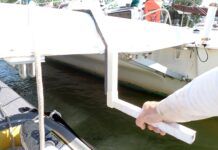
Exploring beaches, marshes, shorelines—and yes, small towns—is one of sailing’s greatest joys. The challenge is getting in and out of a dinghy or kayak, and light chop can make it even more fun when the boat and the tender move to different rhythms.
The Boarding...

Wireless Engine Cut-Off Switches Evolve Into Man-Overboard Alarm Systems
Even sailing greenhorns are familiar with those red coiled lanyards that are, theoretically, attached from an engine’s cut-off switch (ECOS) to the operator’s life jacket (or, more likely, belt loop).
In reality, those lanyards (a.k.a., ECOS links) are often left dangling from the tiller or...
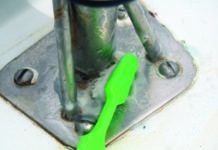
Simple Tips for Maintaining Stainless Steel
When applying a paste cleaner, a toothbrush is useful for buffing tight spots and working into the pores of welds; follow by buffing with a cotton cloth. A green 3M scrubby pad helps for removing more aggressive stains. Continued rusting in welded areas might indicate a developing failure, requiring replacement. Rinse thoroughly with fresh water and mild soap when done buffing.
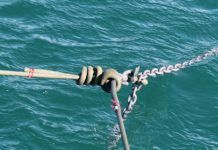
Rethinking Anchor Snubbers
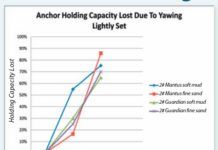
Anyone who has spent a night pitching in an exposed anchorage would not be shocked to learn that in many dragging incidents the snubber parted, or was stretched to its limit, allowing the chain and boat to absorb some teeth-rattling shock loads before something finally gave. Recently, PS testers have devised a series of tests to determine what the ideal snubber looks like. Some of our findings run contrary to popular assumptions. Some will surely surprise you, and may even-one day-save your boat. What does your snubber look like?
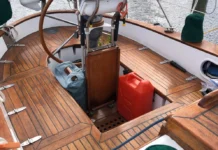
Bob Perry’s Salty Tayana 37-Footer: Boat Review
With several hundred boats sailing the seas of the world, the Tayana 37 has been one of the most successful products of the U.S.s Taiwan-built boat invasion that began in the early 1970s. Its shapely Baltic stern, scribed plank seams molded into the glass hull, and lavish use of teak above and belowdecks have come to epitomize the image associated with Oriental boats.
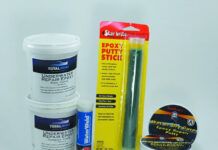
Underwater Epoxy Test
Although laminating epoxies can tolerate some moisture, we know that excessive moisture can prevent a good cure. So how can we manage an emergency repair, when water is seeping into the bilge through a hairline crack—or worse? Well, there are products intended for underwater...

Spring Check: Are Your Onboard Alarms Actually Working?
The sailing season is here again and everyone is doing their spring checks. Something that is often overlooked are the alarms that may one day save your boat and possibly your life. Every boat should have three working sensors and they need to be...
Are Your Cleats in the Right Location?
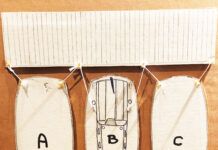
Cleats are those ever-present little devices we all have on deck and, until a line must be tied, most boaters pay little or no attention to them.
However, if you’ve been boating for a while, you’ve certainly tied your fair share of lines to cleats,...
Boatyard Chemical Wisdom
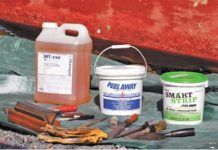
With all of the products out there claiming to be green or non-toxic, surely there must also be villains that are now best avoided. In just a century weve begun to make a fine mess of the world that we need to live in for the next few million years. Yet we are making progress, and finding less hazardous replacements is a part of the answer.

Finally Cheap Enough to Be Dangerous – This 42-Foot Jeanneau DS
Tour the Jeanneau Sun Odyssey 42DS, a 42-foot cruising sailboat that may be one of the most tempting used sailboats on the market. With...



Latest Sailboat Reviews
Beneteau 38.1 Boat Review
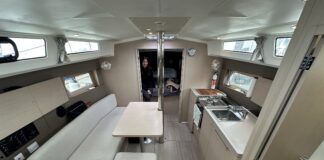
The Beneteau 38.1, considered by many sailors to be an optimal size for a coastal cruising couple with occasional guests, has been in production...