

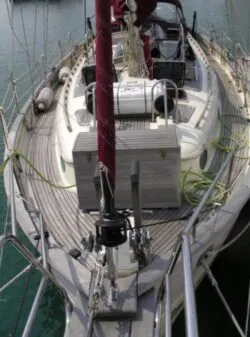
My boat is a Hans Christian 41T, with a waterline length of 36 feet and a displacement of 38,000 pounds. The engine is a Volvo Penta TMD-30A rated at 90 horsepower. The prop is a Maxprop, three-blade, 20-inch prop with 12-inch pitch. A table illustrating speed at various RPMs shows that there is a linear increase of speed with RPM up to about 6 knots (2,600 RPM), but then the speed tapers off with increased RPM. Based on this, I presume that motoring at about 2,600 RPM is optimal fuel burn and speed. Is this correct?
Fran Tansley
Grace, Hans Christian 41T
Ventura, Calif.
Considering Your Boat’s Displacement
Assuming the engine and prop are matched for your boat (confirm prop diameter and pitch with Max-Prop), a fuel-efficient cruising speed for a displacement sailboat like yours is usually somewhere between 60 and 70 percent of its hull speed. Pushing any displacement cruising boat beyond 75 percent of its hull speed greatly increases drag, so that tiny gains in speed require significant increases in horsepower.
Hull Speed Formula
To estimate hull speed for a displacement cruiser such as yours, we’d use the old-school formula 1.34 x √LWL (LWL=waterline length). So the hull speed for your 36-foot waterline is about 8 knots (1.34 x 6 = 8). Your proposed 6-knot speed is right at the 75-percent mark (8 x .75 = 6). At faster speeds, drag exacts a much bigger toll on fuel economy.
Suggested RPM
Small marine diesel engines such as yours are typically designed to run continuously between 60 to 80 percent of rated RPM. Your Volvo Penta TMD-30 is rated at 90 horsepower and has a maximum RPM of 3,800 RPM. Your suggested 2,500 RPM is 65 percent of maximum RPM, so it is an acceptable choice for continuous duty.
Propeller Power Curve
What’s missing is a propeller power curve for your engine. This curve graphs the actual horsepower that your prop uses at various RPM, data that you need for calculating fuel consumption. The TMD-30 brochure (www.volvopenta.com) has a power curve illustrating the engines horsepower at various RPM. Using this curve, you can apply the constant C to the following equation: propeller HP = C x RPM2.7 (where C = rated HP/RPM2.7). However, a quick way to estimate propeller horsepower is to use a table recommended to us by naval architect Dave Gerr.
Your preferred cruising RPM of 2,500 is 65 percent of the maximum 3,800. According to Gerr’s table, at 65 percent of maximum RPM, power at the propeller is about 26 percent of maximum horsepower. So your engine’s propeller power at 2,500 RPM is about 23 horsepower (90 HP x .26 = 23.4 HP). This is the actual horsepower being used to push your boat at 2,500 RPM.
Fuel Consumption Curve
The Volvo Penta brochure also has a fuel consumption curve, which tracks consumption based on RPM and horsepower (measured at the flywheel). Again, you could use this curve to approximate fuel burn, but applying standardized fuel consumption ratings to the real world can be misleading. Gerr suggests a simple formula to calculate diesel consumption: gallons/hour = 0.054 x HP (at the prop). Using this formula, your Volvo TMD-30 burns about 1.3 gallons per hour at 2,500 RPM (.054 x 23.4 HP at prop = 1.26 gal./hr.).
Using your speed table and Gerr’s formulas, we created an index for RPM, speed, and range for your boat with a 100-gallon tank (note caveat below):
1,900 RPM, 4.8 knots, ≈ 655 nm
2,500 RPM, 6 knots, ≈ 460 nm
3,000 RPM, 6.9 knots, ≈ 305 nm
Important caveat: These are estimates. Many factors can impact fuel efficiency, so it is important to ration fuel on a long voyage. A sensible approach is to use no more than one-third of your fuel in the first half of the trip, one-third in the second half, and keep one-third in reserve.
Resources
For more on engine performance curves and fuel efficiency, see Gerr’s article “Engine Power Curves” at www.gerrmarine.com. Gerr is also the author of some of our favorite books for boat geeks, including The Nature of Boats, and The Propeller Handbook.
This article was originally published on 9 August 2016 and has been updated.













Question of units: US Gallons of Imperial Gallons. Really enjoy your articles and find them a wealth of knowledge and advice.
Thank you
Charlie
Question of units: US Gallons or Imperial Gallons. Really enjoy your articles and find them a wealth of knowledge and advice.
Thank you
Charlie
Is it healthy to run the engine for extended cruising at 1900?
I find on a coastal delivery, we can often nail down fuel efficiency by topping the tank every night and comparing this hours and rpms in the log. Keep a fuel log and usually you won’t be very far into your season and you will have a very good idea of what you burn. Remeber that how clean the bottom is wil matter and any roughness on the propeller will make a huge difference.