

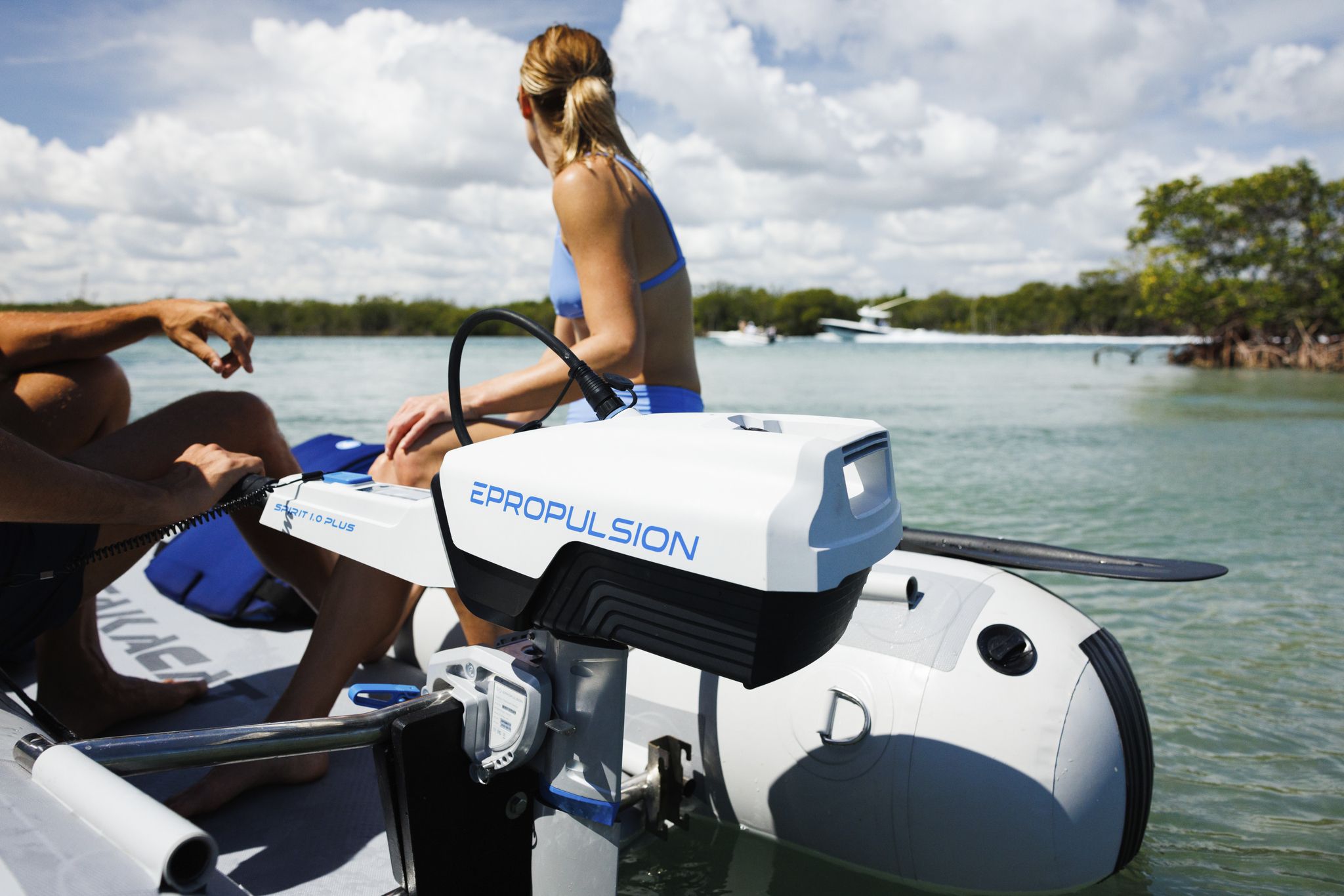
Somewhere around the third carburetor rebuild for our 3.3 hp four stroke dinghy outboard, I decided enough is enough. Four stroke outboards are supposed to be cleaner and quieter than two strokes, but they are heavier, more complicated, and in smaller sizes, not that much quieter. Whether it was ethanol in the fuel, or just bad luck picking a lemon from the dealer, our outboard was a constant source of trouble, and word around the waterfront was that we were not alone in this experience. The old two stroke that we replaced always started first pull, but regurgitating two stroke oil into the ocean and atmosphere is no longer a responsible option. Time to join the electric outboard revolution.
We are three years into ownership of our small electric dinghy motor. Here we are talking about small, roughly 3 hp equivalent, non-planing dinghy motors in general and the ePropulsion Spirit 1.0 Plus in particular. ePropulsion, Torqeedo, Newport and others all make fine small motor options, but we ended up buying the Spirit 1.0 Plus. It is low maintenance and easy to carry since the motor and battery are separate and each get their own hand. No need to store gasoline onboard and, of course, the sweet, sweet silence. After three years of ownership, I thought I would share a little of what we’ve learned and a few things I wish I had known ahead of time. In a nutshell, it’s all about range expectation, throttle discipline, and access to charging.
For the kind of cruising we do, mostly one to three weeks gunkholing around Maine with short dinghy trips from the anchored boat to shore and back, our Spirit 1.0 Plus Sparky has proven well suited to the task.
Range Anxiety
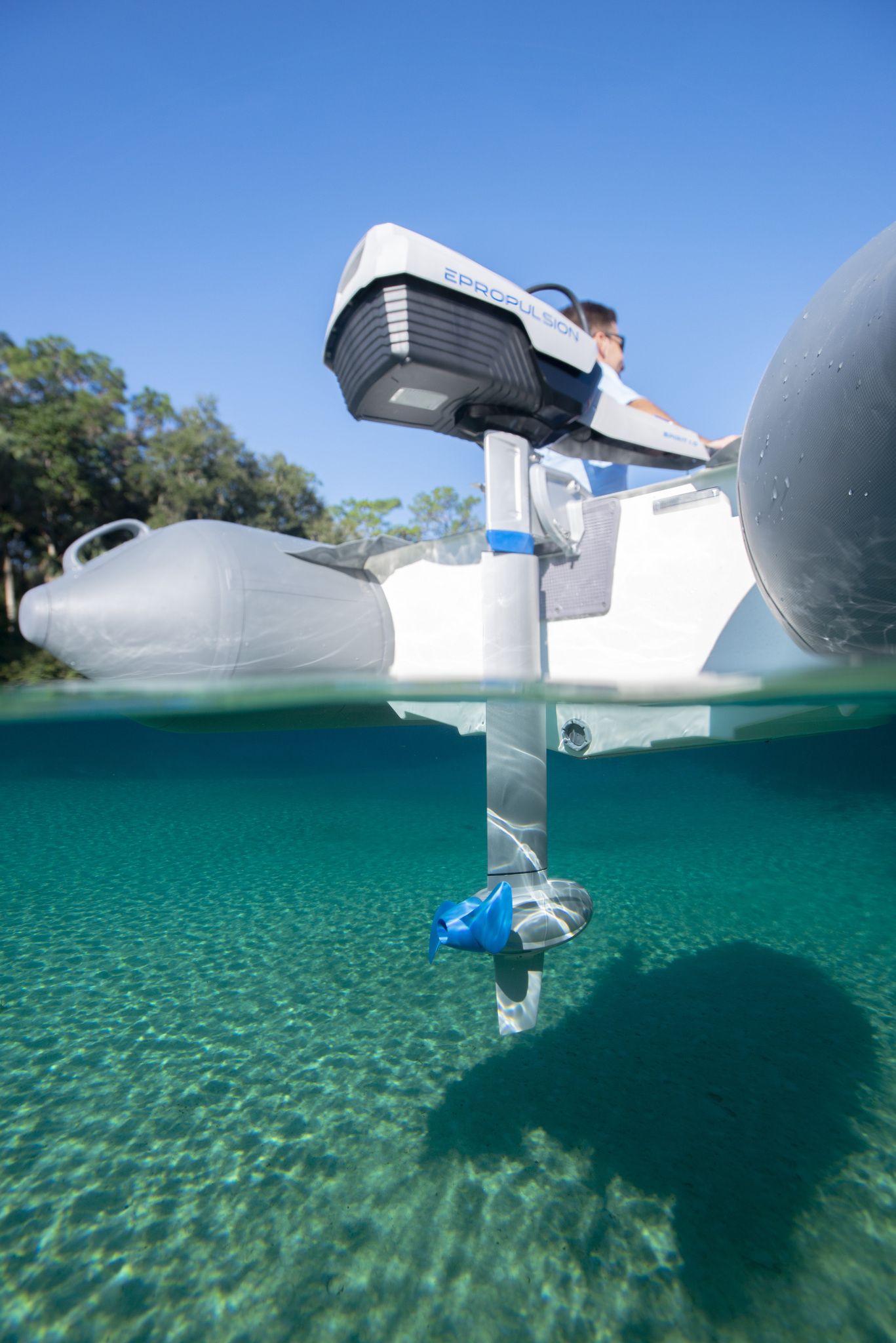
As any electric car owner will tell you, range anxiety can haunt the subconscious mind. A pre-departure full battery charge at home would usually get us through a two-week cruise, but the end of week two finds us throttling back for slow, low power consumption dinghy rides with one eye constantly on the Time Remaining indicator. I confess that with the old gas outboard, I treated the throttle like it had two settings, off and max. Our old two stroke Mariner had a graphic of a turtle for slow and a hare for fast. “More bunny Dad!” my kids would request when they were much younger. Unfortunately, electric outboards have a tendency to suck amps at full throttle.
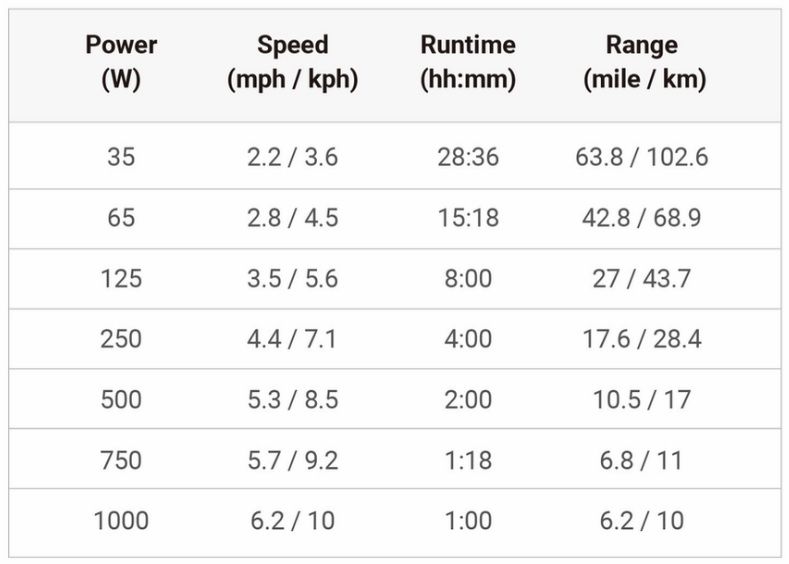
In the chart below, you can see that running full bunny (1000 W) will drain the battery in one hour, whereas running half throttle (500 W) will give you 85 percent of max speed, but double your run time, and cutting down by half again (250 W) will give you four hours at 71 percent of max speed, and so on. I feel sorry for the poor technician who spent over 28 hours going 2.2 mph just to prove the 63-mile range at that speed.
Throttle Discipline Matters
As a case in point, last summer myself and three other adults packed into our little inflatable for a shore excursion up a river near Boothbay. We had about 50 percent charge in the battery before we set off for our destination about two miles upriver and around a bend into a little side river. We knew the current would be against us on the way back, but 50 percent should be plenty for the round trip if we go easy on the throttle. What we didn’t realize was that the bar off the bend would dry up as the tide went out, adding significant distance to our trip. Also, the current was stronger than expected and I had to hold the throttle wide open for what seemed like a long time to get through a rip where the river narrows under a bridge.
Sparky performed like a champ, and we made it back to the mother ship with about 10 percent battery to spare, but not without lots of anxiety and discussion about where we would paddle to beach the dinghy and carry it down river on foot. The moral of the story is you can’t just whip out the gas can and refill the tank. Plan for the unexpected and keep some reserve charge in the battery, and never, never pass up an opportunity to charge.
Charging Dynamics
If you need an outboard to go from the town dock to your moored boat and can take your battery home every night for recharging, an electric outboard would be a good choice. If you do all your cruising stops at marinas with power hook-ups, or if you have an electrical system with a generous surplus capacity of solar, wind and/or generator output, charging won’t be a problem. Just plug-in and charge to your heart’s content. If you are a minimalist cruiser like me, who prefers anchoring out over marinas, and whose boat is equipped with a simple, low-tech electrical system, it gets more complicated.
It takes about seven hours to fully charge the ePropulsion Spirit 1.0 Plus battery from household wall current with the supplied charger and about three hours with the optional Fast Charger. A “full charge” with your boat’s 12 VDC electrical system, using the optional ePropulsion 12 VDC charger, takes a glacial 25 hours. To my knowledge, there is no “fast DC” charger option, and if there were, it would have to draw something like 43 amps at 12 VDC. That would be like running your windlass for three hours straight to get a full charge.
Note, however, it should never be necessary to charge from 0 to 100 percent because, a) You shouldn’t run your battery below about 20 percent and b) Your battery will last longer if you don’t charge above 80 percent. In practice “topping off” the battery to 80 percent after a day’s dinghy use is more the norm. If you are charging off your boat’s 12 VDC system, and you typically “cruise” your dinghy at 25 percent power (remember, that is still 71 percent max speed) that 30 minute dinghy ride to the town dock for ice cream and exploring the harbor will incur a 3.1 hour charging debt, or roughly 1:6 run:charge time. (If you run at full throttle all the time the ride would only take 21 minutes, but your charging debt would be 16 hours!)
They aren’t cheap, but having a fully charged backup at hand is a great remedy for range anxiety. You can keep it where you used to keep the gas can. Since we bought our second battery, and with our “never pass up a charging opportunity” philosophy, range anxiety has all but disappeared. Note that ePropulsion also allows the use of appropriately spec-ed, external, less expensive, third-party batteries for use with their optional external battery connector cable. This goes against my keep-it-simple/keep-it-light ethos, but I realize not everyone is a Luddite like yours truly. However, the thought of running a diesel generator for hours just to charge an outboard battery just seems wrong. We have a dedicated 100 W roll-up solar panel that we use just for the dinghy battery. It charges at a lethargic rate under even ideal conditions, but on a sunny day it can put about one-third of a full charge back in the tank. Electricity is plentiful ashore, but until outboard batteries have the pay-to-charge equivalent of the Tesla Supercharger, you will have to depend in the good will of your fellow person. Emily Post offers little advice about charging your dinghy battery from someone else’s wall outlet, so I am just going to propose my own cruiser’s rules of etiquette for politely begging for energy. “We’ll have two mocha lattes, two muffins, and, oh, do you mind if I plug my battery in over there for a little bit?” Charging your phone is one thing, but lugging an 18 lb. battery and fast charger into a coffee shop and plugging it in will raise some eyebrows. A restaurant or store may do in a pinch, but a marine fuel dock, yacht club, boatyard or harbormasters office will likely be more understanding of your predicament. Even if you are filling up with diesel or renting a mooring or slip for the night it is polite to ask first before plugging in. If someone says no, graciously accept their refusal without argument. For charging ashore, a fast-charger is a must, if you don’t want to be sipping coffee for seven hours. The actual cost to fully charge a Spirit 1.0 Plus battery, 0 to 100 percent, is about $0.44. (Central Maine Power charges $0.30/kWh. Spirit 1.0 Plus battery capacity is 1.275 kWh. Charging efficiency is 88 percent. So $0.30 x (1.275kWh/0.88) = $0.435). If you use the fast charger that works out to about $0.15/hour. Once people realize this, they will usually wave off any offer of payment but they will appreciate the gesture. Try to deal with someone in charge. Offering a fiver to a teenage dockhand might be seen as a bribe and sets a bad example, though a tip after the fact is always welcome. If you are fortunate enough to be visiting friends ashore, a tasty food item or a bottle of wine might seem like lopsided recompense for the favor of plugging in, but it will be appreciated and at least you’ll get to share the snack or beverage with friends. Buy a Second Battery
Add More Solar/Wind/Generator Capacity
Beg for Energy Ashore
Always Ask
Offer to Compensate
Charging Onboard
The house batteries on Misirlou are two 100 ah AGM batteries, and we generally run off only one at a time. 12 Volts x 100 amp-hours means a nominal capacity of 1200 Watt-hours, which, coincidentally, is slightly less than capacity of the Spirit 1.0 Plus battery. Meaning, if we plug a fully discharged Spirit 1.0 battery connected to the ePropulsion 12 VDC charger into one of our house batteries it would bleed the house battery dry, and still not be fully charged since DC to DC charging is only 88 percent efficient. A good friend who bought his motor the same time I did learned this the hard way when he drained his house batteries overnight while charging the outboard battery.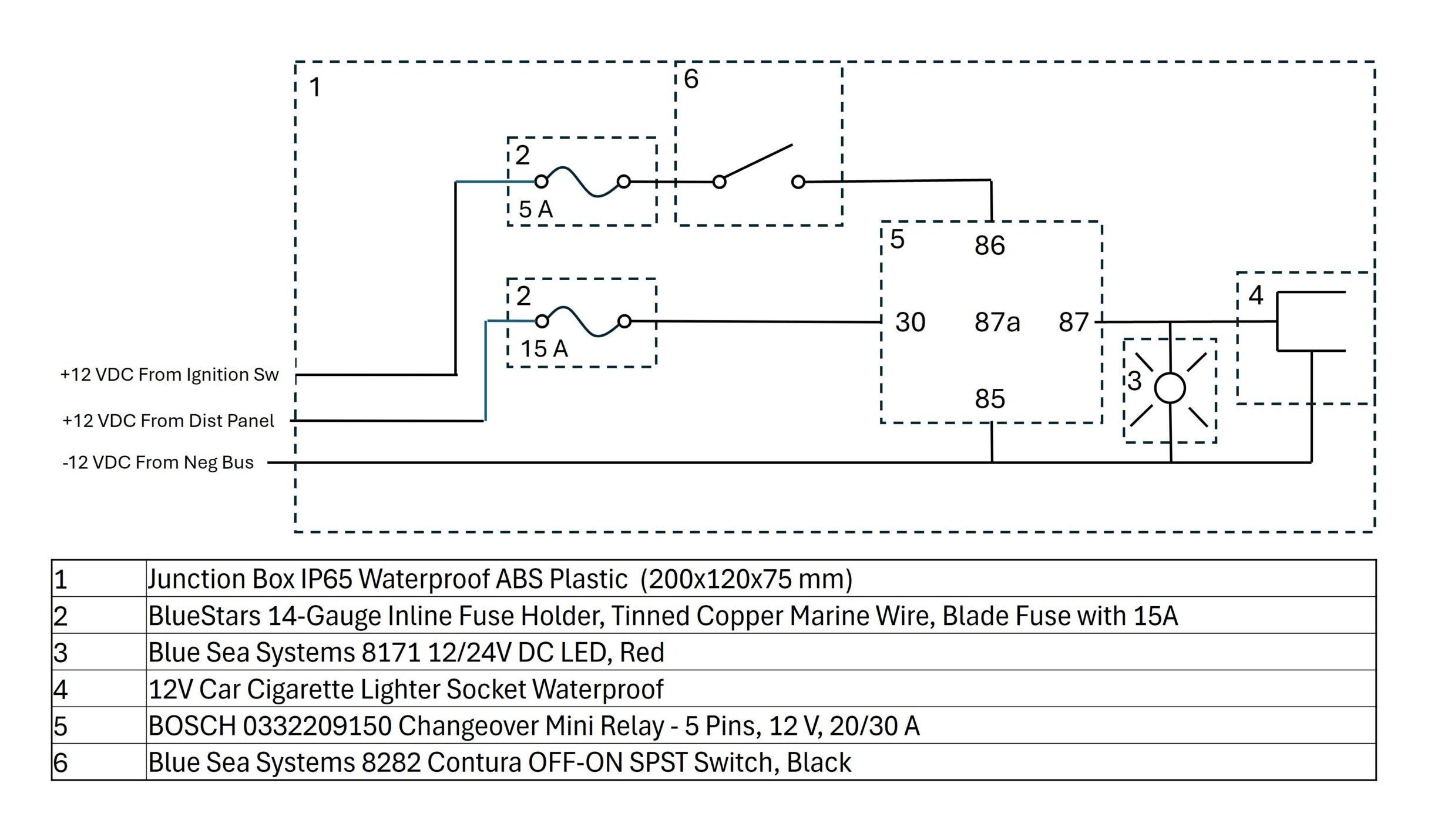
One way to prevent draining the house battery is to only charge when the engine is running. Getting the boat underway and dropping anchor at a new location can be a bit chaotic, and trying to remember to plug-in and unplug the battery during all the commotion is next to impossible, so we made a little box with a cigarette lighter plug for the ePropulsion 12 VDC charger that is only on when the engine is running. A relay wired to the ignition switch connects the battery to the charger only when the ignition is switched on. (A shout out to Keith at Marblehead Marine Electronics for checking my work and offering some advice for simplifying the design. See circuit diagram and parts list above.)
Bottom Line
Between engine charging, the dedicated solar panel, and the second battery, we rarely have to beg for energy ashore. Range anxiety is mostly a thing of the past, and I’ve learned curb my affinity for going full bunny on the throttle and just enjoy the smooth, silent, peaceful ride.
Would I recommend an electric dinghy outboard to friends? I would answer a solid, but qualified yes. You will need to change the way you use your outboard, and plan ahead more. If your needs are compatible with the limitations of electric motoring, then by all means, free yourself from the maintenance and hassles of gas outboard ownership. But NEVER pass up a charging opportunity!









Last year we replaced our venerable Honda 2hp with the same e-propulsion Sprit 1.0 Plus, to power our 8’ inflatable floor Highfield. We see most of the same “pros” in Tom’s article, but are disappointed in the thrust; it’s not nearly as strong as the old 2hp Honda. It was promoted as a 3hp equivalent, but it’s just not. Still, it meets our simple needs – getting us ashore from a mooring or anchorage, and poking around protected harbors.
Also, I caught Tom’s comment about charging, “ Your battery will last longer if you don’t charge above 80 percent.”. That’s contrary to my practice of restoring a battery to full charge as often as possible (granted, a practice learned for flooded cell batteries). I’d like to hear others thoughts about this.
I confess the 80/20 rule (operate between 80% and 20% charge) is a rule of thumb for Lithium-ion batteries in general and, as far as I can tell, not mentioned anywhere in the eProp literature. I know Tesla cars complain and get snippy if you try and charge them past 80%.
Also, eProp does not make it easy to charge to a fixed value like 80%. The only state-of-charge indicator is on the motor LCD display, and to hit a target charge value you have to do some math knowing the initial charge and charge rate to time when to shut the charger off. Needless to say, it is easy to get distracted and run the battery up to 100%, which I do. Frequently. Which is perhaps a case of me saying you should do as I say, not as I do. Has it affected my battery life? I have no idea. I too would love to hear others weigh in on this.
Just a follow-up. This is the reply I recently received from ePropulsion:
“ Regarding charging only to 80%, there’s no official recommendation from the manufacturer about this. I’m aware that in the EV world, manufacturers do the 80% thing for certain types of Li-ionb batteries. If you wish to follow this practice, then there’s certainly no harm in doing so. But just know that it’s not a requirement by ePropulsion.
There is a provision in the Spirit BMS whereby if the battery is inactive for 10 days, it will self discharge to 60% for long term storage.”
Hey Tom great article. I’ve had my Spirit 1.0 Plus for three seasons now and cruise extensively from May to October, use the dinghy almost every day, usually cruising at about 3 knots in an 8 ft AquaPro inflatable. I’ve had nothing but good luck with our little unit and love the quiet vs the Evinrude 4 (2 stroke) and Yamaha 2 (4 stroke) I’ve owned. I also have the 12 volt charger on the boat but find that plugging the 120 volt charger into the boat stand-alone inverter does a far better job of charging while the engine is running. A good alternator with a smart regulator keeps the amps coming. Despite the fact that I don’t like motoring, powering is sometimes a fact of life in BC waters. Although generally at anchor, we stop at marinas once every 5 – 6 days for supplies and charge up overnight. We’ve never been below 25% of a charge and always charge to 100%. No problems yet.
Great to hear you have landed on a sustainable battery routine. It could be that the built-in BMS in the battery is working quietly to prolong battery life, even if we charge to 100%. My inquiry to eProp on the subject went unanswered, but I will dig a little further.
My ePSpirit 1.0 powers my 20 ft daysailer (Paceship Mouette, 700 lbs) more than adequately, and it’s silence is compatible with what we love about sailing. We rarely need the motor but it is so nice to have! (For the first couple of years of owning this boat, we sculled in when we miss-timed the wind in the late afternoons around South Bristol, Maine.) Having the eP definitely makes life easier and supports our willingness to be a bit more adventurous. My spouse is much happier to join the kids and me on the boat, knowing that we won’t ever need to have a long slog home if the wind collapses. We can motor along at 4 knots with quite a low throttle so range has not been an issue so far. To make local daysailing easier, it really is the ideal solution.
I too use an ePropulsion Spirit Plus 1.0 as a kicker on my daysailer (Norseboat 17). It’s got plenty of torque to move that light boat, and I have used it on a 12′ fiberglass dinghy where it also does well. These are not cruiser applications, and I can charge at home.
I have a couple of comments, and one question: First, as a daysailer aux, I have found that the foot and prop drag when tilted up and under sail. When shopping for the Norseboat, I was also looking at a Compac Heritage, and was in contact with the company’s owner. He was using a Torqueedo on his own boat, and while he liked it he also mentioned the drag. The Compac has an aluminum frame for the traveler, and he would loop a line from the foot to the frame, and get enough clearance. I don’t have that option, so I either accept the drag, or use oars for getting home when wind drops.
Secondly, when I first got the eProp in 2019, I had a lot of E20/21 errors, bad connection. I tried spraying it with condensed air, but found that chilled the system and it apparently thought it was too cold to operate. I later discovered that if I made the connection early enough, and let it sit for a couple of minutes, the computer in the thing would get happy, and the connection would be recognized. Maybe I was making some other error, but that was my experience.
My question concerns the plastic cap that covers the charging port on the battery. Mine simply stopped sealing. eProp doesn’t sell a replacement, and I’m not sure I could get the old one off and a new one on anyway. I’ve filled the port with a dielectric gunk, but would rather find a better solution. Tried taping it, but didn’t work. Any ideas?
Hi Frank, Is the drag problem because the lower unit does not tilt up enough to get out of the water? I have seen transom hung outboard mounts that articulate to lift the entire motor up for that purpose. Googling “articulating transom mount outboard bracket” yielded lots of results. If your outboard in in a well, like some boats have, it might be hard to get the lower unit out of the flow.
E20/21 is “Battery/Motor communication fault and, as you surmised, might relate to the pin connection.
Regarding the plastic connector caps, yes, they appear to be inadequate. The YouTube channel Acorn to Arabella has been experiencing corrosion problems and pin breakage issues with both connectors, and has launched an appeal for a solution. Their approach seems focused on replacing both male and female connectors with something more robust. For my part, I am planning to 3D print rigid, gasketed, screw-on connector caps… when I get around to it. I will find some way to make the 3D print files available, if and when I get the bugs worked out.
I have a Torqeedo 1003 that I use on a 26′ trimaran, and it has the same problem of not tilting up enough to clear the water. I have made a little wooden stick that goes into the gap in the lifting hinge such that you lift the motor and put the stick in and it holds it up. It seems to stay firmly even is some chop, but I imagine a bungee would secure it better for rougher conditions. I also shaped it such that is locks in, but your motor is going to be a different shape than mine, so you’ll have to improvise.
I have made an auxiliary battery that I plug into the original battery with some very nicely made, very waterproof connectors I got off Aliexpress for about $8 per connector. They come in many different pin configurations and sizes, I got the medium sized 4-pin to use as a simple power connector. Getting one with large and small pins to replace existing ones might not be possible, but they have up to 9-pin, screw down ones, round with a nut, etc. Obviously you would void any warranty you might have, but I always own old broken stuff I have fixed, so I am the warranty!
Search for IP68 Aviation Waterproof Connector 2/3/4/5/6/7/9Pin Screw Wiring Cable Connector Male/Female Plug Socket Nut/Square/Docking on Aliexpress, I think you can get them on amazon and ebay also.
Anton
I have a ’24 EPropulsion Spirit+ motor, and we love it.
For charging our battery directly off of the house bank on the mothership, (which itself is solar charged), one should use the OEM “Solar charger”, which is twice as fast as the OEM “12V charger” with a cigarette lighter plug, which can overheat, big time!
The ’24 and up solar charger, has incorrect instructions, but works fine once you know how. Plug in or switch on the charger, and the red light gives asymmetrical quick red flashes at first.
Wait 30 seconds to a minute until it switches to symmetrical red on/off, on/off, etc.
THEN plug in the Spirit battery, and it should then have a red lightning bolt looking light on top. 8 hours or so later, it is done when this light turns to blue.
How to know when a battery is charged to 80%, I don’t know. It has to be taken to the dinghy, mounted, and the motor switched on, to see any other state of charge, other than 100%… indicated by the blue light.
Another tip… backing the dinghy off of a beach, you have to hold it kicked up and just under water. This slings a lot of water in your face!
To prevent this, I bought the optional OEM “cavitation plate”, that mounts 2″ above the prop, and blocks this water, keeping it out of my face.
The cavitation plate is only on their various web sites and catalogs, in a different version for a different motor… the Navy. This is NOT it.
I knew it used to be sold for the Spirit+ motor, and my dealer checked her sources for old stock. If you can find one, they really solve this problem. They are out there…
I have been using a ePropulsion Spirit 1.0 Plus outboard for the last three years cruising and living on the hook from Maine to Chesapeake Bay. We are out for about nine weeks each summer. I have been very satisfied with this outboard. It has been reliable and adequate to get us from anchorage to shore in every location. I have 400 AH of lithium for the house batteries and 570 watts of solar on the transom arch. This has always permitted me to charge the outboard battery overnight on the DC charger. We never have to run the engine or charge onshore. I tend to run it at full throttle.
I did have one problem which was caused by a loose negative wire connection on the negative power bus. I heard the DC charger buzzing weirdly. I was further alerted to the problem when my diesel heater would shut down due to a voltage error. By the time I found and corrected the problem, it had damaged the battery internal BMS board. That cost me some to repair but the battery is back in service.
I don’t suffer any range anxiety and I enjoy the quiet reliability of this outboard.
You didn’t mention the e-series so-called extended range external batteries offered by epropulsion…
Or the capability to use any LiFePo4 48v…
Or the foldable solar panel…
I have a hard dinghy that weighs in at 90lbs that should do very well…
My 40′ sloop is all electric: 38kWh at 48v and 1200w at 12v so recharging anything is not an issue with the 1800w of bifacial PV…
Nice article…
sounds complicated. I’m sticking with my Hangkai 3.5hp two banger bought new for $260. Super light, runs clean, fun w piston.
Interesting. One Hangkai model on Amazon sells for about $150. Less than the annual cost to have a 4-stroke professionally serviced. I’d be interested to know how the long term reliability works out. “Runs clean” is a relative term. That 2-stroke oil in the fuel is going somewhere, either into the air or water.
We have the hydrogeneration version of the spirit plus and when we are able to tow our dinghy we can get some extra charge depending on how long we’re out.
I’m thinking about replacing the 5.5hp outboard I’m currently using on my Potter 19 and I’m looking for recommendations. The boat has a 1500 lb displacement. The primary use of the motor is to get in and out moorings and ramps. I’ve never had the throttle above about one third. I would like to have enough power and capacity to motor to a safe harbor in tough conditions if/when I need to, probably over more distance than I would estimate today. Any ideas about what I should be looking at?
If you are just using the outboard to get off the launching ramp or get out to a mooring, and can charge every night, I think an electric outboard would be a great choice. If you are cruising long distances and counting on the motor to get you to shore when the wind dies far from home, not so much, IMHO.
A few observations based on 8 sailing seasons with electric outboards on our Achilles dingy. We, too, got sick of tearing down and rebuilding outboard carbs fouled by gasoline with ethanol.
While we loved the ease of use of the Torqeedo, we went through 4 of them in 7 years – 2 replaced per warranty, 1 purchased used after the 3d one died out of warranty, and finally gave up on Torqeedo after too many problems that were not user-serviceable. The skeg (and prop) are so fragile; the metal parts don’t hold up well in a salt water environment (I destroyed one motor trying to remove a stuck shear pin in the prop shaft), and the lovely error codes that show up when we’re far from home that can’t be resolved without “return to a Torqeedo service center” got to be too frustrating. Last summer we went with an E-Propulsion; so far so good (but we still carry our old gas outboard when cruising as a backup, just in case).
We originally purchased the E-Prop Spirit 1.0, but quickly discovered that the motor would not tilt up sufficiently to drag the dingy up the beach. The dealer graciously allowed us to return it and upgrade to the Evo model, which because it has a detachable tiller tilts 85 degrees (the Spirit only tilts 70 degrees).
With both the Torqeedo and the E-Prop we set up a system for charging directly from our solar panels, by wiring a switch to allow us to redirect the solar output to bypass the MPPT controller (that ordinarily charges our house bank) and send it directly to the outboard battery. With the Torqeedo, the internal BMS can handle up to somewhere around 45V (no need for a separate charger). With the E-Prop, the OEM “Solar charger” will accept up to 52V. With both outboards, charging at higher voltage greatly reduces charging time compared to charging at 12V.