

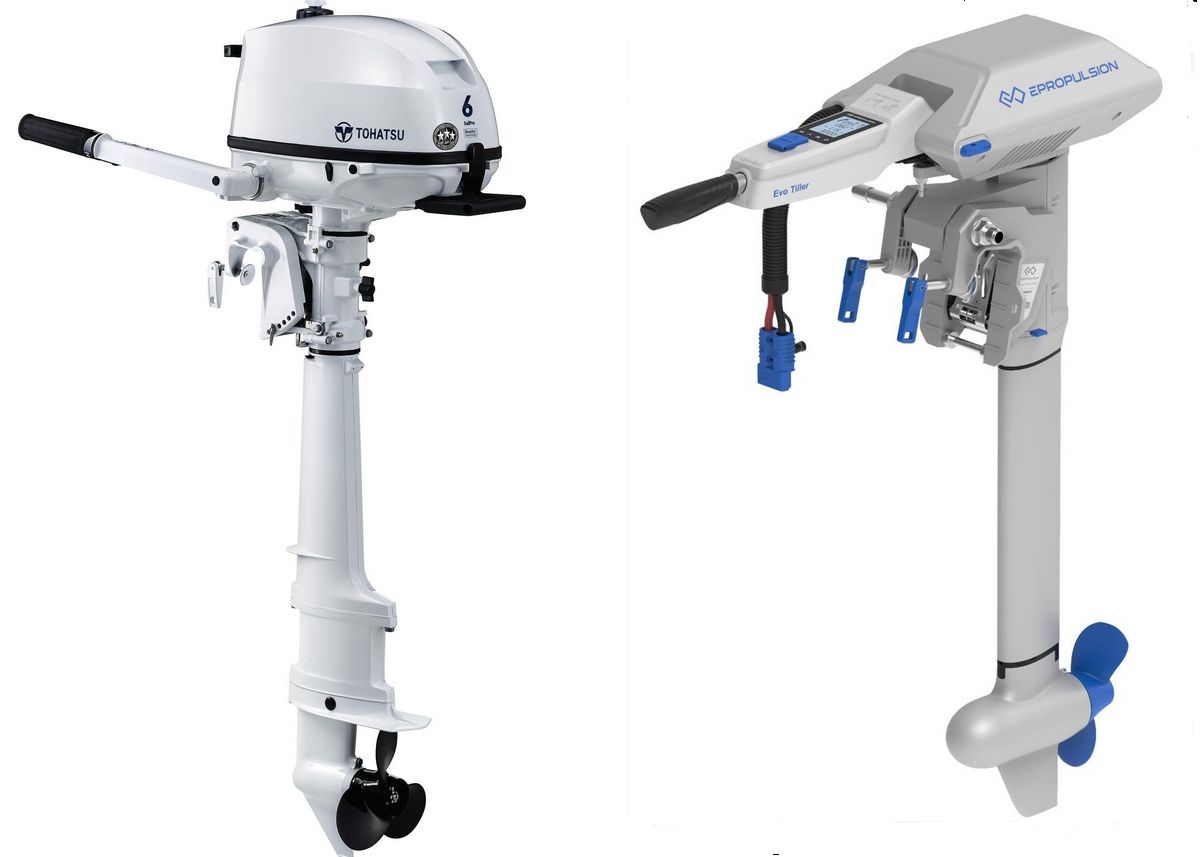
If you own or intend to buy an electric outboard because it is clean and quiet, read no further. Today’s four-stroke outboards are much cleaner and quieter than their two-stroke ancestors, but they can’t match electric outboards on these two qualities. As noted in Practical Sailor’s recent Buyer’s Guide: 10 Gas Outboards for Cruising Sailboats, gas outboards offer advantages over electrics including better range, higher top-end speeds, faster “refueling,” and lower initial cost.
With a 6-horsepower (hp) or 9.9 hp gas outboard and a 6 gallon tank, you can easily power a 20- to 30-foot boat at hull speed all day long and then refuel within ten minutes. With comparable electric outboards, the battery would be drained in little more than an hour motoring at hull speed, and recharging will take as long as 12 hours with a standard charger (or four to six hours with an extra-cost “fast charger”).
Cost Difference between Gas and Electric Outboards
As detailed in Practical Sailor’s recent Electric Outboard Buyer’s Guide, the initial cost difference between electric and gas outboards in the 3-hp range—power appropriate for inflatables and sub 20-foot sailboats—is currently about three-to-one, with electrics with integral batteries costing about $3,000 versus roughly $1,000 for gas 3-hp models. Total cost of ownership might be a wash over the life of the product, considering the ongoing cost of fuel, oil and maintenance required for gas models. On the other hand, batteries last only seven to ten years and are expensive to replace. Well-maintained gas models can keep running for two decades or more. If you store and maintain a gas motor yourself, you’ll likely come out way ahead on total cost of ownership.
The cost differential between gas and electric is even greater in the 6-hp to 9.9-hp range, where separate remote batteries are required. Assessing online prices available in August 2025, a 6-hp Tohatsu SailPro gas outboard can be purchased for around $1,900. A comparable 6-hp electric outboard with one manufacturer-recommended battery will cost anywhere from $6,100 (for the ePropulsion Navy 3.0 with a tiller control, 48 volt/3072 watt hour E60 battery, and a 25-amp fast charger) to $7,896 (for the Torqeedo Cruise 3.0 long-shaft tiller model with a 24-3500 battery and 10-amp charger). The cost difference of $4,200 to $5,996 between gas and electric options will obviously pay for many years’ worth of fuel and maintenance—and even a second outboard for your inflatable.
If money is no object, one can buy multiple batteries to get extended range with an electric outboard, but you’d still have to compromise on top-end speed (as gas horsepower, which is rated at the prop shaft, beats top-end electric horsepower, which, at this writing, is rated as input power).
Total Carbon Footprint Case Study
If part of your motivation to go electric is to lower your carbon footprint, consider your sailing habits holistically. Are you driving a plug-in electric vehicle? If so, great. If not, you’re probably burning far more gas just driving to and from your marina than you ever would using a gas outboard.
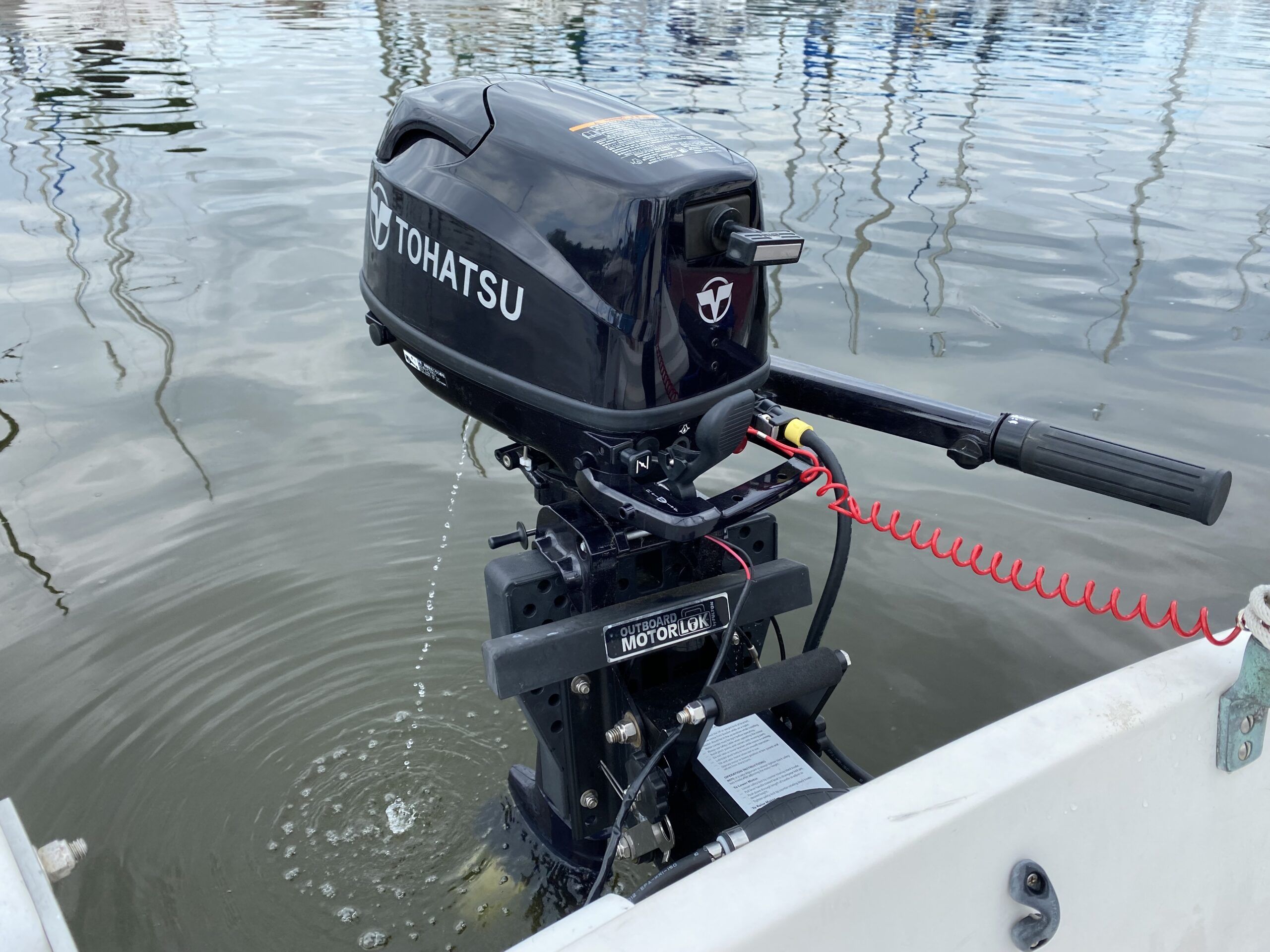
Looking at my own experience, back in 2020 I was driving my then marina on the Hudson River, where I kept a Tanzer 22, in an aging 2004 Toyota Sienna van with a V6 engine that got about 24 miles per gallon. The 44-mile round trip for 20 sails that season totaled about 880 miles. That translates to roughly 37 gallons of gas used and about 740 lb. of C02 emissions—at approximately 20 lb. of CO2 emissions per gallon of gasoline, according to the U.S. Environmental Protection Agency (EPA).
Checking my ship’s log for the 2020 season, the vast majority of my sailing time was powered by the wind. Out of 70 hours spent on the water, fewer than 24 hours were spent using the 6-hp Tohatsu SailPro outboard motor (including 15 minutes each way getting out of and back into the marina). All told, the outboard consumed about 10 gallons of gas the entire season, for a total carbon contribution of 200 lb. Summing up, my fuel-related CO2 emissions tied to sailing totaled 940 pounds in 2020, with 79 percent of that total being from my automobile.
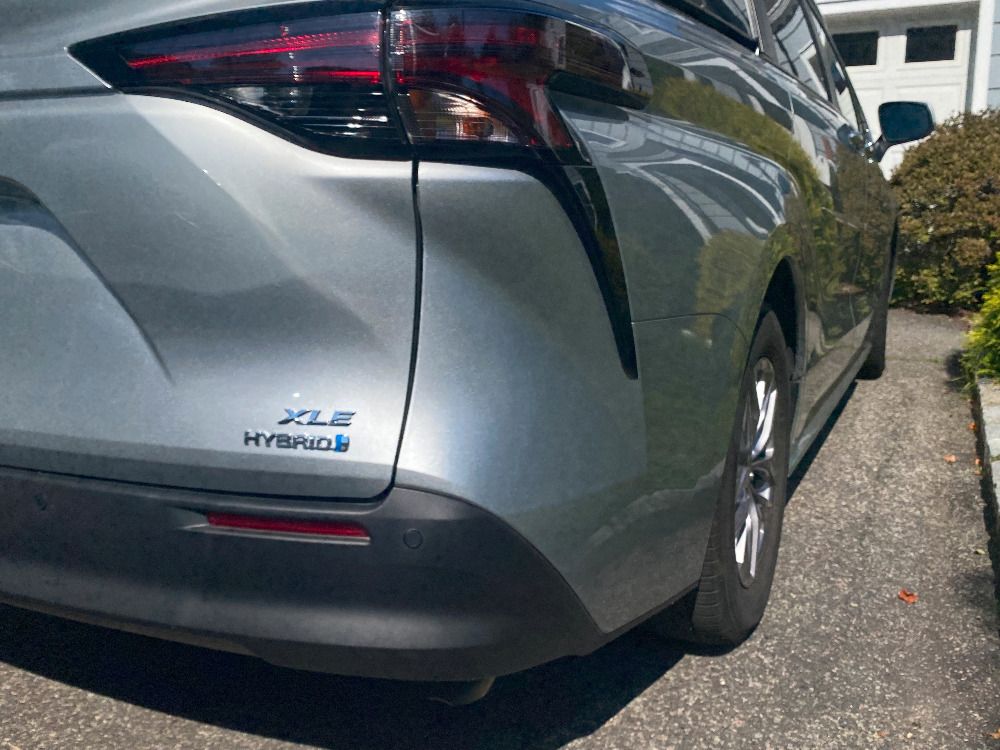
I cut my carbon footprint dramatically in 2023 when I upgraded to a 2023 Toyota Sienna Hybrid, a gas/electric vehicle with a 4-cylinder engine that averages 38 miles per gallon. On the sailboat side, in 2022 I upgraded to a 30-foot Albin Ballad, a bigger and more comfortable cruising boat that I keep on the Long Island Sound.
The round trip to and from my new marina is longer, at 62 miles, but with the switch to a bigger and more comfortable boat, I did more overnight and multi-day trips, so there were fewer back-and-forth trips to the marina. My 16 round-trip drives to the marina in 2024 required 992 miles of driving. Despite the longer distance, the hybrid’s better mileage reduced the fuel requirement to 26 gallons and lowered my automotive CO2 contribution of 520 lb.
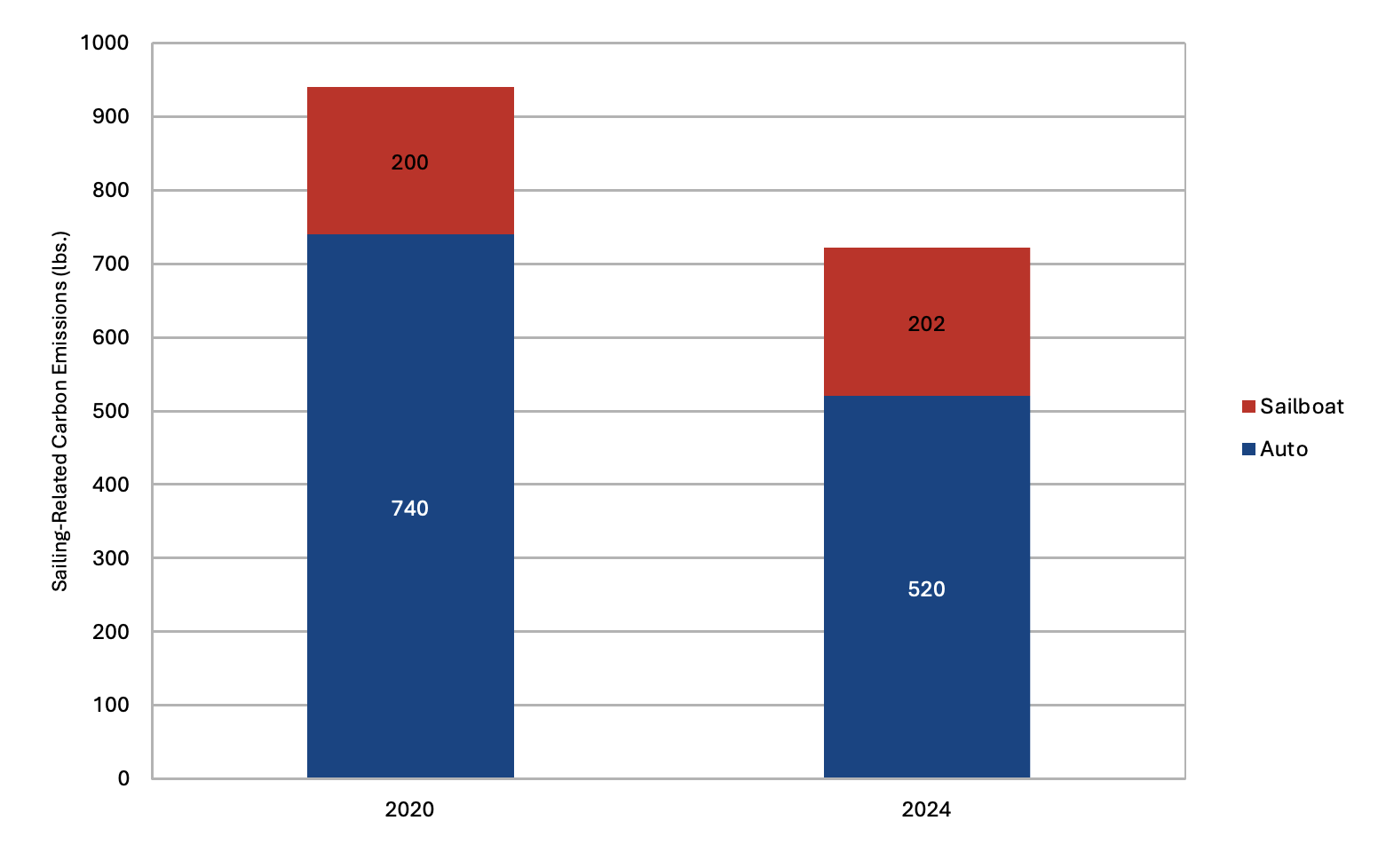
You’d think my sailboat fuel requirement would have increased with a move to a bigger boat and a bigger harbor, where I need 30 minutes of motoring each way to get out of the harbor and back. To the contrary, the Albin’s 10-hp Volvo Penta diesel inboard sipped only 9 gallons of fuel for 27 hours of motoring during the 2024 season. Diesel is more carbon-intensive than gas—at 22.4 lb. of CO2 per gallon, according to the EPA—so my CO2 contribution of 202 lb. in 2024 was about the same as the footprint for the gas used in 2000.
Summing up, my total fuel-related CO2 emissions tied to sailing in 2024 were 722 lb., 218 fewer than in 2020. The reduction, which exceeded the CO2 contribution of both my gas outboard in 2020 and my diesel inboard in 2024, was due entirely to driving a more fuel-efficient vehicle.
Electrics are Not “Zero” Emission
Finally, consider that electric cars and electric outboards are not zero-emission devices; the emissions just happen at the electric power plant. If it’s a natural gas-powered plant, CO2 output averages 1.08 lb. per kilowatt hour while solar sources average .09 lb. and wind and nuclear average .02 lb. per kilowatt hour, according to the World Nuclear Association.
Electrics are also not cost free after purchase, as batteries do need to be replaced within ten years or even sooner. True, recharging is cheaper than refueling, as the 12-hours needed to recharge the battery for the Torqeedo Cruise with its standard 350 W battery charger costs only about 67 cents at the average utility rate of 16 cents per kilowatt hour. I won’t get into the higher math of calculating the carbon impact of mining the rare earth minerals needed for manufacturing batteries and then recycling those batteries once depleted.
Conclusions Beyond Sailing
Not to get too far off the subject of sailing, but a few more calculations about my habits in 2024 revealed that my family’s red meat consumption (about 2 lb. per week) and my own business-related airline travel (about eight transcontinental flights per year) had more than 22 times the carbon contribution of all my driving and motor usage related to sailing—habits I’ve since made an effort to change.
The point of all this analysis is certainly not to discourage readers from going electric, but unless you’re already an electric-vehicle-driving vegan who entirely avoids air travel, the choice between electric and gas propulsion for a sailboat is not the biggest opportunity for you to lower your total carbon footprint.
If quiet operation is the objective, by all means go electric. But until electric motors and batteries become more price competitive—and they will surely drop in price as scales of economy kick in—you can think of a sailboat with a gas outboard or diesel inboard as a hybrid vehicle. As long as there’s wind, you can spend a low-carbon-impact day on the water. If the wind dies, you can motor to a protected harbor or marina at cruising speed (or even hull speed) without range anxiety. As an added safety measure in case of an emergency, the alternators built into 5-hp-plus gas outboards and diesel motors will keep your batteries charged and you’ll have a backup/emergency power source for nav lights, VHF radios, spot lights and cell phones.









Our Dragonfly 32 tri has a Yanmar inboard diesel for auxiliary power but we do have a Takacat dinghy that we use when at anchor to go back and forth to shore. We use a Torqeedo electric motor as the dinghy’s propulsion. We bought the high capacity battery for the motor and with it fully charged, we can easily get 5-6 days of 2-3 trips to shore and back every day. Best motoring speed/power consumption is around 3-4 knots as long as the breeze is under 15-18 knots headwind and relatively flat water. Most larger sailboats I see will still use a gas outboard for their dinghies because you have enough power to plane and the range to go further distances (especially if you want to surf, snorkel, or paddle a remote spot).
The different HP rating method for gas (shaft HP) and electric (input HP) is important. Our e-Propulsion is marketed as equivalent to a 3 hp gasser, but it’s just not. We’re still happy with it (quiet, simple, and light weight sans battery), and it does a proper job getting inflatable dink from ship to shore, which is all we ask.
We tried a Torqeedo Travel 1003 on our CLC Passagemaker dinghy as an alternative to the typical RIB and gasoline outboard. It has sat unused after the first season for several reasons.
The finish precluded leaving it on the dinghy (in davits after fresh water rinsing) the finish deteriorated quickly.
Although we had two of the larger batteries, range was severely limited by the time and energy required to charge one, much less both batteries. Our 900 W solar array was totally inadequate so we had to run the generator to charge.
The prop was inadequate due to light weight and design. On two occasions we but floating debris which caused the prop pun to strip the inside of its hub. This proved impossible to repair adequately with epoxy using what we had on the boat.
We liked the quiet operation, and freedom from gasoline and carburetor repairs, but overall it was a bust. Back to my favorite Yamaha 15HP 2-stroke.
If you still believe the whole CO2 global warming narrative, I encourage you to read Dr Steven Koonin’s book UNSETTLED.
Darn,missed a few typos, can you fix those on my prior post? I don’t see a way to edit.
We HIT floating debris, and the propPIN
Darn,missed a few typos, can you fix those on my prior post? I don’t see a way to edit.
We HIT floating debris, and the prop PIN stripped the hub of the prop
Thank you for the analysis. Beyond the carbon footprint argument my concern with my 3HP ICE and all the other outboards is the fouling of our waterways from fuel, lubricants and gases. This really should be quantified and of primary concern by the pleasure boating world.
My analysis of “carbon emissions” covers the “gases” part of your comment. As for the liquid “fuel” and “lubricants” part of your comment, such liquid emission are minuscule for four-cycle motors, as compared with the horrible two-cycle polluters of old, but, yes, there is still spillage, careless over-priming, etc. My point is to address your carbon footprint and polluting habits in priority order, starting with the biggest culprits. For me that was switching to a hybrid vehicle, eliminating red meat from my diet and drastically reducing the number of airline flights I take each year.
We have a small 14 lb EP Carry electric dinghy motor which we use on our Highfield 310 RIB 90% of the time to go to and from shore in settled weather. Store in lazarette. One hand lift. Faster than rowing but never a surf landing. Battery lasts 1.5 hours. Had a 2 hp Honda with yearly gummy carb. Also have 9.9 Suzuki for power. I love my little electric motor.
Lower pollution at the boat is always preferable but not with the author’s demonstrated cost prohibitive electric (really electric charged battery from mostly nuclear, gas, or coal sources) alternative nor with the illusion of saving the planet from the global cooling (1970s), global warming (1990s), or climate change (2000s+) or whatever it will be called next year green hoax. I own 20 Black and Decker and DeWalt battery (my utility uses nuclear and natural gas) hand and yard tools and their advantages work better than air, gas, or corded electric, but yes the older nickel/cadmium and newer lithium batteries have to be regularly replaced. These batteries get recycled to a refurbishment center. Cars like Tesla have massive batteries and are fast and powerful but my 60 volt DeWalt mower blade needs more power too spin the cross shaped blade faster and cut better and I suspect the sailboat battery motors are also overpriced, and underpowered with limited runtime. In some battery products we are not just there yet. Why would I ever trade my 2008 Land Cruiser for some high mpg often recalled battery SUV? What other than it or a Sequoia has forever been universally rated the longest lasting most reliable SUV? I can seat 7-8 and tow 8,500lbs. Many get 350k-500k lifetime miles. I have a low 175k miles. My tradeoff is very poor (13-17 mpg) gas mileage and poor emissions (I assume and this is on a 5.7 L V8, but SC does not have emissions test). I saw a used boat for sell with a propane outboard and thought that was interesting. I have seen a house burn due to a neighbor’s propane gas tank negligence and we have seen Teslas and bus videos of unextinguishable highly toxic lithium fires. Usind any fuel source we have to be very careful. Maybe a fire extinguisher has finally been made to treat it. Well, technology is always evolving and so must we at the right time. Thanks to the author for a fair and great article. Use long proven products and avoid ones that underperform, are expensive, and are bought to save us from some political theory.
You, like many people, make the mistake of analyzing operating cost against cost per KW hour (your’s is 16 cents) and the cost of gas. You look at gas prices with federal, state and local taxes built into the cost, but not the many taxes added on to the cost of electricity – taxes, delivery, etc, etc. My real cost per KW hr in the Chicago area is over 45 cents per KW hr. It’s still cheeper for electricity but what’s also left out is the tax benefits of the utilities, which are exempt and those of the fossil fuel companies who pay large amounts of taxes, which benefit the country as a whole.
Like electric cars, electric outboards have a range issue. Personally, I don’t think electrics are suitable as a sailboat auxiliary. The wind can die when you are twenty miles from the nearest harbor. or worse, you need the engine to get away from a dangerous situation.
Where small electrics make sense is as a dinghy motor for day sailors. If you are using the dinghy just to get to and from the dock to the mooring, electrics can be easier to handle than gas. The downside is that you will need access to 110v to recharge the battery.
As for carbon footprint, I agree with Henschen that outboards are the wrong place to look to make an actual difference. Heating and cooling are the largest consumers of energy. Still, many people use electric vehicles (and outboards) as virtue signaling.
I got an epropulsion electric outboard for one reason only- I do not want to carry gasoline on my boat. That’s it.
The danger of carrying gas is a very good reason for not choosing a gas outboard. I kind of chuckle when I hear e-outboard (or e-inboard) owners say they carry a gas generator just in case. That said, “hybrid” systems are now emerging with (mostly) diesel generators as a backup when solar and regeneration power can’t keep up with the demand on batteries. The propulsion motors are electric, which are very efficient. Submarines and railroad locomotives have long used electric engines powered by diesel generators. I intend to investigate the new breed of marine hybrid systems for a future article.
Thank you mate for the state-of-the-industry on marine hybrid propulsion.
I’ve converted our sailboat to an electric drive propulsion system, replacing the diesel auxiliary engine. We love the system for all the day sailing that we do and for weekend cruising as well, with about 30 Nm of range with our battery bank. I carry a 2000 watt generator for backup on longer cruises when we don’t expect to find shore power and feel OK with 2 gallons of gasoline versus the 45 gallon diesel tank I used to have. Replacing the noise, smell, soot, and vibration of the diesel engine with the quiet ease of the electric drive has greatly enhanced our boating experience. My next purchase will be an electric outboard to replace the gas outboard we have now. Would like to get gasoline completely off the boat.
We seem to have missed that the E-Propulsion Navy is only 3.4 hp input. There is a vague claim that it is “equivalent to 6 hp,” but no manufacturer backup to the logic, and every head-to-head independent test suggests that it is no more than 3.5 hp. See Ernest’s comment. He’s not the only one. We are NOT comparing apples to apples.
Thus, the capital cost comparison is way off. I doubt the fuel consumption figure makes sense either; the electric cost of a Tesla has been evaluated to be similar to a 40 mpg car. Only a little more efficient.
Then there is the efficiency of electricity and what that means for carbon. The makers consistently overlook the upstream losses. According to USDE generation is on 37% efficient. There is 5% loss in transmission (wire losses), and there is charging hysteresis. The overall efficiency (carbon rating) must assume that the overall efficiency of electricity is only 35% before it even reaches the motor. This can all be checked via Google, with a little engineering thrown in. Yes, solar or wind is great, but the incremental power is coal, oil, or gas. Really, solar and wind are powering the base HAVAC, industrial, and lighting loads.
I get the convenience (but my outboard does start on 1-3 pulls–using the right additive and fuel storage practices really helps). I get the quiet. But I don’t think the carbon or financial arguments are there yet, and range isn’t even close.
Boats aren’t cars. I’ve looked at this many times, hopefully, but no.
We switched to electric in large part because of the unreliability of gas powered small outboards, despite regular maintenance. On the Chesapeake Bay our dinghy use case is short distances in settled water, which means we rarely have to recharge even on week long trips. I also love not carrying gasoline on our diesel powered sailboat. Admittedly if cruising in the Caribbean we’d make a very different choice. Also, consider lightly used electric outboards. Some people buy them, decide they’re not right for their use case, and sell much cheaper than new.
Regarding reliability of small outboards:
The first article I wrote for Practical Sailor (2008) related to gasoline and additives. I was in the fuels industry and had epic problems with my outboard. I chased down the problems, investigated proper fuel storage and additives, and have not had a single outboard or small engine problem since, including lawn equipment and a string of multihulls with 2-3 outboards (twins plus dinghy).
The problem with e10 is that it attracts water, and water causes corrosion, carb plugging, and sometimes phase separation.
* Keep the gas dry. The vent should ONLY be open when running. If it is an installed tank, install a silica gel vent filter. A single rainstorm with an open vent can screw up a dinghy outboard.
* Use a good anti-corrosion additive. PS has tested many, and Biobor EB Stabil 360 Marine get top marks. There are also many that don’t work.
* Run the engine every few months if you can. This includes snow blowers and mowers.
* If the engine does not have a filter (some small ones do not) add a small in-line mower filter and keep a spare. Well worth it.
Search PS articles on gasoline additives, e10, and vent filters. With proper fuel management, 1-3 pulls should be all it ever takes to start. We tested and researched this for our readers! As a side benefit, I no longer have engine problems. That’s nice.
Have to agree with Drew on the ease of starting modern four strokes. I’m guessing many of those experiencing problems are using old two strokes, which are an environmental disaster. If you have a two stoke, put a bullet in it. I used Sta-Bil 360 Marine in my gas and never had a problem starting my Tohatsu 6 hp four stroke.
We bought a new Torqeedo Travel this year, hoping for lighter propulsion and freedom from Gas. So far, it has been a disappointment. Apart from apparent quality issues (a wrong charger in the box, battery poles corroding in 2 weeks, and the prop cracking and shearing before the pin), the horsepower difference has been a significant issue. The lit promised 2-5HP equivalence, but we are much slower than our 2HP Honda.
More importantly, becuase we have an extended battery, the overall weight is equal to or more, and every time we motorize the dinghy, the battery has to be installed, which is a bummer in our inflatable. And because of range limits, we now have to carry two giant batteries that take all day to charge (on a good day) via solar power.
I have been told that Torqeedo has been acquired. Maybe with some $$ investment, they can improve, until then – LMK if you are in the market for an e-mote.
Stuart, I just checked and Torqeedo was bought by Yamaha so that they can ‘pursue carbon neutral propulsion options and offer wider distribution channels’, the company said. That happened in Spring last year.
I have enjoyed the wide variety of perspectives in this article. Rarely do I find so many well informed and experienced adults that behave in providing their opinions. Sailors just want to learn and share experiences and avoid flame wars. What a breath of fresh air in my sails. Well that is why I have checked out of social media and am reducing’news’.
Thoughts:
1. Direct comparison of hp vs. kw is not a thing. Multiplying by 1.34 misses the point of how different they are delivering thrust. The only valid method is to put it on your boat and see what it does. For at least some boats, several YT videos show similar performance of 1kW to 3HP.
2. Don’t buy marine anything if you don’t have to. Good quality 48V/100A batteries can be purchased on sale for $600 where the equivalent marine brand is $1900 with no meaningful difference. Check DC House and Eco worthy on sale.
3. Tech is changing fast in this. Check out new releases. The Newport NT300 is $1300 w/o battery. With a battery, it should be about the same $1900 as the gas outboard and will likely move a small sailboat sufficiently for on/off mooring.
If you really want to minimize carbon footprint, keep using whatever you own and maintain it. Diesel engines are very dirty but can be substantially cleaned up by burning bio-diesel. Even 15% blend will dramatically reduce soot to the point the transom will be much cleaner at the end of the season. Old 2 strokes are an exception; they are very, very polluting and should be ditched.
When your propulsion system have dies, do some research and look for a modern alternative. To be fair, compare thrust vs. thrust in use and not discount input vs output power while ignoring just how badly power inefficient gas outboards are in real life use. Don’t ignore that electric outboard maintenance consists of rinsing it off at then end of the season. Don’t ignore that most go sailing for the peace and quiet of nature.
I still recall the surprise the first time I fired up the inboard diesel on my first “real” sailboat. No one mentioned that would have all my conversations while under power at a yell.