

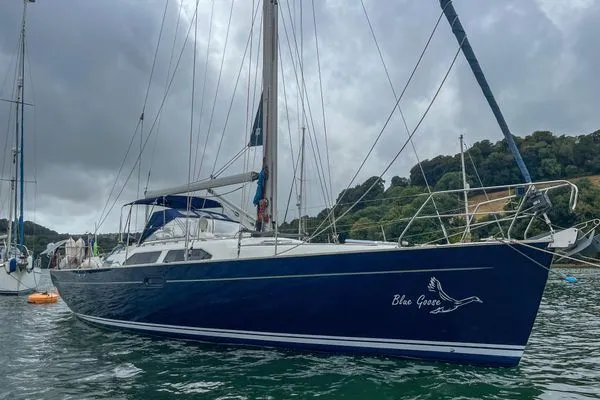
Comfort, robustness, performance—choose two. At least, that’s the usual tradeoff to keep in mind when buying a sailboat. A stout and solid boat with a well-appointed interior will rarely win races, just as a fast and nimble bluewater racer will rarely feel luxurious. But the Moody 46 Center Cockpit (CC) is a boat that wants it all, and while no boat can truly shine in all three categories at once, this Moody comes admirably close: the 46 CC is a true bluewater cruiser that offers a generous interior and premium feel without sacrificing too much in performance.
To be fair, this isn’t a boat likely to be seen leading the pack at your local regatta, but the performance tradeoffs inherent in her design will appeal to her intended audience: liveaboard and bluewater cruisers. In exchange for a little speed and agility, you get a boat ready to cross oceans and comfortably live in, plus a conservative sail plan makes her easier—and safer—to crew shorthanded. This makes her an excellent option for couples and small crews looking to sail the world and build up serious mileage in comfort. And if you do find yourself in a friendly competition, the Moody is unlikely to disappoint here either.
“A true cruiser’s cruiser.”
The Moody Story
Moody Yachts has a deep and storied history in the world of sailing, dating back to its foundation as a Swanwick, UK repair yard in 1827. The company made the jump to constructing its own (wooden) sailboats in 1935, followed by a move to fiberglass construction in 1965. If that sounds rather early for fiberglass—it is. Moody’s 1965 Solar 40 was the first ever fiberglass (a.k.a glass-reinforced plastic) constructed boat. From then on, Moody continued to innovate, carving a name for itself in the world of luxurious bluewater monohull boats and flaunting the kind of overbuilt ruggedness typical of many English shipbuilders of the era.
In 2005, Moody was acquired by Hanse, the well-known German yachtbuilder. Combining English maritime heritage with German engineering, today’s Moody yachts are innovative, luxurious, and big monohulls—flagship models stretch up to 58 ft. LOA. Most recently, they’ve won acclaim for their luxurious deck saloon models, uniting cockpit and saloon into an interconnected space for “one-level living.”
The 1960s era of the Solar 40 also saw the beginning of a long and fruitful partnership between Moody and Bill Dixon, the legendary naval architect and designer of our Moody 46 CC. Under the tutelage of Angus Primrose, who also designed for Moody, Dixon honed his craft and the duo went on to design 39 boats and sell a whopping 4,223 vessels for Moody. Though Primrose sadly passed away in 1981, Dixon Yacht Design continues to serve Moody and designs all of their vessels.
Design and Construction
Center Cockpit Design
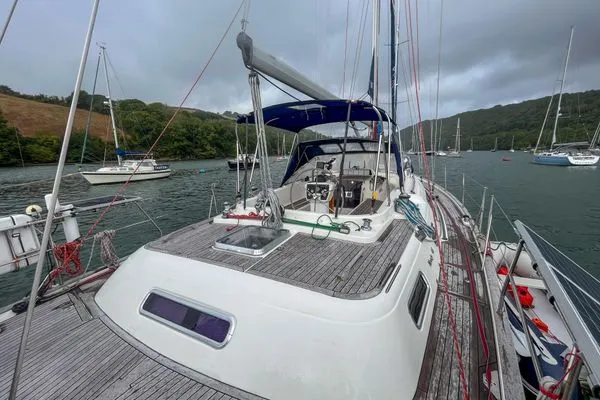
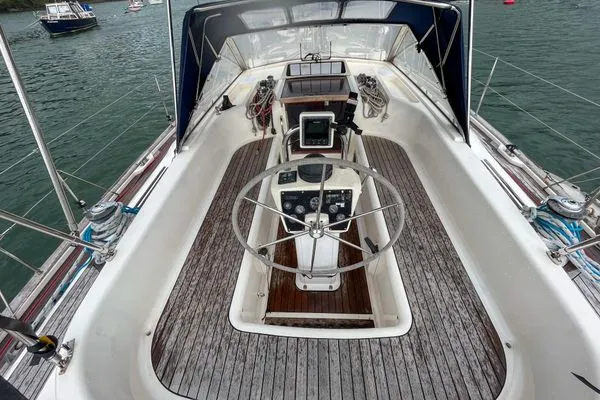
The most distinctive feature of the Moody 46 CC is, of course, her center cockpit. While the center cockpit’s popularity may have faded somewhat from its heyday in the 70s and 80s, it still has its fair share of diehard fans—including yours truly. The central location and high coamings mean you’re less likely to fall overboard and more likely to stay dry when the seas turn rough, a key consideration for offshore sailors. Some sailors also prefer them for docking and undocking due to 360-degree visibility you get from the high central perch.
But the center cockpit is not without its drawbacks. Foregoing a walkthrough transom, you’ll need to climb a ladder to get on the boat from the water, while boarding from the dock means climbing over some decks to get into the cockpit. This may be a concern for mobility-challenged guests, so plan accordingly. This is not a boat designed for dockside happy hours.
“Center cockpits are built for making miles in a rough sea, not for dock queens or party boats—and that’s a good thing.”
It’s worth noting the center cockpit also comes with another nice benefit: more room underneath. This gives the Moody 46 CC ample space for a beautiful stateroom and main cabin down below—more on those in a minute.
Hull Form and Particulars
As her name suggests, the Moody 46 CC clocks in at 46-ft. in overall length with a beam of almost 14.5-ft. Displacing 30,000 lb., she has a ballast ratio of approximately 32 percent and a comfort ratio of 34.06, which puts her solidly in the middleweight bluewater cruiser class—exactly what we’d expect from a boat looking to strike a fine balance between comfort, robustness, and performance. She draws 6.76-ft. in her standard configuration, although a shoal draft version drawing 5.25-ft. was also made.
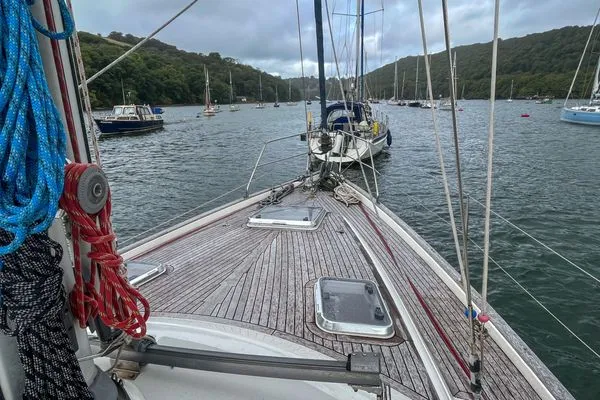
During this era, Moody partnered with Plymouth’s Marine Projects to build their boats, so all structural components were produced in humidity and temperature-controlled shops under the watchful eye of Lloyds. For the 46 CC, Moody went with a hand-laid polyester fiberglass hull with solid laminate below the waterline and cored above, striking a balance between strength and weight below with rigidity and lightness up high. The deck is cored with end-grain balsa, the frame and stringers are cored, and watertight bulkheads separate the anchor locker and engine compartment.
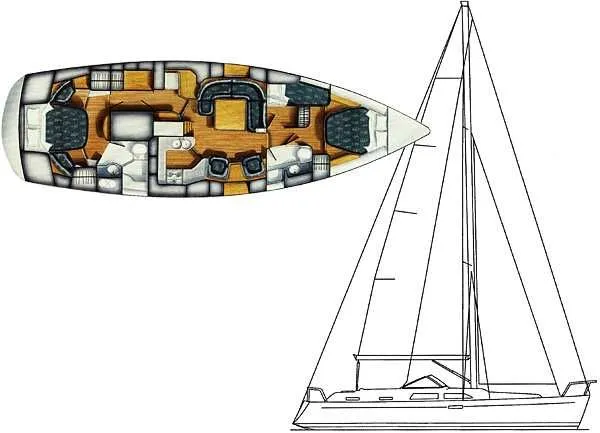
Sailboat Specifications Courtesy of Sailboatdata.com
Hull Type: Fin w/spade rudder
Rigging Type: Cutter
LOA: 46.13 ft / 14.06 m
LWL: 39.37 ft / 12.00 m
S.A. (reported): 945.00 ft² / 87.79 m²
Beam: 14.44 ft / 4.40 m
Displacement: 31,945.00 lb / 14,490 kg
Ballast: 10,362.00 lb / 4,700 kg
Max Draft: 6.76 ft / 2.06 m
Construction: FG
First Built: 1997
Last Built: 2001
# Built: 55
Builder: Moody
Designer: Bill Dixon
Make: Volvo
Model: TMD22
Type: Diesel
HP: 78
Fuel: 114 gals / 432 L
Water: 204 gals / 772 L
S.A. / Displ.: 15.08
Bal. / Displ.: 32.44
Disp: / Len: 233.70
Comfort Ratio: 34.06
Capsize Screening Formula: 1.82
S#: 2.13
Hull Speed: 8.41 kn
Pounds/Inch Immersion: 2,031.32 pounds/inch
I: 58.07 ft / 17.70 m
J: 17.36 ft / 5.29 m
P: 52.16 ft / 15.90 m
E: 16.90 ft / 5.15 m
S.A. Fore: 504.05 ft² / 46.83 m²
S.A. Main: 440.75 ft² / 40.95 m²
S.A. Total (100% Fore + Main Triangles): 944.80 ft² / 87.77 m²
S.A./Displ. (calc.): 15.08
Est. Forestay Length: 60.61 ft / 18.47 m
Rig and Deck Hardware
The sail plan is a straightforward masthead cutter with in-mast furling for the main. From the factory, the 46 CC came rigged with furling genoa and staysails, although owners have been known to modify her to a sloop rig by removing the inner forestay.
Moody chose a conservative 15:1 sail-area-to-displacement ratio and moderate aspect-ratio for the 46 CC, a blessing for couples and shorthanded crews looking to tackle bluewater with confidence—as well as, dare I say it, the occasional solo sail. Personally, I like this decision by Moody and believe it’s totally worth it to sacrifice some speed for a safer and less exhausting sail plan. In line with this philosophy, the Moody 46 CC features the heavy-duty deck hardware and through-hull chainplates you’d hope to get from a British bluewater sailboat.
The chainplates are actually a good indicator of Moody’s approach: stainless steel, passing through the deck to thick plywood-core bulkheads glassed to the hull, and secured with multiple high-tensile strength boats. To inspect the backing plates and bolts, you’ll need to remove a panel, keeping the interior clean while maintaining serviceability. This is a comfortable and battle-ready boat.
“She’s not going to win races, but she’ll keep going when everyone else has to reef, and she’ll do so with surprising balance on the helm.”
Fit and Finish
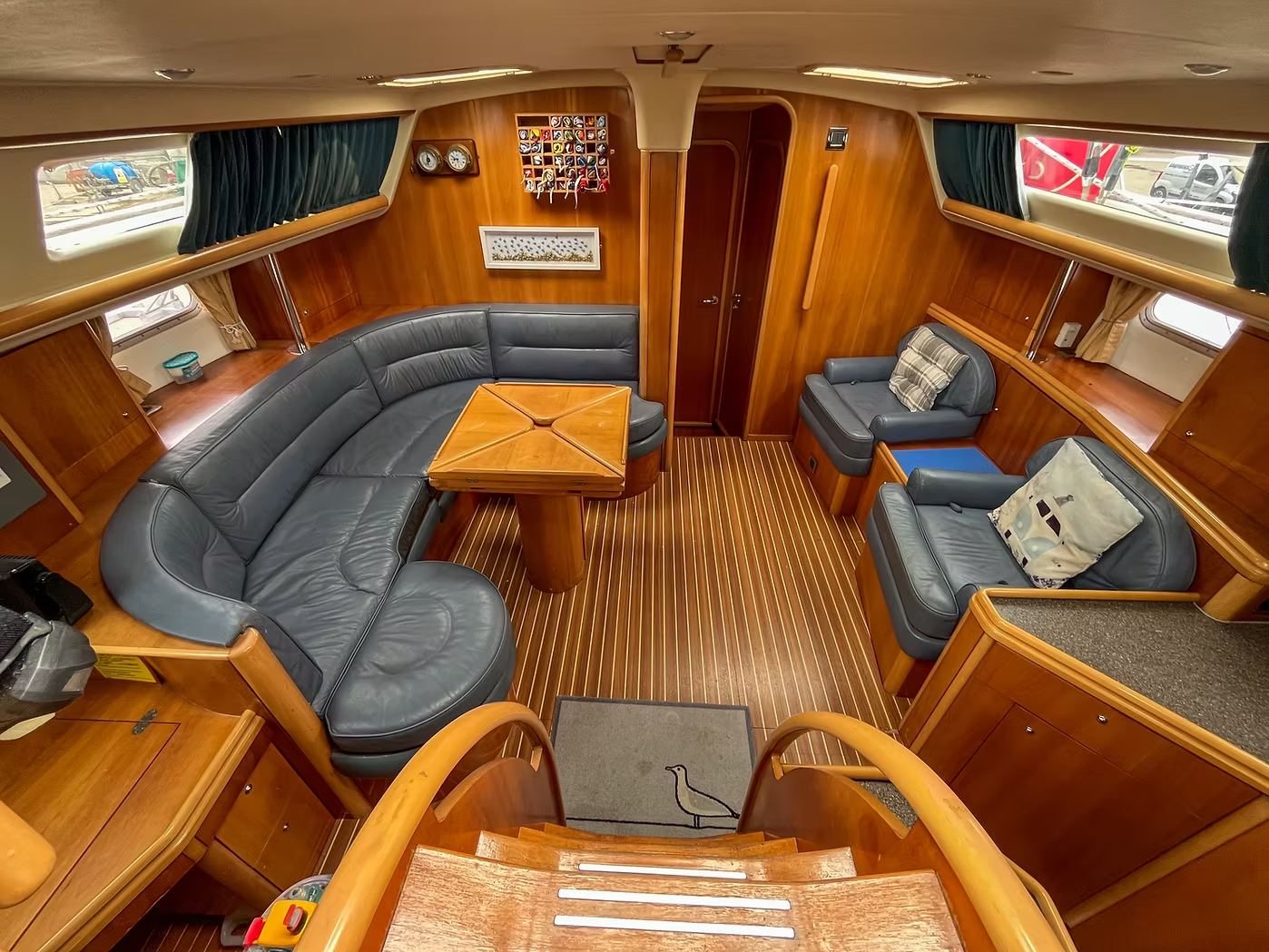
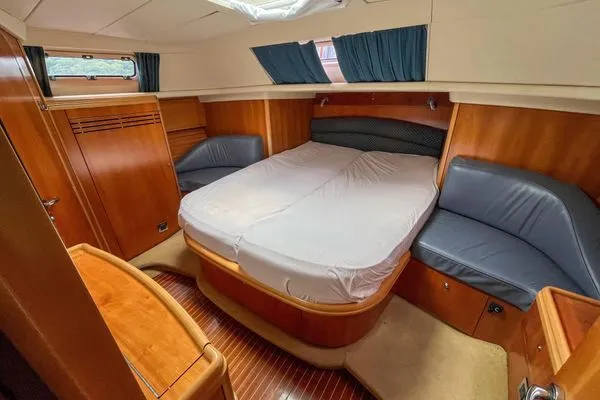
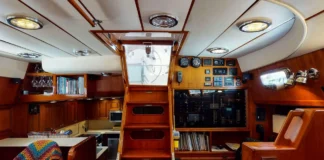
The Moody 46 CC really shines below deck. With the extra space afforded by her center cockpit, she boasts a massive aft owner’s stateroom—one of the nicest I’ve seen in a bluewater boat—featuring an island queen berth, ample storage, and ensuite head with separate shower stall. You’d be forgiven for thinking this was a vessel over 50 feet. And as you can clearly see in pictures of the Moody’s cabin, headroom is generous— averaging about 6.5 ft.—so most folks should be able to stand comfortably inside.
“One of those rare sailboats that manages to balance bluewater capability with liveaboard comfort.”
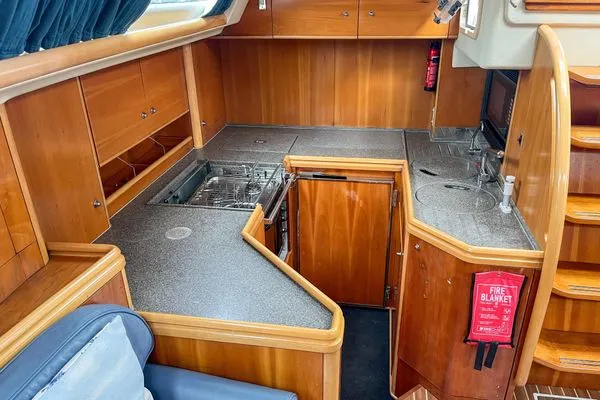
The galley is located along the walkthrough from the aft cabin, set low in the boat to facilitate cooking in rocking seas. She’s well-appointed with a gimbaled Smev 4-burner propane cooktop, front-loading Isotherm fridge, top-loading Isotherm freezer, microwave and double sink.
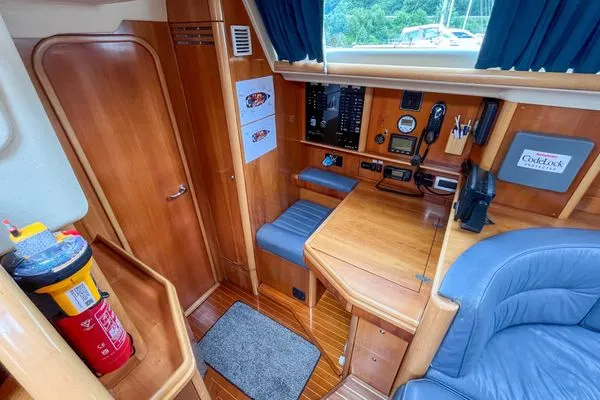
From the galley, we open out into a spacious and airy saloon—almost open concept—with wraparound seating and a proper navigation table. The front houses a guest cabin with a V-berth and second head, and most models also come with a third bunk room or office. As you would expect, fit and finish are top-quality throughout, with beautiful teak joinery, sturdy handholds, deeply fiddled countertops, heavy-duty hardware, and a traditional warmth that is often lacking in more modern production boats.
On the exterior, the Moody 46 CC sports generously wide side decks, solid stanchions, and molded nonskid surfaces that perform well in the wet. Most models feature a windlass and anchor setup suitable for extended stays at anchor, as well as stern davits and arches for solar panels and dinghies—all essential for serious liveaboarders.
Engine and Performance
The standard powerplant for a Moody 46 CC is a 75- or 100-hp Yanmar diesel, centrally mounted under the cockpit sole. Maintenance access is excellent on a boat of this size and design, with multiple access panels throughout.
Tankage is a very adequate 130 gal for fuel and 200 gal for water, ideal for bluewater and liveaboard adventures. Under power, you can expect a solid 7 to 8 knots thanks to the Moody’s efficient shape and moderate engine load.
The Keel Stud Question
Spend any time researching the Moody 46 CC online and you’re likely to come across the question of keel bolts, or to be precise, studs. These bolts use mild steel keel studs instead of the stainless steel more common today. Because mild steel corrodes faster in sea water, they’re likely to appear much worse than stainless steel bolts of the same vintage, which can be alarming to less experienced buyers and surveyors. However, in most cases, this corrosion is only cosmetic and can be wirebrushed away (don’t forget to repaint the studs afterwards). If you experience persistent stud rusting or see water squeezing out from the keel joint when the boat is resting on her keel, the problem may be serious.
The best way to confirm if Moody’s keel bolts are good (and save yourself the trouble of pulling a stud for inspection) is to get a proper marine survey. Since the Moody 46 CC was produced from 1997 to 2001, even the newest examples are over 20 years old, so a marine survey is a smart choice regardless.
“In short, get a good surveyor to inspect the Moody 46 before you buy one.”
Owner Feedback
Given that there were only 55 made, comments from Moody 46 CC owners are few and far between on the internet, but for that very reason are worth a close look. Here’s what we heard from our viewers. Your mileage may vary!
- The appearance of mild steel keel studs should be taken with a grain of salt, so to speak; chances are the studs are just fine.
- The teak decking and veneer of the Moody 46 CC should be monitored and bonded anywhere they may be delaminating (e.g. sharp bends and corners).
- The windows will likely need periodic rebedding every 10-15 years.
- The 6-hp. bow thruster may be underpowered for some sailors; consider upgrading to an 8-hp. thruster.
- The holding tank may be undersized for longer voyages.
- Aft lazarettes may leak in heavy rains if not battened down.
- Rudder post/bearing issues have been known to occur and you may need to drop the rudder for service/replacement.
- Be aware that the batteries are located under the aft bunk, so electrical cables running to the windlass will span the length of the boat and may therefore see an impactful voltage drop. Upgrading to higher voltage systems (24 V, 48 V) will ameliorate this to some degree.
- The Moody 46 CC handles heavy winds and big seas with ease.
- The center cockpit does indeed do a great job of keeping you dry in rough seas!
Conclusion
Overall, we think the Moody 46 is a fantastic liveaboard and bluewater cruiser. But given there were only 55 made, finding one could be a challenge. Thankfully, there are alternatives worth considering. Namely, the Passport 47. Same center cockpit, same price, same length. But while the Moody is undoubtedly more refined, the Passport may be a more practical voyager. We don’t think you can go wrong with either one if your dream life involves more time on the water than off.
What do you think of the Moody 46 Center Cockpit—would you buy one?
For the owners out there—have you had any issues with the keel studs?
Let us know in the comments.
And if you’re interested in seeing more center cockpit boat reviews (Passport 47, anyone?), be sure to drop that down below.
Market Scan Contact
1998 Moody 46 CC Hinds Taylor Yacht Brokers LLP
£225,000 +447557097597
Dartmouth, Devon Boats.com
2001 Moody 46 CC MGM Boats
€194,995 +353 1 280 2020
Cork, Ireland Band of Boats








would you review the Hunter 50 CC?
As I’ve commented before, when can we see a review of the Taswell 43?
If you are looking for a Moody 46, there’s also a Moody 47, which is all but the same boat. The only difference between the 46 and 47, as far as I can tell, is 6-9″ of tail above the water line. At least one Moody 47 owner was able to fit the guts of a watermaker in the space behind the headboard of the aft cabin and the swim platform. I own (second owner) one of the last 6 46’s and a friend bought one of the first 47’s, and there really was no difference in the boats. So there’s another 46 47’s out there for a total run 101 boats of this design.
One option to keep an eye out for is that later hulls are more likely to have hard dodgers installed at the factory. If you are sailing in high latitudes, it’s a real advantage to have that anchoring a cockpit enclosure.
It’s a great boat, and with the center cockpit, it feels like a smaller boat–until you get into rough water or want to go fast. We had a glorious time rounding Brooks Peninsula on the west coast of Vancouver Island–10-11 kts in a high 20’s wind and 2m seas. Felt like we were on a lake. Absolutely stable and ripping fast! (and only 5º of heel in a close reach. Wow!)
Love our Center Cockpit boats.
We own a Hylas 44.
When we were boat shopping, we boarded a Moody 46 CC. It seemed a bit moldy in the cabin and we were told that most moodys don’t focus on air movement or dorades so they are known to be a little stuffy and mold can accumulate.
But we love the look, and the fit and finish of Moody Yachts.
Great article. More please.
Would you please review the Hylas 44 CC?
Thank you