

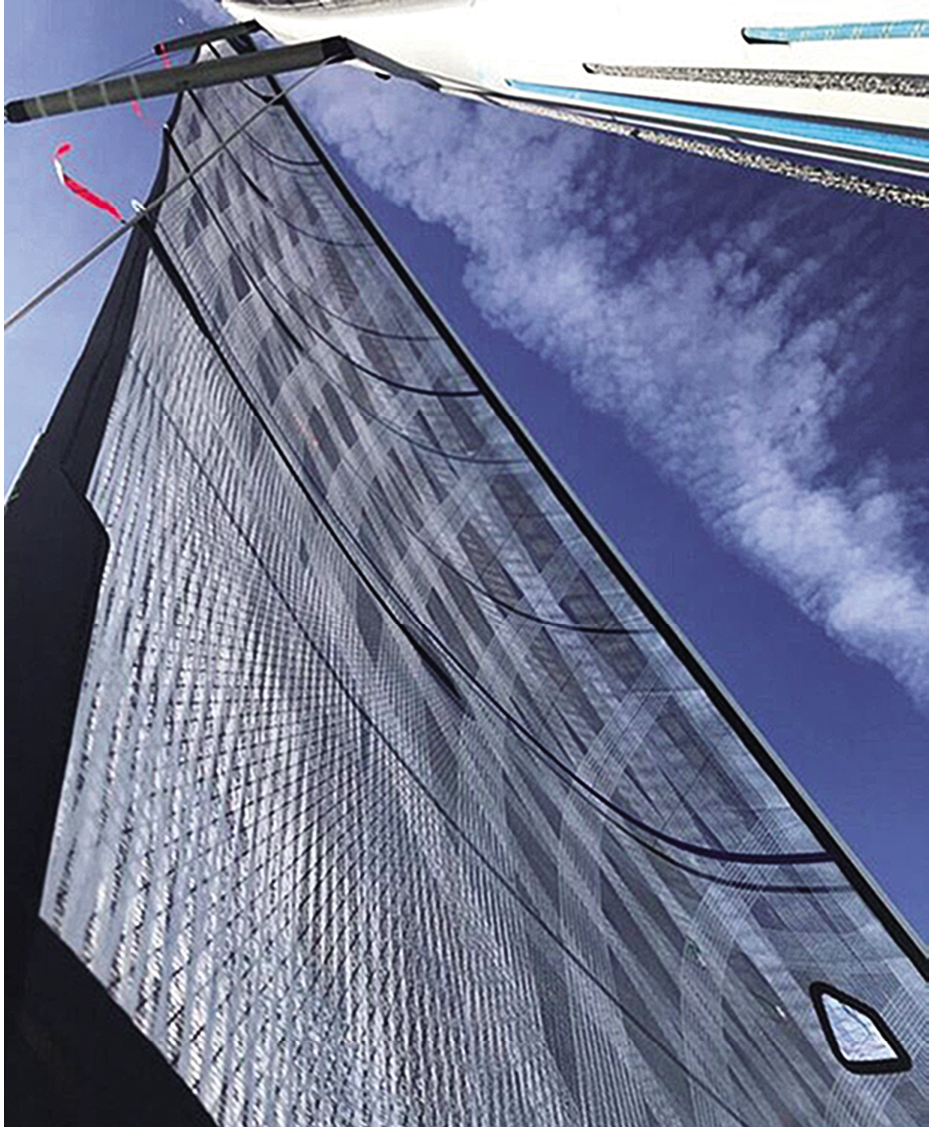
Even the most laid-back cruiser has days when they would like to get there an hour sooner. But speed is not the only reason to fine-tune sail trim. Proper sail trim can often eliminate the noise of motoring. Properly trimmed sails last longer. Also, when faced with a real blow, being able to trim like a racer, including when reefed, is basic seamanship. The trained ability to wring every ounce of performance from those sails may be all that keeps you off a lee shore or at the proper angle to the waves. Too many close calls saved by the engine can cause a sailor to assume that the auxiliary will always be there to get them out of any pickle. Learning how to drive the boat right at the edge of the performance envelope can help end this over-reliance on the engine.
Telltale Placement on the Genoa
Telltales are placed on both sides of the sail, with rows positioned at approximately 1/4, 1/2, and 3/4 of the hoist. The lowest row must be visible to the helmsperson from the helm. Avoid seams, since the telltale can hang-up. At a minimum, telltales will be placed 12 inches aft of the luff and midway between the leech and luff. If the sail is sometimes roller reefed, a whole row can be appropriate, since the relative locations change when the sail is rolled. A fat foil and a padded luff can also disturb the air flow a little, requiring the first telltale be at least 12-16 inches aft.
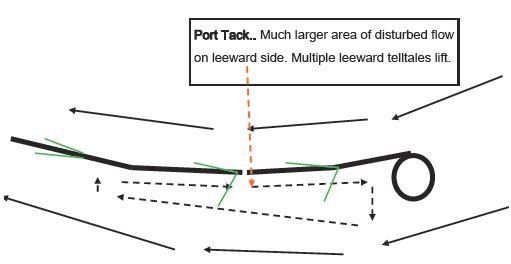
Reading Genoa Telltales By Point of Sail
Beating
All telltales should flow aft. It is acceptable for the forward telltales on the windward side to occasionally lift and for the forward part of the sail to occasionally shiver, an indication that the apparent wind is as far forward as practical.
Close Reaching
When the apparent wind is forward of the beam, all of the telltales should flow aft, indicating maximum power. Power can be reduced when sailing with wider angles by over-sheeting the sail and stalling the telltales on the lee side (they will droop), but control may suffer, particularly if the main is still properly trimmed. You can also allow excess twist, bleeding power aloft, but the sail will luff if this is taken too far, which is very hard on the cloth and the nerves. Easing the jib sheet only makes the sail too full, increasing power. A better answer is to reduce sail.
Beam and Broad-Reaching
The aft telltales may stall, particularly down low, because twist is not sufficient aloft. This is normal.
If the sail is roller-reefed, by rolling a portion of the sail around the forestay, the forward most telltale may be influenced by this bulge, particularly when it is on the lee side, trembling occasionally. So long as the next telltale aft is streaming, do not try to trim this out. The sail will also be slightly more efficient to weather when the bulge of the sail is on the windward side, traditionally the starboard tack.
Reading Mainsail Telltales
Most cruisers install telltales only on the leech. Body telltales on the windward side will always fly unless the sail is grossly undersheeted, and so are of minimal value. The leading telltale on either side may lift due to mast turbulence, which is even more disruptive than the turbulence in roller furling genoas. Telltales on the leeward side will always stream aft if the genoa is properly trimmed. The wind rushing through the slot keeps them blowing straight back—so they are useless for trimming.
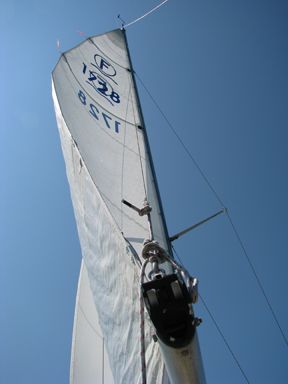
Finally, telltales on the body of the sail are subject to damage by the lazyjacks. And thus, the most important indicator is the leech telltale, which tells us whether air is leaving the leech of the mainsail cleanly, or if the sail is stalled, which will cause the telltales to suck behind the sail. The masthead wind indicator also provides important information at the masthead; the sail should be trimmed just slightly to windward of the vane angle.
Match the Twist
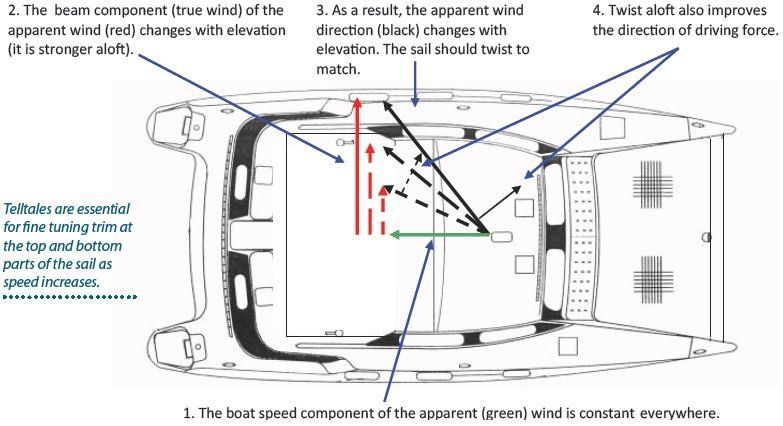
Unless the boat is sitting still, the wind at the masthead and the wind at the deck are different. Trimming the sails to match this twist maximizes power and optimizes the orientation of the lift. Telltales will show you the way.
Beating
The telltales should stream aft.
Close and Broad Reaching
The telltales should stream aft.
Running
The sail will stall and the telltales will suck behind the sail. This is normal.
Special Cases
Rotating Masts
Because of reduced mast turbulence provided by a rotating wing mast section, body telltales can be useful; however, they should be farther aft, about two feet behind the mast. Follow similar rules as for genoa telltales. Power can be lessened by reducing mast rotation (reduces draft), particularly if the mast incorporates pre-bend.
Fractional Rigs and Small Jibs
Particularly when paired with a wing mast, the mainsail becomes the main driver. Add body telltales and trim the telltales as per the genoa.
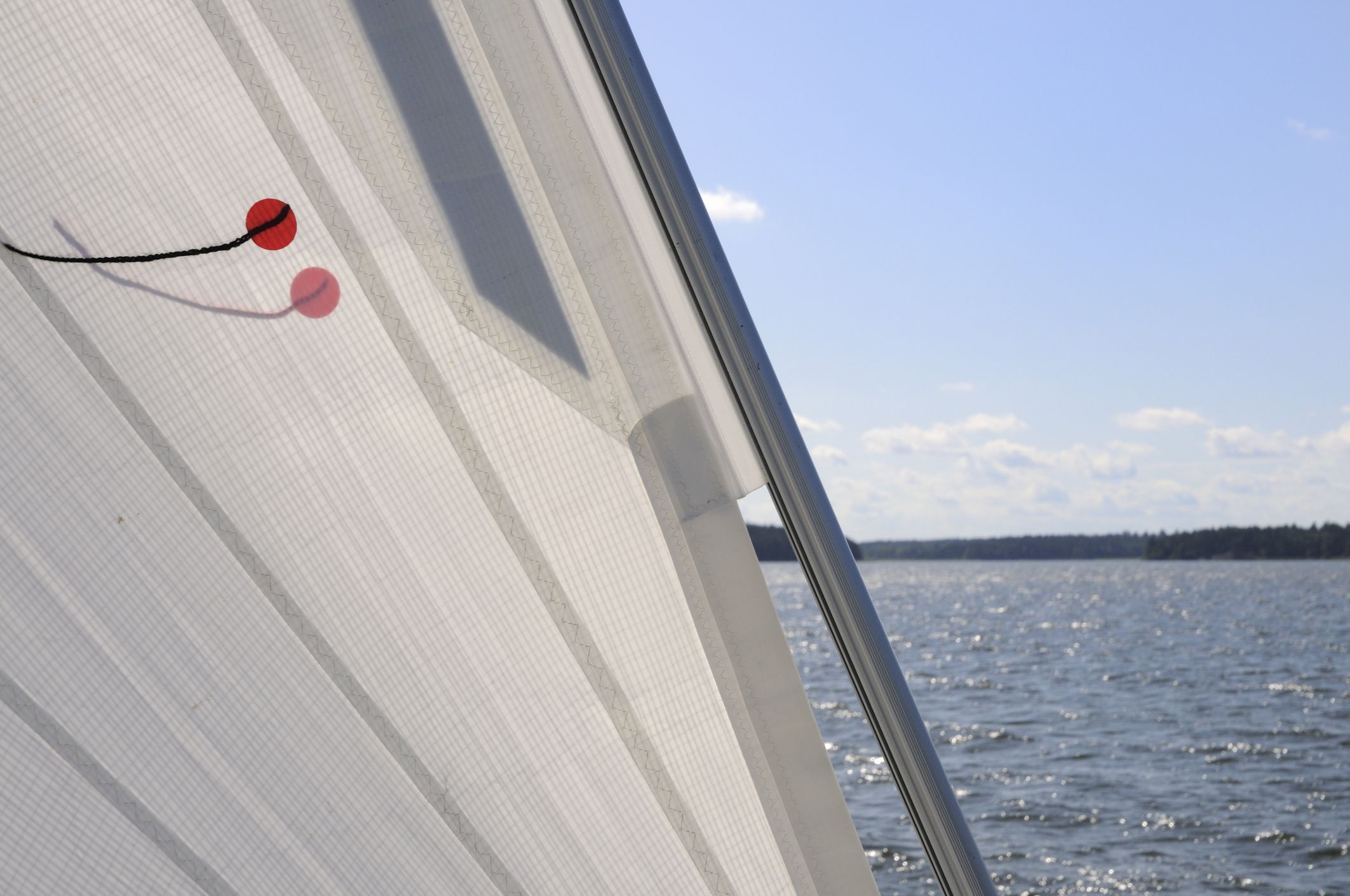
Spinnakers
Telltales are sometimes installed on spinnakers as well, though most sailors read airflow on the chute through the motion of the cloth, watching for curling at the leading edge.
Conclusion
Practice reading telltales in consistent conditions on the same tack, and work with the genoa first since the telltales are more responsive to trim adjustments. When you understand how telltales work, reading them becomes a conversation with your sails—one that informs every decision from the helm.
This article was published on 17 April 2018 and has been updated.








Dear Darrell, Your correct & informative text could read, Rotating & or Wing Mast? Also on the cat plan sketch, the apparent wind black lines, could be misleading as the mains’l, (which wouldn’t work), but people are busy, & may be confused, (I was till 2nd read, with 58 years experience, 12 main boat, & 300 pages of personal Sailing Stories). I like U’re suggestion of adjusting the furling line to get the roll of reefed heads’l, to windward for less turbulent drag to leeward. I also believe leech telltales are good on the heads’l leech, to adjust the fullness & a Barber Hauler is a great help off wind, to adjust twist & drive. THANK YOU, Darrell, for a great thought provoking article. ‘B J’.
I think there is some misunderstanding about what the lines mean. This is a high school physics or engineering 101 explanation, but not the way things are commonly presented outside of that environment.
The forward component of the wind from the motion of the boat is the same at all levels, deck to masthead. (green) Obvious.
The true wind component varies with the height above the water; the wind is much stronger at the masthead than at the deck. (red) In this example it is on the beam and the lines are of variable length. The true wind, however, is coming from the same direction at all heights, just as the boat wind is coming from forward.
The apparent wind, or what an engineer would call the resultant, is the sum of the two velocity vectors and is represented by the black lines. Both visually and mathematically, this sum can be represented by a line connecting the two vectors. To match the resulting twist of the apparent wind direction the sail must twist, the amount depending on the course. To windward, for example, the twist is much less because the true wind arrows are pointing farther aft and the resultant arrows point much closer to the same direction.
I think the quick refence box is wrong. It says:
Leeward telltales lifting = Sheet in or head up
Windward telltales lifting = Ease sheet or bear away
It should say:
Leeward telltales lifting = Ease sheet or head up
Windward telltales lifting = Sheet in or bear away
Yup. Reversed.