WipeOut Eraser vs. Mr. Clean Magic Eraser
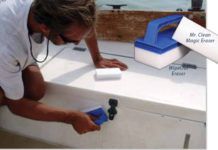
A few months ago, we noticed that our dock neighbors were cleaning their decks with spongy-looking nanofiber pads. Ditching a multitude of cleaners for one re-usable sponge was quite appealing, so a test was in order. We pitted the original Mr. Clean Magic Eraser from Proctor & Gamble against the WipeOut Eraser made by Ralph Perez. These rectangular, nanofiber pads resemble sponges but they don’t require added cleaner, and both use a unique cleaning action to lift and trap dirt. We used them to clean dirty gelcoat and nonskid, and to tackle the waterline, rust stains, and scuffs on our test boat.
Clean Bottom, Fast Bottom
Determining how much faster a boat can sail with one paint versus another would be difficult as the prep and application of both paints would have to be identical, as would test conditions, in order to have a fair trial. None of the antifouling manufacturers we spoke with are aware of any documented head-to-head speed tests of paints.
Mailport: February 2012
Letters to Practical Sailor, February 2012. This month's letters cover subjects such as: Engine-Free, Titanium, Sabre Solace Twin, and More!
Where Credit is Due: February 2012
Letters to Practical Sailor, January 2012. This month's letters cover subjects such as: West Marine/Navico Reps, Raymarine, Garhauer Marine, and More!

A Toast to Ziggy the Iguana
Ordinarily, we don't enlist animal subjects for our testing at Practical Sailor, but our report of odor-eating chemicals this month called for special measures. Ziggy the iguana stepped up to the plate, and I can assure you he was well treated throughout the process. I had hoped to feature his photo here so that you might admire his healthy green complexion, but he was a bit camera shy, and I couldnt bring myself to use a photo of just any old iguana.
Traction in Action: PS Tests DIY Nonskid Options
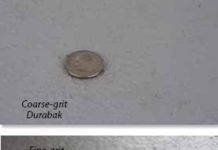
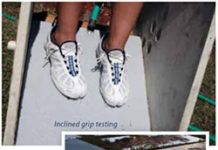
Boat owners looking to put some stick back into a slip-and-slide deck have a few options: apply a deck paint with a nonskid additive or glue sections of specialized nonskid mat to the deck. Choosing which type of nonskid is the right one for your boat makeover is a balancing act between aesthetic taste, traction needs, and budget. Practical Sailor tested 11 commercially available nonskid options that the average boat owner can easily apply: one paint with no filler media, five paints ready mixed with nonskid compounds, three nonskid additives that testers mixed with two-part topside paints, and two nonskid mats (one is self-adhesive, and one is glued on with an epoxy). All of the products can be applied to fiberglass, wood, or metal. Manufacturers included Pettit (Kop- Coat), Epifanes, AkzoNobel (Interlux and Awlgrip), West Marine, Pachena (KiwiGrip), Durabak, Tiflex (Treadmaster), and SeaDek. Using some creative bench tests, we evaluated how much traction, grip, and drag resistance each offered; we also rated how easy the products were to apply, how uniform the grit was, and how easy they were to clean.
Slippin’ and Slidin
A good DIY nonskid offers effective traction (obviously) and is easy to apply, easy to clean, durable, and gentle enough on knees and elbows that a foredeck monkey won’t leave blood stains behind. Testers focused on these criteria during bench testing, and when considering final ratings, we weighed the results according to their importance. For example, a product that had great grip but was hard to clean rated better overall than one that was easy to clean but offered no traction. This was a fairly close race, so we used a plus-minus system in the ratings (see accompanying Value Guide)—something we don’t often do—as every point mattered.
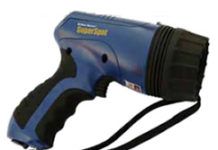
Testers Search for an All-star LED Spotlight
With numerous types of spotlights flooding the market, Practical Sailor testers narrowed the test field to seven LED spotlights from manufacturers that have done well in our past tests: West Marine, Sirius, Coleman, Brinkmann, and Streamlight. Prices ranged from $50 to $150, and all but one test light had a rechargeable battery. The evaluation focused on several key criteria in choosing the best spotlight: ergonomics, beam pattern, beam luminance, beam effectiveness at a distance, and service time (how long to half strength and how long to recharge).
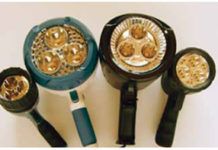
Testers Check Beam Patterns and Illumination
Testers evaluated a number of spotlight features. Although some points such as ergonomics involved a small degree of subjectivity, features such as brightness carried much heavier weighting in the final ratings. Here is what we looked at: Ergonomics. Some models merely have an on–off switch; others add one or two controls to change power, or activate a strobe feature, or turn on a red beam. There were, however, as many configurations of use and meaning of the switches as there were spotlights. Testers concentrated on how these are used: Is one–hand operation possible? Are the controls logically placed? Do they snap into position, providing satisfying feedback? Can the light be turned on by accident, possibly leading to a depleted battery?
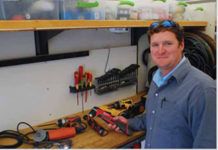
What’s In the Practical Sailor Toolbag?
Formerly the manager of a full-service boat yard, Practical Sailor Technical Editor Ralph Naranjo offers a survey of the tools he can’t live without. His toolbag is chocked full, and a peek inside finds saws, trimmers, planers, grinders, belt sanders, multi-tasking power tools, and drivers. His tool inventory—comprising top-of-the-line power tools and tried-and-proven devices, is one that enables him to handle most any boat project. If you’re looking to fill in you’re the gaps in your tool lineup or to stock your workshop, be sure to check out this special report.

Performance Sailing – Beneteau First 44 Review
The Beneteau First 44 Performance is not just another modern cruiser. In this Practical Sailor boat tour, we take a close look at the...

Latest Sailboat Reviews
Tartan 395 Boat Review
Co-founded by Charlie Britton in the early 1960s, Tartan Yachts was established on the shores of Lake Erie in Grand River, Ohio. The original...