
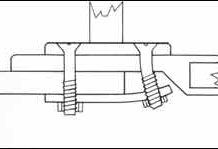
A Better Way to Mount Hardware
Improperly mounted stanchion and pulpit bases are a major cause of gelcoat cracks in the deck radiating from the attached hardware. The cracks are usually the result of unequally stressed mounting fastenings or inadequate underdeck distribution of hardware loads. Frequently, a boat is received from the builder with local cracks already developed. Once the deck gets dirty enough, these minute cracks start to show up as tiny spider webs slightly darker than the surrounding deck gelcoat While repairing these cracks is a fairly difficult cosmetic fix, the underlying problem — poor mounting — is fairly easy to correct in most cases.
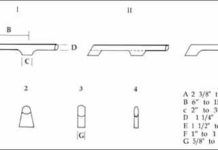
Design For: Building Your Own Handrails
One of the most used and easily made items of safety gear on boats is the handrail. Rare is the boat which shouldn't have handrails along the major portion of either side of the cabin top, and also down the centerline of the deck. Belowdecks, handrails are also important for safety. They are usually mounted on the cabin overhead, parallel to and on either side of the boat's centerline. To simplify mounting, the most desirable position is under the rails on deck. That way a single set of bolts can serve to fasten both rails.
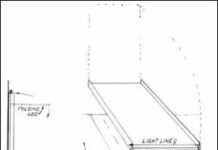
“Good Hope’s” Folding Fiddles
In a rare instance of getting to have your cake and eat it too, this design for folding fiddles affords sturdy permanent fiddles suited to the typical folding cabin table found on boats under 35', while avoiding some drawbacks of many fiddle arrangements. It has the advantage that the fiddles are always attached to the table; they do not have to be removed when the table is folded up against the bulkhead. In addition, the fiddles can be folded out of the way when the table is in use, making the table more useful for dining in harbor, when the protection of fiddles isn't usually necessary.
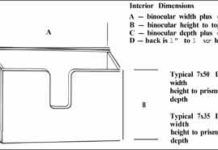
Design For: Box for Binoculars
One of the primary causes of ruin for many pairs of binoculars is that they have no home. Loose in the cockpit, or sharing a coaming locker with winch handles — their usual places — it's no wonder so many pairs die of drowning or having their prisms knocked out of alignment. It's all well and good advice to always keep binoculars in their carrying case snugly stowed in a safe place, but in practice they're in such frequent use that the advice is unrealistic. What is needed is a snug home which is both protected and accessible. A binocular box mounted just inside the companionway answers all requirements. It keeps the glasses both protected and easy to get at.
Improve Your Catalina 30: Upgrading the World’s Most Popular 30-Footer
The Catalina 30 is a remarkable success story. We suspect that more Catalina 30s have been built than any other boat of that size anywhere in the world. While the basic boat has remained unchanged since it was introduced in 1975, there have been dozens, perhaps even hundreds, of minor developments in the boat in the course of a production run that is approaching 4,000 hulls. The advantage of a boat in production for so long is a high degree of product refinement over the years. The challenge for the owner of an early version of the boat is to upgrade his boat to the standards of models currently in production.
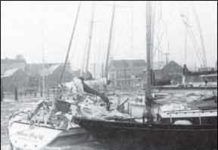
How To Help Your Boat Survive A Major Storm
Hurricane Gloria was a most impolite lady. She barreled up the Atlantic coast, scaring the heck out of people from Florida to Massachusetts. Despite the fact that the storm didn’t live up to its billing, hundreds of boats in New York, Connecticut, Rhode Island, and Massachusetts were destroyed or severely damaged. In some cases, the boats were lost through no fault of the owner. No amount of preparation will save your boat if another boat drags down on it in the middle of a hurricane. In other cases, however, lack of proper preparation was a major cause of a damaged boat. There’s no excuse for that type of loss.

Mailport: May 2011
Letters to Practical Sailor, May 2011. This month's letters cover subjects such as: Practial Heads, Anchor Lockers, Handheld Vacs, and more!
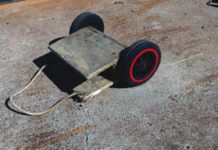
How To Make a Dinghy Roller for Less Than $25
Making a portable set of dinghy wheels is relatively simple and inexpensive. Reader (and PS contributor) David Liscio sent us the following DIY how-to on dinghy-roller making, a timely Reader Workbench as we’ll be reviewing dinghy wheels in an upcoming issue. Email us your DIY project ideas at [email protected].

Where Credit is Due: May 2011
Letters to Practical Sailor, May 2011. This month's letters cover subjects such as: BoatU.S. Insurance, Marinco, Rigging and More!
Chandlery: May 2011
Hydro-powered hull scrubber takes slime off but not barnacles. Bottom-scrubbing is definitely one of our least favorite boat chores. And because the warm Florida waters are the perfect nursery for hull-fouling slime and barnacles, we’re always on the lookout for products that will make the never-ending hull cleaning more bearable. That quest recently led us to try the Subscrub, a device that allows users to clean their boat hulls without hauling out or going for a…

Performance Sailing – Beneteau First 44 Review
The Beneteau First 44 Performance is not just another modern cruiser. In this Practical Sailor boat tour, we take a close look at the...



Latest Sailboat Reviews
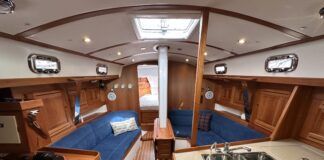
Tartan 395 Boat Review
Co-founded by Charlie Britton in the early 1960s, Tartan Yachts was established on the shores of Lake Erie in Grand River, Ohio. The original...