









Marking Lines for Safe Sailing
Boats sail better when rode, docklines, running rigging, and sail control lines are properly adjusted, and many lines are easier to adjust if common positions are marked.
Deck-level Wind Vanes
There are two primary wind indicators on a sailboat. First, we watch the sails. Sailing to windward we watch the jib for luffing and for flow on telltales.
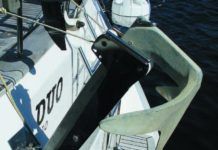
Selecting a Stern Anchor
I have a 30-foot sailboat and I was considering keeping an emergency anchor ready to lower quickly as a temporary way to stop drifting in case the engine failed. I have limited mobility so it should be close at hand.

Overheating Ropes
We have a love-hate relationship with nylon rope. When it comes to absorbing shock, it offers the best available combination of strength, elasticity, and economy. On the downside, it is sensitive to UV, abrasion when wet, has a low working load limit, and is weakened over time by internal wear.
Cam Cleat Wisdom
Sailing is all about pulling and securing strings. For infrequent securing, a horn cleat works fine. Others are constantly tweaked and require something more responsive. Cam cleats have become the go-to tool when we need easy adjustment or instant release. But for the cam cleat to work as intended, an often overlooked component comes into the picture-the fairlead. Before you replace or add new cam cleats, consider the following fairlead options

Adding a Polyester Cover to Dyneema Single Braid
Extremely low friction allows Amsteel and other high molecular weight polyethylene (HMPE) lines to run like lightening through low friction rings. Unfortunately, they also run right through cleats, jammers, and your hands. If a jammer did hold-and it wont-the load would probably exceed the capacity of any device that matched the lines tiny size.
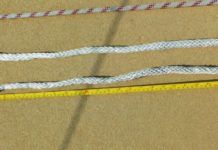
Splice Failure Linked to Fatality
On the 4th of September 2015, Andrew Ashman was killed during an accidental jibe, when the boom delivered a fatal injury to the base of his neck. The boat, CV21 Ichor Coal, had been running in strong conditions, and yawing allowed the wind to get on the wrong side of the mainsail, as occasionally happens. A preventer was rigged, but a strop securing a low friction ring turning block near the bow failed, allowing the boom to cross the cockpit unrestrained. On such highly engineered boats, how did this happen?
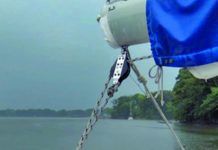
A Sure Way to Secure the Boom
When the wind really blows, the pleasant chiming of a marina takes on a different character. Above the howling of the wind is the Devils Tattoo, the racket of one hundred poorly-secured halyards hammering against aluminum. Booms creak from side-to-side, and some pound against stays. Workers are distracted and anyone living aboard wishes his neighbors had taken a few small steps to preserve the peace, not to mention their rig.
Making Sail Repairs Last
Polyester has long been the workhorse sail fabric; durable, easy to sew and handle, and relatively stretch resistant. It is also relatively easier to repair (see Sail Repair Tapes vs. Glues, PS November 2017). Racers needed something that was lighter and held an aerodynamic shape better, and so laminate sails were born, using Mylar films and non-stretch fibers such as carbon and Kevlar.

Long-term Clear Vinyl Protection
When the clear vinyl on one of our multihull test boats began to crack and fade after approximately 10 years, the costs estimates for window replacement began at around $1,500. Thus began our investigation into ways to prolong the life of clear plastics. In previous issues weve reported findings at the six-month and two-year marks. Here, we present a last look at products and best practices to preserve clear plastics, and the five-year performance of four popular types of clear plastic in the marine environment.

Why Is This 46 Foot Sailboat So Cheap? Hunter 460 Review
Is the Hunter 460 really one of the best-value cruising sailboats on the used market? In this video, we take a deep, honest look...


Latest Sailboat Review

Irwin Citation 38 Used Boat Review
As the largest of the Citations, the Irwin Citation 38 is probably the best looking, handling the high-sidedness better than her smaller sisters. The boat has three windows set in the sheer stripe on each side, so they are not very noticeable. Like the other Citations it is distinctly modern-looking not pretty, but not ugly either.