









Sail Repair Tapes vs. Glues
Sail repairs are a fact of life for the sailor. A stray cotter pin can shred a spinnaker. Perhaps the mainsail luff could use some chafe protection, or the genoa sun cover is flapping. Often, a trip to the sailmaker isn't justified for these repairs. The sail is too old to take stitching without further weakening the material, or you simply want to delay that repair until the end of the season. Perhaps youre on a cruise and would rather wait. A sewn repair is generally the gold standard, but some tears better-fixed with a patch.

The DIY Sail Repair Kit
If youre going to sail youll be doing some stitching. No two ways about it. Dont jump into the $100 do-everything kit. Start with a modest kit, adding tools and materials only as your skills grow and projects require them. You already have most of what you need in your other supply lockers or tool boxes. Study a good book on sail and canvas repair, concoct a few small projects for practice.

Short Scope Anchor Test
In the process of our ongoing investigation on the effect of time and wind gusts on anchor setting and holding capacity, we performed limited testing at short scope and couldnt help but notice that holding capacity at short scope varied greatly. When recovering the test anchors, some anchors would lift out of the bottom while we were pulling the dinghy over to them, while others required heroic efforts even when the rode was nearly vertical.
Stopping Anchor Chain Twist
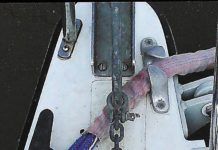
When an anchored boat spins, the anchor chain twists, and the anchor can come up backward. One solution is an anchor swivel, but failures with some poor designs are a concern-a lovely stainless swivel on one of our test boats had an interior crack that became visible only when disassembled. And as we found in our most recent test, many swivels arent very effective at reducing twist due to the inherent friction in the swivel.(see How Well Do Swivels Reduce Twist, Practical Sailor March 2016 online).

Setting an Anchor in a Small Boat
In our ongoing study of ways to compare, and hopefully improve the way our anchors set, weve learned that it takes time and slow, delayed setting to make best advantage of very soft mud. However, firm sand and weeds can have the opposite character-making it hard for the anchor to penetrate.
Essential Sailing Gear that Lasts
Our long-term testing at Practical Sailor may have the initial appeal of a tortoise race, but things do heat up at the finish line. The following conclusions stem from a decades, and in some cases, an even longer period of observation. In this round of field test feedback, I focus on hardware, cordage, fabrics and coatings plus two pieces of essential equipment that have kept my Ericson 41 Wind Shadow ready for sea as she enters her 50th year.

Custom-Made Hard Top Biminis
I was wondering if there is any information regarding the protocol for replacing canvas with a rigid Bimini/dodger on a small 36-foot catamaran. I could not find a review of solid Bimini replacements. We have strong stainless steel frames. They are fixed with metal struts with no flexible straps. I do want to be able to see the sails from the helm and bulkhead mount. I want to be able to take advantage of roll up clear plastic front and side curtains. Most summers my current set stays in the rolled up position. They have since shrunk enough that they can no longer be fully snapped.
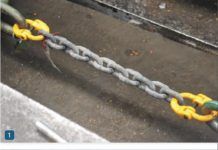
Regalvanizing G70 Chain
As high tensile G70 chain becomes more prevalent in the marine market, Practical Sailor has been busy testing the limits of this material, which has been used for many years in other industries. One question we have raised in the past is whether G70 chain can be safely regalvanized (see PS June 2014, Making Sense of Marine Chain Standards). Chain is expensive and regalvanizing helps to extend its life. If G70 chain can't be regalvanized, as we have suggested in the past, this needs to be factored into the initial cost.
Fixing Tears in Sunbrella Boat Canvas
Sooner or later, chafe, UV rays, and sharp edges take their toll on our canvas. A misplaced screw or simple friction will eat holes in a dodger. A seam gives up, a boom rubs through the fabric, and a few snaps come loose.
Using a Jordan Series Drogue for Steering
Thanks for this discussion of using drogues for controlling a boat with a rudder lost or jammed over (see Sailing Without a Rudder, Practical Sailor, April 2017). I carry a Jordan Series Drogue (JSD), and I think that by bridling it somewhere in the middle, such that some of the cones open to resist water flow, and some are collapsed one could adjust the amount of drag that was appropriate for the conditions. Have you considered testing this?

Why Is This 46 Foot Sailboat So Cheap? Hunter 460 Review
Is the Hunter 460 really one of the best-value cruising sailboats on the used market? In this video, we take a deep, honest look...


Latest Sailboat Review

Irwin Citation 38 Used Boat Review
As the largest of the Citations, the Irwin Citation 38 is probably the best looking, handling the high-sidedness better than her smaller sisters. The boat has three windows set in the sheer stripe on each side, so they are not very noticeable. Like the other Citations it is distinctly modern-looking not pretty, but not ugly either.