

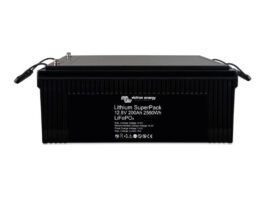

Bilge Pump Basics to Keep Your Boat Afloat
Our research into bilge pumps and associated equipment stretches back several decades with the most recent bilge pump tests taking place in 2010 (See PS September 2010, and October 2010 online). When selecting a pump, keep in mind that sailboats rarely meet the ideal flow rate.

How to Measure Boat Humidity: Psychrometric Charts Do It Right
Insulation is a greater energy-saving expedient; if our heater or air conditioner is undersized, fixing drafts, shading or insulating windows, and insulating non-cored laminate are all ways to reduce the thermal load. For boaters, however, that is only half of the equation.
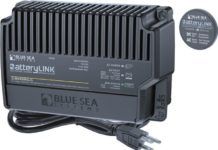
Blue Seas New Smart Charger
Keeping batteries fully charged is a science that cruisers have to master sooner or later. If todays high-capacity AGM batteries arent managed properly, valuable amp hours in can permanently trickle away through sulfation, as we saw in our test of AGM batteries (See Fighting Sulfation in AGMs, PS May 2015). Good battery management means complete re-charging that matches the charging profile of your battery, and this means an accurate sensing of battery voltage. As we saw in our recent report on battery monitors (see Best Battery Monitor Test Update, PS October 2017) a good monitor will also keep track of temperature, as this can be a limiting factor in charge acceptance rate.

Tohatsus Propane Engine Ups the Ante
Just as we were wrapping up our small outboard test, Tohatsu introduced a 5 horsepower LPG motor into the mix. The new model competes squarely with the propane motors from Lehr that have been on the market since 2012 (see New Options in Small Outboards, PS January 2016.)
Towing Generator Field Report
For free power when under sail on ocean passages, towing generators are hard to beat. In the early 1980s I purchased a first generation towing generator from Hamilton Ferris. At six knots the output was five amps providing all the electricity I needed on passage. During 15 years and 100,000 miles of use I only needed to replace brushes and bearings twice.
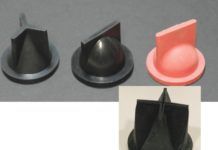
Marine Toilet Tech: A New Joker Valve
Joker valves are no joke for us. Weve spent far too many hours tackling what has to be one of the least favorite tasks of sailor-dom-the cleaning and rebuilding of the marine head. Situated at the toilet outlet, the joker is the infamous valve between what you want in the toilet bowl (odorless clear water) and what you want out (the other stuff). It never seems to work right and requires the sort of lavish attention wed rather save for our beloved. The most common problem is that the valve stiffens with lime deposits and remains open, allowing holding tank odors to permeate back into the cabin. When we heard Thetford had come up with yet another iteration of the infamous valve, we were intrigued.
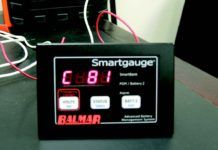
12-volt Battery Gauge Testing
Our test gear comprised a ProMariner ProNautic 12-40P battery charger; West Marine-branded, flooded-cell, deep-cycle battery with a 75-amp hour rating; and two 120-volt, 70-watt incandescent light bulbs powered through a Heart 140-watt DC to AC inverter. This setup created a 12-amp DC load on the battery. We confirmed voltage and current draw using a Fluke Model 867B graphical meter and a Blue Sea Systems Model 8110-amp clamp/multimeter.

Rebuilding a Water-Damaged Torqeedo Motor
Were been following the Torqeedo portable electric outboard since our first test of the Travel 801 in 2008. Since then, weve put two of these motors into long-term service on test boats. Both are still operating with no major problems, but we have received a few reports from disappointed owners. PS reader John Poindexter, a retired naval officer who sails on the Chesapeake Bay, sent us an account of his experience with the Torqeedo.
Plastic Through-hull Warning
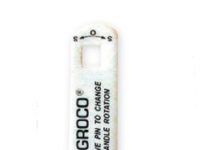
Cracked nylon thru-hulls are a common problem, as a walk in almost any boatyard will bear out. Unlike fittings constructed of industry approved materials (bronze, Marelon, etc.) nylon thru-hulls are not recommended for use at or below the waterline. Age often plays a factor in the failure of nylon thru-hulls, but ultraviolet light is the main culprit. While different brands vary widely in their susceptibility to UV damage, some are so poorly made they can fail within the first year of use. The stress placed on the thru-hull by an unsupported hose can also cause failure, with the weight of the hose acting like a lever as the boat bounces around while underway.
Dealing with Bad Diesel
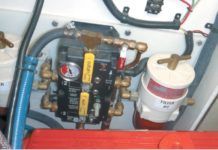
About this time of year, many of our readers will experience a gradual loss of engine power, maybe even a complete shut down. Theyll pull the filters and find them so clogged youd think the last fill-up was a spinach smoothie.

O’Day 40 – A Budget Cruiser for the Bahamas
The O’Day 40 (1986) is one of those cruising sailboats that somehow slipped through the cracks of sailing history. Built during the final years...



Latest Sailboat Review
Island Packet Estero Used Boat Review
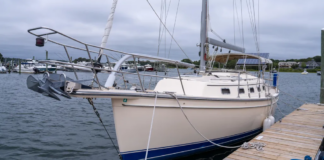
Florida-based Island Packet targets a relatively narrow niche, so the toughest competitors to its new boats are often older Island Packets. Introduced in 2010, the 36-foot, shoal-draft Estero is the company’s latest attempt to introduce a distinctive model that doesn’t stray too far from the company’s proven formula for success: moderate displacement, full-keel cruisers designed to be lived on, sailed far and in comfort, and endure the bumps, scrapes, and storms that cruising boats inevitably encounter. After sailing the Estero on Florida’s Sarasota Bay and inspecting its interior, construction, and systems, Practical Sailor testers noted that the shoal-water cruiser will appeal strongest to Island Packet fans who’ve been waiting for a shoal-draft, easy-to-sail boat that compares to the IP37 in terms of interior space. These strengths will be most apparent on intracoastal or riverine adventures like the Great Loop.