


Long-term Test Gear Updates
Many of Practical Sailors tests move from the lab (workshop/garage/driveway) to our fleet of test boats, where we can evaluate the top products in real-world conditions over the long haul. These long-term tests can last from two to 10 years, and we try to offer occasional updates on their status, when its warranted.

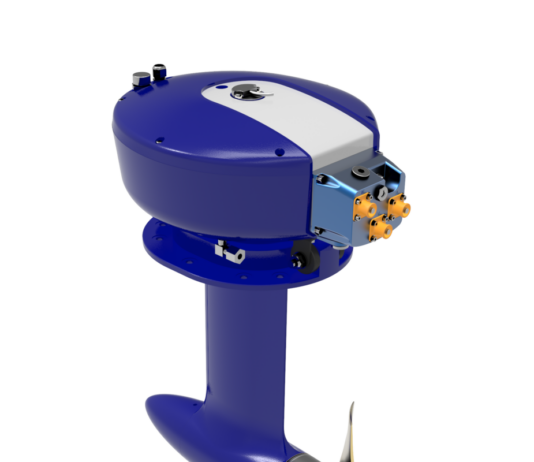
New Options in Small Outboards
Propulsion has long been lingering high on the list of priorities for our trailerable test boat, the Catalina 22 Lil Spitfire. Our first instinct was to go used. We scoured the Internet for a rugged two-stroke like the old Johnson 9.9-horsepower Sailmaster (with electric start) that we loved (and hated) back in the 1980s, but each one was broken or missing a rare part. Although there are still plenty of aficionados who enjoy resurrecting these old engines-Lee Roy Wisner has a website dedicated to the motors, www.leeroysramblings.com-a disheartening glance at our calendar showed no time for messing about with and old blue-smoker. We poked around for a newer motor.

West Marine Oil Changer
Changing the oil in a car is easy. On a boat, the engine is generally buried in the bilge and draining is awkward or impossible. Even outboard-powered boats (like our test boat, a 34-foot-long, 16-foot-wide catamaran) can be a oil-changing challenge. For these boats, changing the oil by sucking it through the dipstick hole is an effective solution.
Playing it Safe with LPG Heat
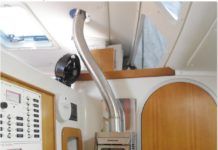
Unlike many sailors, Practical Sailor contributor Drew Fryes version of sailing occurs in any weather where the water isn't frozen. So when his family purchased a used PDQ 32 catamaran six years ago, one of the first items on the To-Buy list was a cabin heater.
Taking the Spill Out of Fill-ups
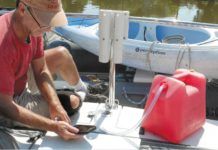
Fueling a boat has never been as easy as fueling a car. Spills-exacerbated by poorly designed fill pipes and vents-are common. The U.S. Environmental Protection Agency (EPA) has updated the fill and vent requirements on boats to prevent these spills, but they only apply to new gasoline-powered boats. New jerry cans designed to prevent spills and comply with new emission standards arent making things easier. Most are hard to control and slow during filling, spill prone, and break after limited use.
Additives vs. Gum, Sludge
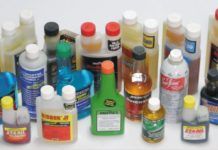
If we used our boats like the family car, back and forth to work each day, fuel would never sit for more than a few weeks and it would never age. Instead, boats sit for weeks at a time in-season, and for months during the off-season. Water, oxygen, bacteria, metal ions, and even instabilities in the molecules themselves combine to turn fresh fuel into a soup that will clog filters, corrode fuel systems, and leave us stranded. Fuel refineries have long known this, and all products are dosed with inhibitors at the refinery; however, these dosages are calculated for the normal distribution and storage times, not half-full tanks that will sit for months or even years.
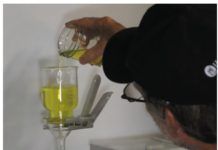
Testing Boat Fuel Stability in Diesel and Gasoline
We followed standard test methods for storage stability. Diesel was tested using ASTM method D 4625, Standard Test Method for Middle Distillate Fuel Storage Stability at 43C. Samples were exposed to air for up to two years at 113 degrees (45 degrees Celsius); each day simulated about four days of real-world storage, according to industry experience. We settled on 8 months of exposure, the equivalent of about three years. At the end of each period, samples were filtered, and the insoluble solids weighed.
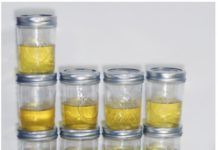
Reduce Gasoline Evaporation in Boats with These Tips
Sometimes it is not what has been added to your fuel that matters, but what is missing. The most obvious difference between gasoline and diesel during our vented, fuel-aging tests was that gasoline samples evaporated and required replenishment at the mid-way point; diesel samples did not. Studies by BoatUS and the U.S. Environmental Protection Agency (EPA) have shown that anywhere between 5 and 20 percent of the contents of a portable or installed polyethylene gas tank can vanish in one year through evaporation and permeation. The remaining fuel is lower in octane, contains fewer of the volatiles that are so essential for easy starting, and has reduced solvency for gum and varnish. It often looks perfectly good-most of our samples did-but it is perfectly rotten and potentially harmful as fuel.
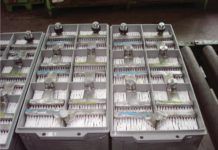
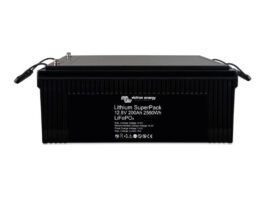
AGM Batteries Test Update
In our recent test of absorbed glass mat (AGM) batteries, we cycled five different batteries through 30 deep cycles to 11.7 volts but only partially recharged them for one hour after each discharge cycle at a charge rate of 46 percent of battery amp-hour capacity. (See PS May 2015 online.) The object of the exercise was to demonstrate just how quickly sulfation, which is caused by keeping a battery in a partial state charge (PSOC), can reduce the capacity and eventually permanently ruin a good battery.
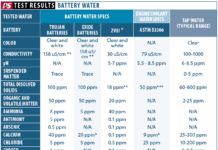
Watering Batteries
Our May 2015 report on absorbed glass mat (AGM) batteries got us thinking about wet cell-batteries. While it is easy to find distilled water suitable for topping off the battery electrolyte in the U.S., what happens when we are not near a reliable supply? Are there any substitutes? What should we avoid?

Small Boat, Big Keel Why This 27 Footer Works
What makes a small sailboat truly seaworthy? In this video, we take a deep dive into the Pacific Seacraft Orion 27, a rugged, long-keel...



Latest Sailboat Review
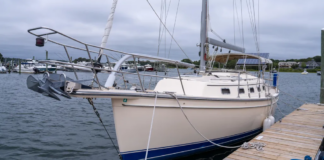
Island Packet Estero Used Boat Review
Florida-based Island Packet targets a relatively narrow niche, so the toughest competitors to its new boats are often older Island Packets. Introduced in 2010, the 36-foot, shoal-draft Estero is the company’s latest attempt to introduce a distinctive model that doesn’t stray too far from the company’s proven formula for success: moderate displacement, full-keel cruisers designed to be lived on, sailed far and in comfort, and endure the bumps, scrapes, and storms that cruising boats inevitably encounter. After sailing the Estero on Florida’s Sarasota Bay and inspecting its interior, construction, and systems, Practical Sailor testers noted that the shoal-water cruiser will appeal strongest to Island Packet fans who’ve been waiting for a shoal-draft, easy-to-sail boat that compares to the IP37 in terms of interior space. These strengths will be most apparent on intracoastal or riverine adventures like the Great Loop.