


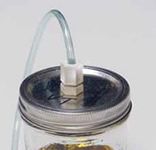
Testers Tinker with Tinker Bell-sized Fuel Tank
If you really must know how we compared the fuel additives, here are the particulars.

PS’s Best Practices to Combat Fuel Problems
Additives can’t solve real gasoline-quality problems. At best, consider additives to be only a final tweaking opportunity, something to supplement the following fuel management practices.
PSs Best Practices to Combat Fuel Problems
Additives can’t solve real gasoline-quality problems. At best, consider additives to be only a final tweaking opportunity, something to supplement the following fuel management practices.
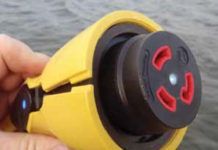
Marinco’s Shorepower Solution
We’ve seen a slew of new shorepower cords, plugs, and accessories coming onto the market in recent years, and with good reason. The majority of AC-related onboard electrical fires occur at the vessel’s shorepower inlet. The twist-lock connector used in shorepower cords and at the boat outlet has been around since the 1930s, and the design has seen little updating to make it better suited for use in the marine environment. The electrical contacts are small, exposed to the elements, and often required to support the plug and cord, all factors that beget corrosion and loose connectors, which can lead to electrical arcing, overheating, and fire.
Marincos Shorepower Solution
We’ve seen a slew of new shorepower cords, plugs, and accessories coming onto the market in recent years, and with good reason. The majority of AC-related onboard electrical fires occur at the vessel’s shorepower inlet. The twist-lock connector used in shorepower cords and at the boat outlet has been around since the 1930s, and the design has seen little updating to make it better suited for use in the marine environment. The electrical contacts are small, exposed to the elements, and often required to support the plug and cord, all factors that beget corrosion and loose connectors, which can lead to electrical arcing, overheating, and fire.
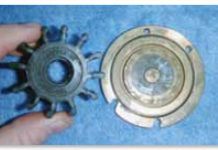
SpeedsealLife Kit Test Update
In the Practical Sailor August 2010 issue’s Chandlery, we reported on the installation of a SpeedsealLife kit aboard one of our test boats, a Union 36 sloop powered by a 43-horsepower Beta Marine inboard. An improvement on the original Speedseal (PS, July 15, 2005), the SpeedsealLife is designed to extend the life of a water pump impeller, even in a run-dry situation.
Y-valve Installation Advice and Troubleshooting
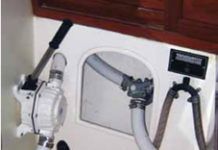
All waste plumbing hoses should be kept as short and straight as possible with no dips where waste could collect. The diverter valve should be located for easy access to the selector handle and free of other stored “stuff” that could bump the handle. The handle positions should be clearly marked for no confusion as to tank or overboard. Before mounting, make sure there is enough room for all three hose fittings and hose bends. Use 120- or 90-degree hose fittings where necessary to prevent tight bends in discharge hoses, and make sure to use the correct reinforced hose designed for sanitation systems.
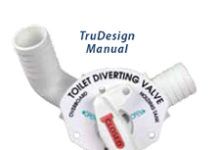
Y-valves Under Pressure
Continuing with our most recent evaluations of marine sanitation systems, Practical Sailor tested eight marine-grade diverter valves (Y-valves), the valves that control the flow of liquid from one source to two different outlets or from two sources to one outlet. The test field comprised seven manual diverter valves and one electric valve from seven manufacturers. Testers looked at construction, performance, ease of use and install, price, and warranty. The manual Y-valves tested included products from Bosworth Co., Jabsco, Forespar, Groco, Johnson, Whale, and Trudesign (distributed in the U.S. by Raritan). Testers also looked at an electric Y-valve from Trudesign.
Marine Sanitation Hose Test
Sanitation hoses are specifically designed to contain odorous gases. They are made of very different materials than the many similar-looking hoses used for fuel, coolant, and potable water—and they are not interchangeable. In a home, sewage is contained by rigid metal and PVC pipes, materials that are not practical on a boat. So what are the best hoses to use in an onboard waste system? Practical Sailor tested hoses made of butyl rubber, white vinyl, and polyurethane from Raritan, SeaLand, Shields Marine, and Trident to find. This report covers the test results at the one-year mark.
Installing Hoses Highlights Their Differences
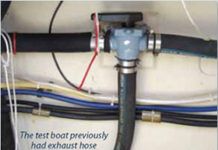
While model holding-tank testing allows side-by-side comparisons, there’s nothing like on-the-boat testing to sort out practical differences. Our test boat, a PDQ 32, had been plumbed with a mix of low-end vinyl sanitation hose and water exhaust hose; the rubber hose was permeated, cracked, and discolored, and the sanitation hose was permeated to the point of having a thin film of sticky goo that had condensed on the external surface. A textbook case of time showing the weaknesses of poor material selection.

Small Boat, Big Keel Why This 27 Footer Works
What makes a small sailboat truly seaworthy? In this video, we take a deep dive into the Pacific Seacraft Orion 27, a rugged, long-keel...



Latest Sailboat Review
Island Packet Estero Used Boat Review
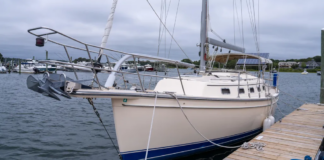
Florida-based Island Packet targets a relatively narrow niche, so the toughest competitors to its new boats are often older Island Packets. Introduced in 2010, the 36-foot, shoal-draft Estero is the company’s latest attempt to introduce a distinctive model that doesn’t stray too far from the company’s proven formula for success: moderate displacement, full-keel cruisers designed to be lived on, sailed far and in comfort, and endure the bumps, scrapes, and storms that cruising boats inevitably encounter. After sailing the Estero on Florida’s Sarasota Bay and inspecting its interior, construction, and systems, Practical Sailor testers noted that the shoal-water cruiser will appeal strongest to Island Packet fans who’ve been waiting for a shoal-draft, easy-to-sail boat that compares to the IP37 in terms of interior space. These strengths will be most apparent on intracoastal or riverine adventures like the Great Loop.