
Good boats outlive us, or at least outlive our interest in them. In time, we become the dreaded Previous Owner (PO). Will we make this transition gracefully and become that “great person” who really took care of that boat? Or will we be cursed to one of hell’s inner circles, along with all of our progeny, for the poor decisions and even neglect inflicted upon the boat? Do we consider ourselves to be owners, caretakers or stewards? How do we want to be seen, years from now?
Owner
I could be an owner. I can do as I please. I’ll sell it before it needs work, and if it has flaws, it’s up to the buyer to find them.
- Who needs lifetime sanitation hose? The white stuff was good enough for the builder.
- Tinned wire is way too expensive. I’ve got some lamp cord and Romex. If it’s good enough for the house, it’s good enough for the boat.
- I can fix that with caulk.
- Maintenance log? I’ll do what needs done, and the gaps could be embarrassing.
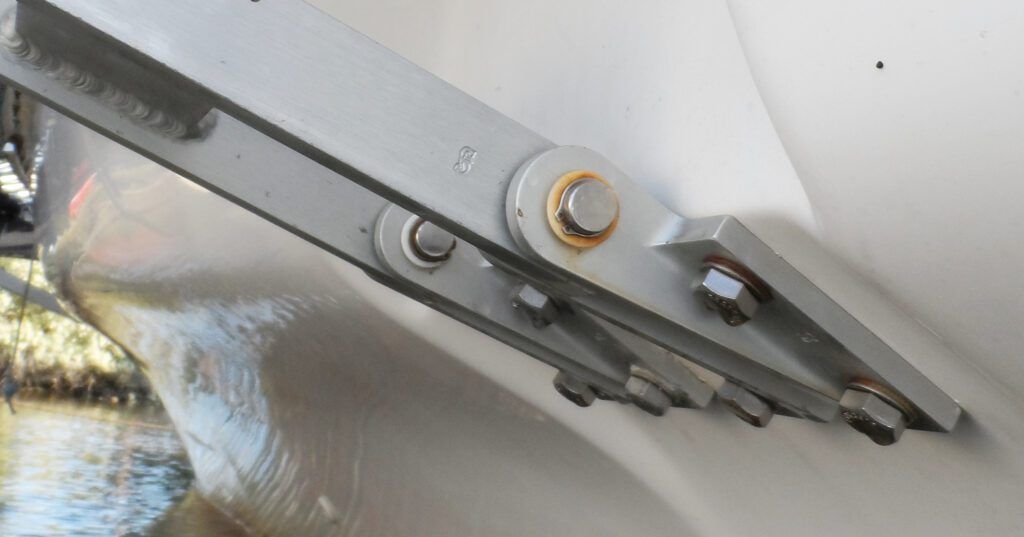
Circlip location on the F-24, luckily we found the rusted clips before their failure caused a huge problem. (Photo/ Drew Frye) Circlip location on the F-24, luckily we found the rusted clips before their failure caused a huge problem. (Photo/ Drew Frye)
Caretaker
I could be a caretaker. I’ll keep her shiny and looking good at the dock. I’ll change the oil and winterize her. She’ll pass survey—probably, if, they don’t look too deep.
- No street shoes. If she gets a smudge I’ll lose value.
- No sailing without full crew; there won’t be enough hands when docking to fend off.
- If something fails, I’ll replace it in kind.
- No expensive upgrades. Maybe some stuff I can just clamp on. Someday I’ll get a bigger boat with more stuff.
Steward
Or I could accept the responsibility of being her steward. I have been entrusted with her care and will endeavor to present her to the next owner as a better boat than I found her.
- When something wears out, I will use better materials and better workmanship when repairing it.
- When something breaks, I’ll reengineer it so it won’t fail again.
- When something is hard to work on, I’ll redesign it for easier maintenance.
- When upgrading, I will strive to make the change an organic part of the design. It must function as though it was always there. The best improvements will be invisible or nearly so.
Keep the boat long enough and you become the “next owner.” Have you ever found yourself crammed under the head or elbow deep in a wiring panel, cursing the idiot who installed a strainer where it couldn’t be cleaned or used the wrong-colored wire, only to realize that person was you? Guilty as charged. And so I strive to do better.
How to Steward
A good steward performs solid work and strengthens weak points in the design as they find them. We can strive to go beyond that, to understand the nature of the boat. When considering changes or improvements, complement that nature and never go against it. A racing boat may sprout sail control systems, but always with an eye towards efficiency at speed. Interior modifications are kept to minimum weight, recognizing she never will be a proper cruiser. The deck won’t be cluttered with stuff clamped to the rails, high-windage canvas or so many solar panels there is no room to sail the boat.
In contrast, a cruiser may add sail trim controls, but always with an eye towards minimizing cockpit and side deck clutter. Storage will be thoughtfully adjusted to suit the stuff they actually use, and the cabin will function like a finely tuned home. Both stewards will spend hours staring and considering how a smart designer would attack the problem, or whether the designer would say, “No, not on this boat.”
We’re diving deep into the realm of opinion, so I’ll stop pontificating and instead, offer up a few examples from my own upgrade experiences, and how I feel about them over time. Some represented good stewardship, and some abject failure. You judge.
Good Ideas for Stewardship
The Boats
- The Stiletto 27 is a twitchy 1,200-lb. racing catamaran with the only the faintest nod towards overnighting.
- The PDQ 32/34 is comfortable cruising cat you can live on, but with the potential to out sail most cruising boats 15 feet longer.
- The F-24 is a racing/daysailing trimaran that is well mannered, weatherly and speedy, with minimal but functional overnight accommodations. I consider her a daysailer for grownups that still harbor a need for speed.
Some of these good ideas were years in the planning. The goal is to introduce upgrades that look and function like part of the original design, only better. The best were invisible to the untrained eye.
Stiletto 27
- Installed Fuel Tank. The original 5-gallon portable tank sat in the cockpit and snagged the mainsheet every chance it got. On a tender boat, like the Stiletto, this is both a nuisance and a hazard. The new 12-gallon fiberglass tank hung under the bridge deck, but tucked up out of the way, under the cockpit seats.
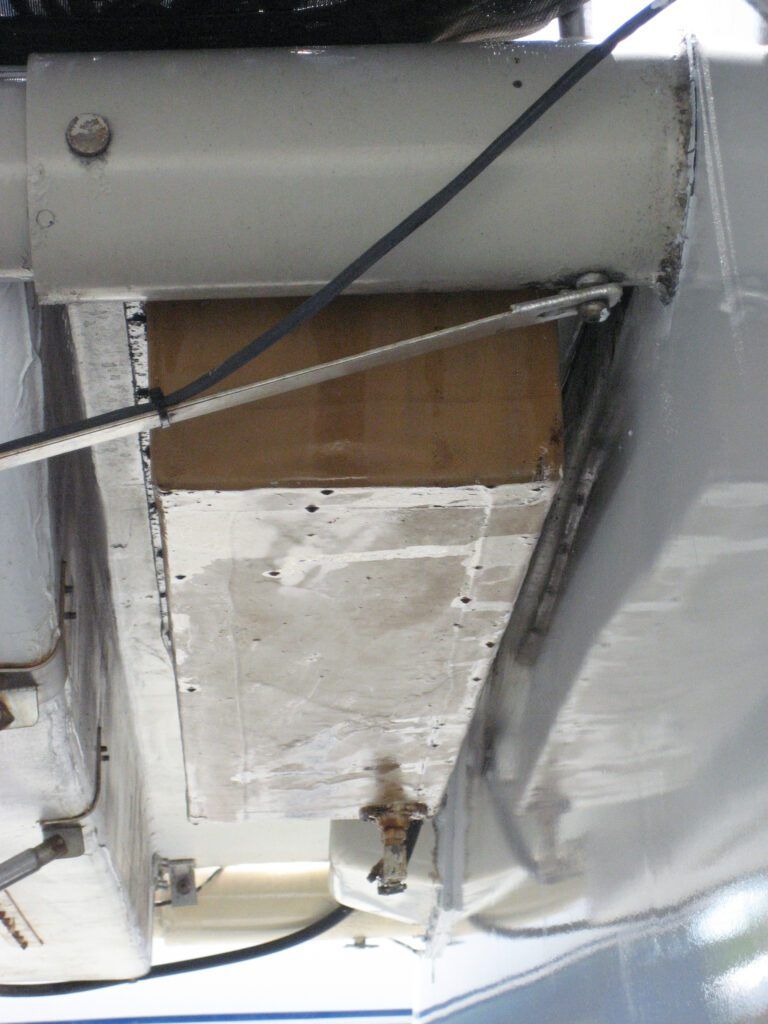
Stiletto gas tank. Installing them under the seats was lightweight, fume-safe, and out of the way. Same with the water tank on the other side. (Photo/ Drew Frye) - Additional Pipe Berth. I duplicated the original design, installing a third bunk in unused bow space. Built from aluminum conduit, webbing and a thick mattress topper, it weighed only a few pounds.
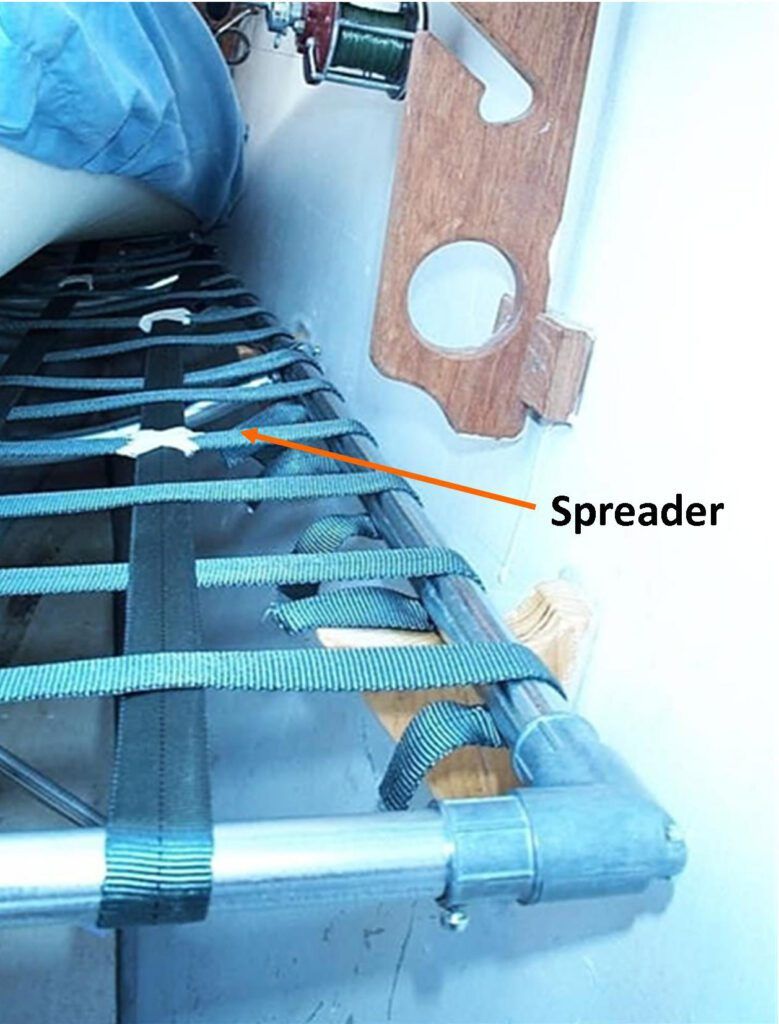
A DIY pipe berth. (Photo/ Drew Frye) - Barber Hauler. By moving the jib sheet lead forward and outwards, a barber hauler dramatically improves jib trim off the wind. I’ve added these to every boat I’ve ever owned.
- Adjustable Rake Rudders. I like helm feel, but I don’t like having my arm stretched. After weeks of consideration and hours of measuring, I found the rake could be elegantly adjusted by relocating the pivot points and installing new bushings.
PDQ
- Air Conditioning. There is generally a breeze when anchored out, but marinas can be agony. In cooperation with Dometic and Good Old Boat magazine I detailed an installation the factory was proud of. Everything was hidden, the vents and thermostat mount looked factory, and the through hulls were all in a bulkheaded compartment. On the other hand, my neighbor with a sister boat but poor installation had to disconnect hoses and prime his water pump every time the boat moved. He since paid to have the AC replaced.
- Better Storage. Most boats suffer from either too little or impractical storage. One solution is to add shallow trays on top of lockers, reminiscent of the trays in steamer trunks of old. I made light drop in and sliding boxes from ¼-in. and 3/16-in. plywood and epoxy.
- Propane Heater. We nearly froze during our December delivery trip. We knew we would install a bulkhead heater, but uncertain of the best location, I taped a cardboard box in place for the summer, to satisfy myself there was no conflict. Eight months later, confident I had found the best location, I cut the holes and did the installation, comfortable I would not be moving it later. Cutting a 5-in. hole in the roof of a newish boat is nerve wracking unless you are sure.
- Better Winterizing. Why would you build a boat in Canada and not include the valves required for easy winterizing? An hour spent installing valves to add glycol the head, potable water, and AC systems, saved many hours over the next 10 years, and probably helped sell the boat.
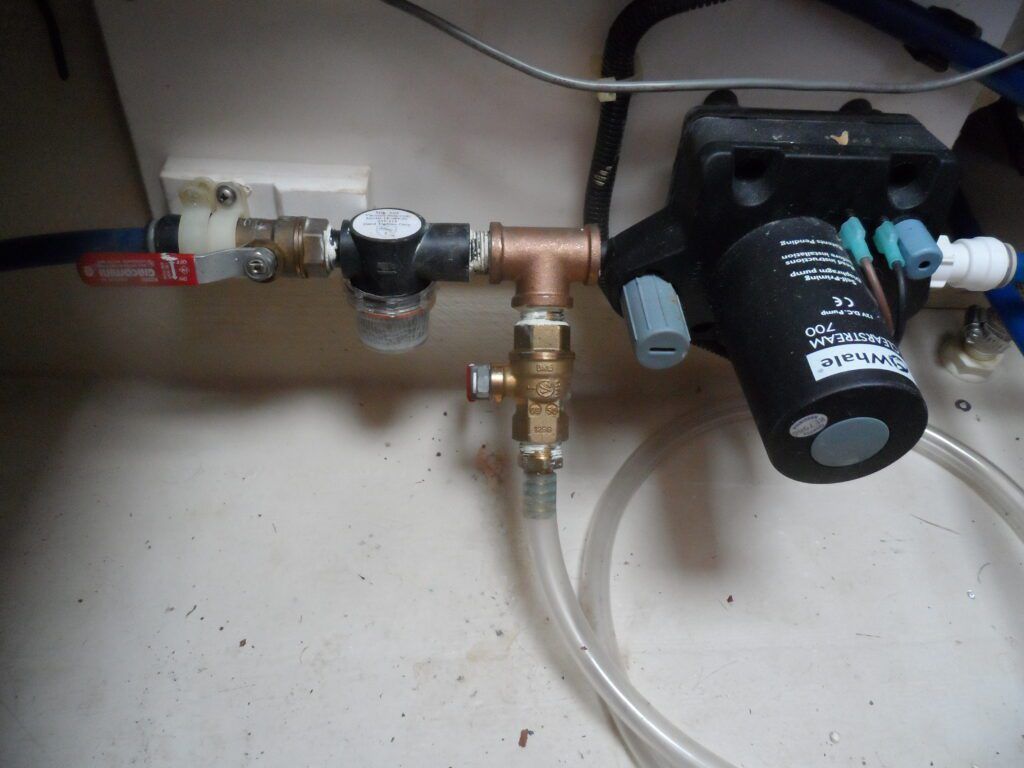
A potable water winterizing valve is a desirable fix for those in colder climes. (Photo/ Drew Frye) - Storm Windows. These should also be stock up north. On many boats, screens can be replaced with Lexan winter windows in a matter of minutes. The view is better and the boat is warmer.
- Genoa Tracks, Keel Fairing, and Transom Extensions. This was a multi-year process, requiring calculation and planning. Each item affected the balance of the boat and interactions had to be carefully considered. The result was doubled VMG to windward with few visible signs of change. Tacking and handling improved and dinghy boarding was easier. It is possible to out-designing the designer, but it’s not easy.
F-24
- Simple Solar. A 6-hp kicker that is used only to motor a few hundred yards through the marina doesn’t charge enough to overcome self discharge, let alone electronics, and chronic undercharging was killing the battery. A single 50 watt semi-flexible panel secured to the companionway turtle is nearly invisible, out from underfoot, and seamless in operation. Only a few pounds were added. Later, we swapped the lead battery for lithium iron phosphate, saving 25 pounds. More capacity and no need to plug in at night. One less thing.
- Storage Improvements. Continuing the storage theme, but with even less weight, I created removable hanging bag liners for deep lockers. Light weight and reduced clutter compliment her nature as a fast boat.
- Rudder Anti-Ventilation Plate. Every time we passed 12 knots (and the boat is much faster than that) the rudder would ventilate, losing 50 percent of its steering control just when you need it most. The cure was to add an anti-ventilation plate, built to designer specifications. Fingertip steering under all conditions was restored.
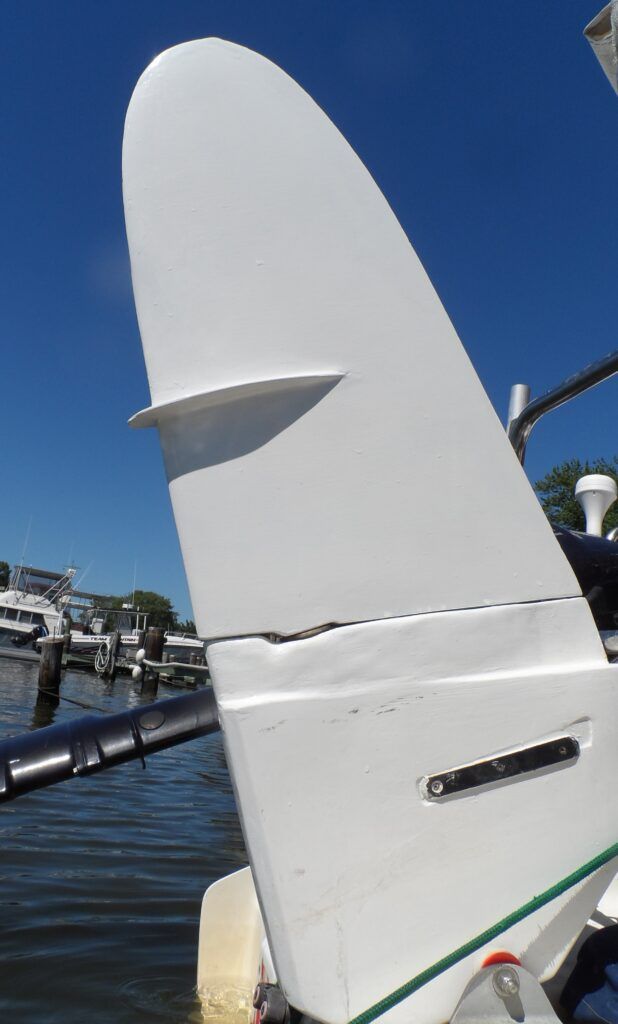
Rudder anti-ventilation plate and reduced gap. This boat was prone to rudder ventilation above about 12 knots. Adding a plate and reducing the gap improved control. (Photo/ Drew Frye)
Bad Ideas for Stewardship
Some of these bad ideas were poor repairs or poorly executed additions, born of POs with an “owner” mentality. Some, I admit, were my fault.
Stiletto 27
- Atrocious Wiring. I don’t think the PO could wire up a flashlight from two D-cells, a bulb and some wire. Motor alternator leads were on opposite poles of the battery switch (no charging). Speaker and bell wire was used for most wiring (corroded and non-functioning). He used the mast for the tricolor ground leg (horrible corrosion—never do this). Required a 100 percent re-do.
- Fragile Bow Hatches and a Spongy Deck. One day he hacked holes in the deck and installed two cheap RV hatches with silicone. Parts were constantly breaking, they leaked, and because he didn’t reinforce the deck around the large cutouts, the deck was floppy, requiring reinforcement by me.
PDQ
- Spinnaker Traveler. The spinnaker tack on the Stiletto 27 could be moved from side to side on a cable traveler. However, because it was a fast boat with a flat reaching chute, the tack always remained centered. The PDQ was slower and performed better sailing deep if the tack was moved to windward. I designed a more elegant version of the cable traveler for the PDQ’s chute, with blocks sandwiched between aluminum plates to provide more purchase and smoother operation. And it failed miserably, not moving the tack far enough to windward.
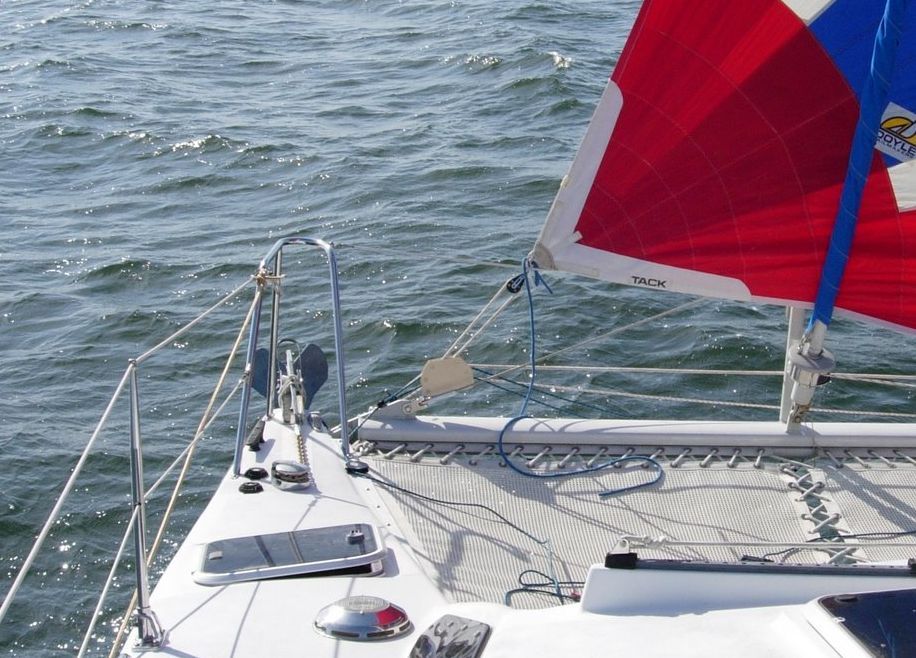
Spinnaker traveler block was a failure. In this case a minimalist bridle was lighter, simpler, and provided a wider range of a adjustment. (Photo/ Drew Frye) I tried a bowsprit, as these are all the rage. The problem is, a bow sprit doesn’t help when the wind is far aft of the beam. And it most often was, running up or down the Chesapeake. I ripped it all out and rigged the tack with a simple 3:1 tackle to each bow. Lighter, faster, cheaper, and … better.
- Undersized Fuel Filter. To solve carburetor problems, the PO installed a tiny lawn mower filter near the fuel tank, serving twin outboards. It chronically starved the engines. If even slightly fouled—which happened often enough—both engines would quit, generally in a breakwater channel. I replaced it with twin Raycor 500s, which though overkill, performed beautifully. Too bad he didn’t read “E10 Fuel Additives That Fight Corrosion.”
- No Backing Plates. The PO installed a pair nice big secondary winches in a cored section of deck without even oversized washers. One very expensive winch nearly went overboard when it pulled it out of the cored deck on a breezy day. Both winches now have fiberglass backing plates several inches larger than their bases.
- Filler Repairs. The motor mount was cored (builder error) and crushed under the clamp bolts. Just a few weeks before selling the boat, he filled the holes with Marine-Tex, which just continued to crush. On the two-day of our cruise home, the twin outboard engines nearly fell off the boat. I replaced the core an skin, and bonded a 3/16-in. fiberglass plate over the mount area.
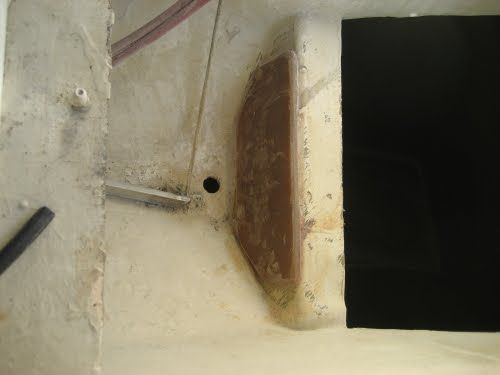
Reinforced motor mount. I’ve had to fix this on two boats. In both cases, the builder used cored construction under the bolts, which crushed under pressure, and the POs filled the dented core with MarineTex. This was a cosmetic repair. What was needed was reinforcement with a plate. Both motors came loose underway, one I nearly lost. (Photo/ Drew Frye) - Curtains. The PO did a very nice job and they were cute. But critical to this boat, they reduced visibility from the salon, from where it is quite practical to stand watch. Thus, the curtains were in conflict with how the boat should be operated. I was aboard a sister ship without curtains and immediately removed them (we did install interior privacy covers on sleeping cabins and the head).
F-24
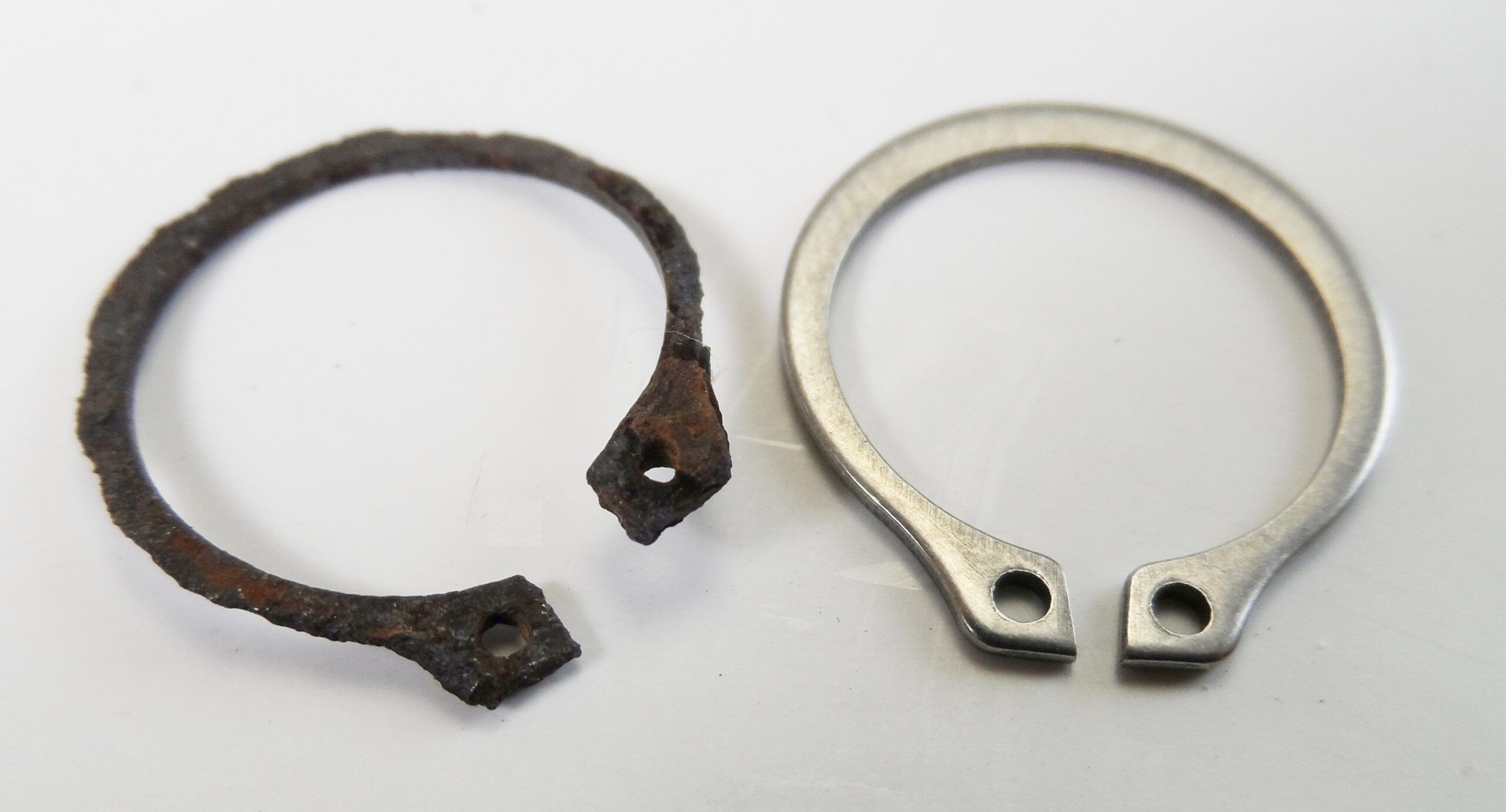
- Non-Stainless Fasteners. This PO’s cheapness nearly cost me an engine (plain steel anchor bolt on the outboard) and did cause a broken beam hinge (plain steel circlips). Had we not noticed the remaining rusted circlips during our bottom painting inspection we would have lost the beams underway, very likely losing the boat and injuring someone. I’m guessing the cost vs. savings ratio was about 1:50,000.
- Fender Washers. They bend under load, resulting in loose bolts (they lose tension), hole an damage and core failure, and bent bolts and fatigue. Failures include the boarding ladder, clutch mountings and mast hinge mounts. Fender washers have been a pet peeve of mine on every boat I’ve owned for 40 years. With the exception of the PDQ outboard mount, every bit of core replacement can be traced back to a bent washer. Every core incident of damage I have repaired can be blamed on thin washers. Don’t be “that person.” Use a backing plate or use extra thick grade fender washers—see “How Thick Does a Backing Plate Need to Be.”
Conclusions
Good ideas sometimes become bad ideas, given time and experience. Bad ideas may be re-engineered into good ideas. Ideas that are good on one boat may be bad ideas on another. We’re not always smarter than the original design engineers, and our workmanship (or more often our short cuts) often falls short, particularly while learning. First and foremost, the goal should be to do no harm.
Have I been a good steward? I hope so. Each boat was faster, more comfortable, easier to sail, and more reliable when I sold her. Each time I’ve kept in touch with the owners for a short time, discussing the best way to service something or explaining operation. I’ve always thrown in a few operating lessons—they knew how to sail, but not the best way to use the systems on the new-to-them boat. I want them to be happy with her and get the best from her. I don’t think they’ve cussed me much, or at least my dreams are not haunted.