

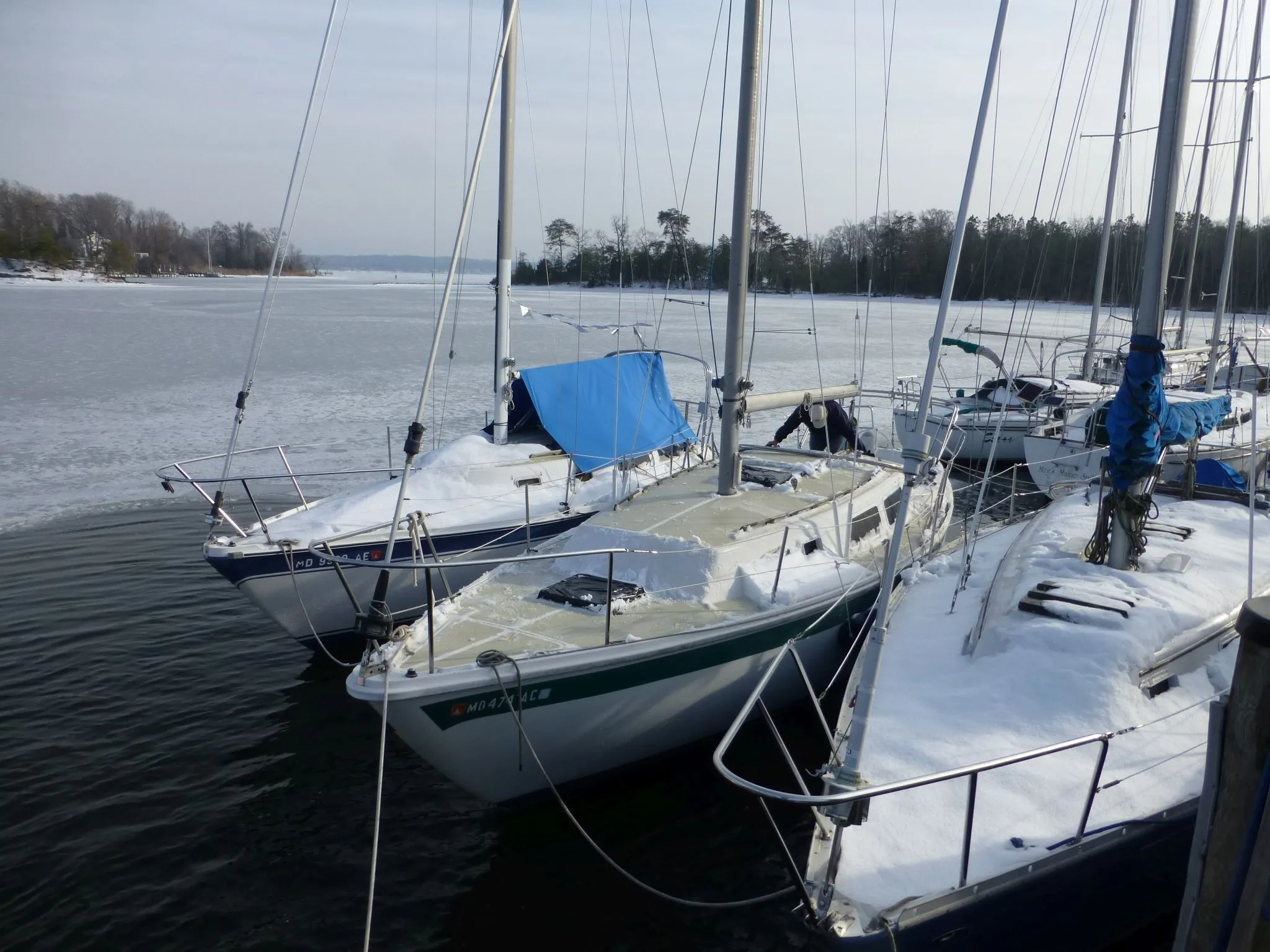
Winter temperatures are challenging for year-round sailors. Appropriate clothing is vital, including waterproof socks, layering for the legs and midsection, finishing off with a balaclava, hat, and even ski goggles. The boat requires winterizing. Inboards are challenging to winterize if actually used, and ice in the potable and waste plumbing can break fittings even in occupied boats if any piping wanders through unheated spaces (or the heat is off). The electrical system seems like the simplest part.
“But I never sail in cold weather.” Probably true. But it is also likely that you have solar panels plugged in through the winter—or will when you get around to installing them, which we recommend. You could disconnect everything through the winter—some do—but for boats left in the water with a sump pump that’s not a good idea. We’ve found it simpler to top off the water in lead-acid batteries and leave most systems connected, making sure we have isolated any parasitic loads. You could arrange some manner of heat, but is that safe unattended? Does the marina allow it? And what about power failures? If your boat lives in a cold climate, the impact of cold weather on the electrical system must be considered.
Lead-Acid Battery Basics in Cold Weather
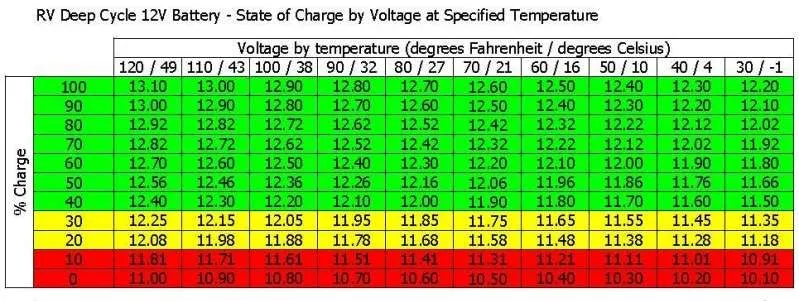
Lead acid batteries are simple enough. They charge in more or less the usual manner. They won’t freeze unless allowed to discharge completely. The voltage, on the other hand, is lower when cold for any given state of charge. I keep this chart by my panel to keep me from being over optimistic.
When Electronics Start Failing
The problem for a cruiser is twofold. First is that many electronics turn off due to low voltage at 11.0-11.8 volts. The manual may say as low as 10.5 volts, but experience says that most glitch or wink out at 11-point-something (the voltage on the instruments warning screen), and an autopilot that loses heading, for example, is as good as useless. At summer temperatures this only happens below 40% SOC. Start the engine while you can. Confirm that the solar, if applicable, is working. If the engine won’t start, power down everything and wait for the solar to build some charge, which will take some time. Cycling below 40% SOC is going to reduce battery life, so don’t.

Capacity Collapse: Why Your Usable Power Shrinks in Cold
However, if the battery compartment drops to 40 F, electronics can start cutting off at 60-70% SOC. It is impractical to recharge lead-acid past 90% SOC on a daily basis because absorptions slows way down as batteries become fully charged, so your usable capacity drops from 90%-40%=50% to 90%-70%=20%, a reduction of 60%. Running diesel or propane heat (fans and pumps) all day and night can really chew into your now-meager capacity. Solar is less effective in the winter (low sun angle and short days).
Lead-Acid and LiFePO4 vs. Temperature
Lithium iron phosphate batteries behave differently. The voltage is a little higher to start with, which is good news. We can charge them more easily to 95%, assuming we have enough alternator or solar to do so. More capacity can be fit in the same space, so we may have 20-30% more power to start with, if we installed it. But let’s compare them on an equal capacity basis.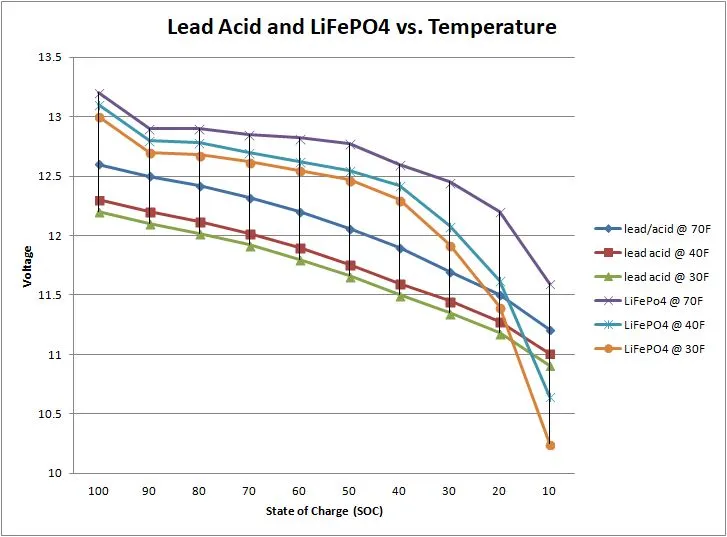
LiFePO4 battery voltage drops faster and farther with low temperatures than lead-acid battery voltage.
The news for cold weather is not as good. At 40 F the voltage still drops to 12.0 V at 30% SOC. So much for the famous level discharge profile of lithium batteries. Your batteries may have been slightly better charged to start with (lithium charging does not slow as much as lead when nearly full) but you’ve still lost 20% of your Ah bank capacity due to cold. They don’t drop below the critical 12 volt threshold until about 30% SOC, but if you leave any cushion this challenges one of the key lithium advantages; that batteries can be cycled to a much lower state of charge than lead acid without serious reduction in life expectancy. The practical limit in cold weather may be only 40-50% SOC in cold weather, in large part because of charging problems if the boat gets cold.
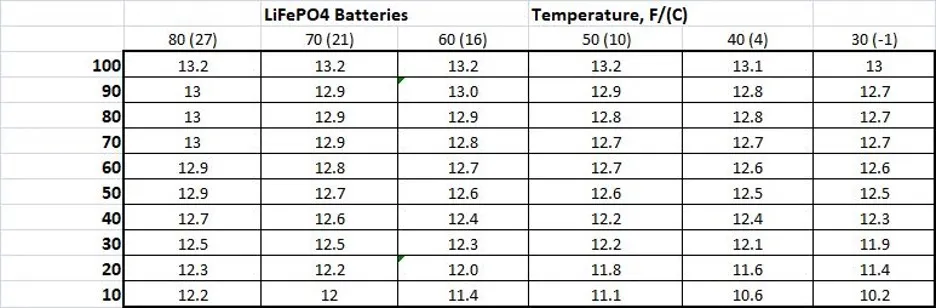
A handy chart for estimating LiFePO4 battery SOC at lower temperatures.
Lithium’s Low-Temperature Charging Limit
Then there is the problem of charging. The most common rule is that lithium batteries cannot be charged below freezing. Your phone or power tool batteries can be discharged below freezing; you just take them indoors to charge. Your Tesla has battery heaters. But let the cell phone, power tool, or Tesla (if battery sufficiently discharged that the heaters turn off) batteries go below freezing and they will not recharge until they are warmed above about 40 F, depending on the battery management system. Even drop-in lithium batteries have (if they do not, don’t buy them) low temperature cut-offs that block low temperature charging below about 35-38 F. Remember the 2024 stories of stranded Teslas, unable to charge until towed somewhere warm?
Note: Freezing is not a “magic” temperature with lithium because there is no water to freeze. Primarily, it is just an easy number to remember. Below 40 F safe charging rates tumble, becoming increasingly damaging and impractical below 32-40 F.
What Happens If You Charge Below Freezing
What happens if you somehow did charge below freezing? Lithium plates out on the electrode causing permanent loss of capacity. Reports are mixed on how bad and whether any charging is permissible. More robust batteries (ReLiOn report) state that the batteries can be charged at very low rates at freezing and below. The maximum charging rate at 32 F is 5% of battery capacity (often written as 0.05C), equivalent to a full recharge in 20 hours. The maximum charging rate at 15 F is 2% of battery capacity (0.02C), equivalent to a full recharge in 50 hours. But not all manufacturers agree, due to differences in cell construction and an abundance of caution. In practice, these trickle rates are often impractical and it is better, in general, to just say no.
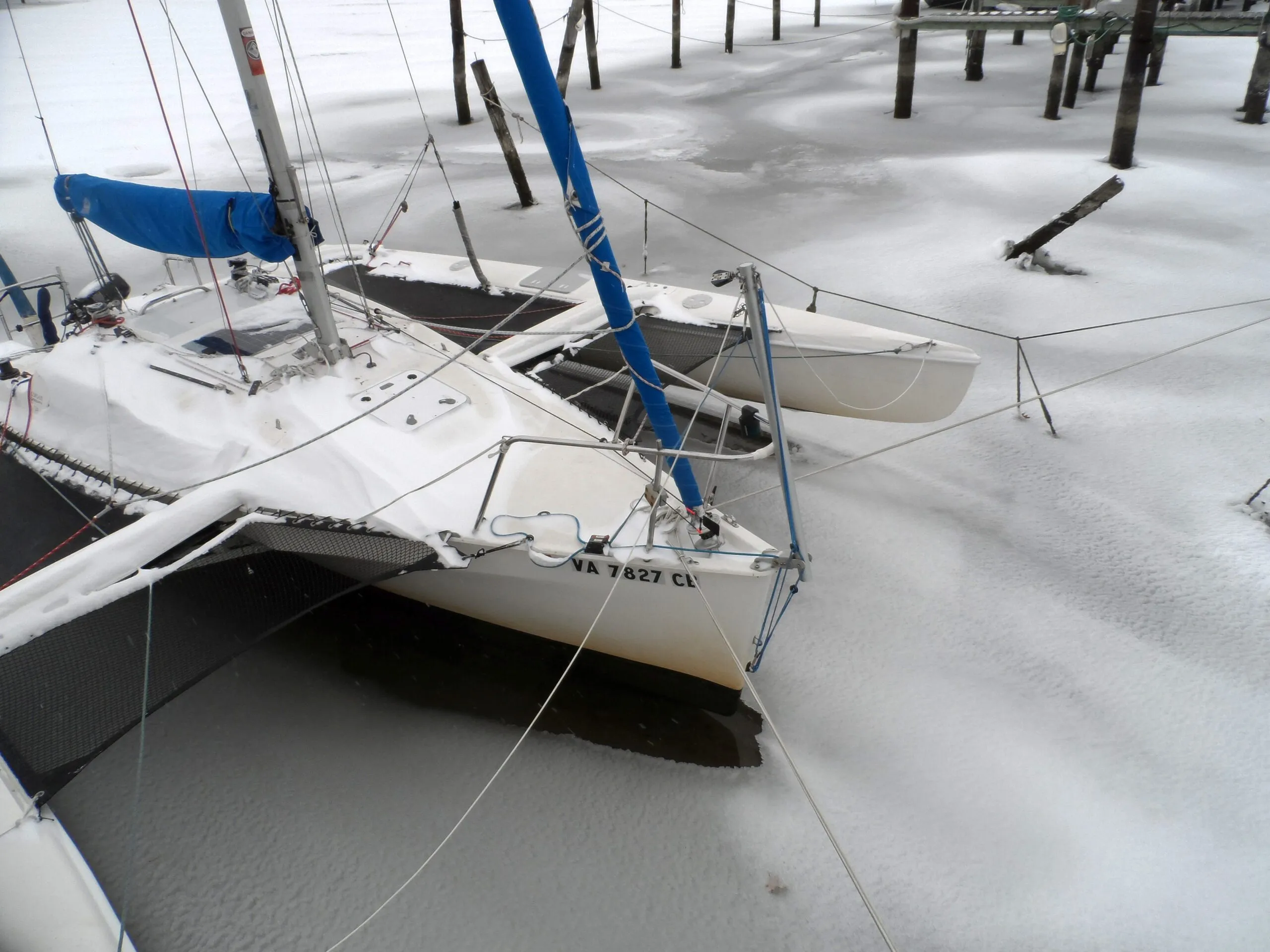
Note: Our test F-24 trimaran lithium battery has a battery management system (BMS) that prevents charging of the battery below 35 F. Additionally, the solar panels produce a maximum charging rate of about 3% of capacity in winter (low sun angle) and an observed maximum rate of 1% of capacity in winter; still safe if the BMS somehow allowed charging.
Designing a Cold-Weather Electrical System
So what is one to do if the lithium battery is flat, the heat won’t run, and it isn’t looking to warm up soon? Design a system with at least one lead acid battery, plus the ability to run everything on just that. You want a lead-acid battery for engine starting anyway, unless you have an outboard you pull-start. Start the heat when you have enough charge, warm the cabin, and use fans to blow warm air around the battery. Are the batteries in a place where you can safely circulate cabin air (circulating bilge air is not always wise)? Next time you are doing boat work, perhaps a small closable heating duct should be routed to the battery space, or at least a small fan or louvers to move some air there.
No lead acid battery? This is going to be a tough bootstrap. The propane stove won’t light (solenoid). The heat won’t run. Unless it’s an outboard you pull start, even if by using an emergency cord, the engine won’t run. The anchor electric windlass is dead. Sounds like things are going old school.
We’re not anti-lithium—not at all. We’ve installed systems on several boats because the benefits outweigh the challenges and the experience has been very positive. But you need to design for the differences. If you can’t pull start the motor you really need a lead acid battery that you can charge and use to bootstrap the boat’s systems and warm up your lithium.









They sell lithium batteries with heaters inside. This prevents most of the problems.
Yes, true. As long as the battery is plugged into a charging source with sufficient power, the battery stays above freezing. My batteries have such a system. But there are still two problems:
1. Many boats go for months without use. They may be connected to charging, but dock power can fail for weeks after an ice storm (we just had a big one), and solar panels are commonly covered for weeks or months with snow. If a heater tried to keep the batteries above freezing, they would go flat. Thus, the heating systems for marine batteries are not designed to heat from their own charge, as they are for electric automobiles. They only heat from a charging source.
2. Marine battery heaters only work when there is charging power. In the slip you can lose power due to an ice storm or even a breaker popping, and you won’t know about the latter until your next visit, months later. On the hard you rely solely on solar, and my panels (Chesapeake Bay) are typically covered for weeks at a time in winter. Farther north that could be months at a time. No charging power input = no heating.
Any winterization plan that relies on a consistent power supply, either from the dock or solar, is not robust. This includes frost watch heaters. Without frequent monitoring there is no way to know if power delivery is consistent. It’s not like your house or place of business, where power interruptions are noticed and breakers are reset.
I sense your analysis is too simplistic. First, AGMs should not be discharged below 50% without loss of capacity. Same as if Lithium is charged at too low of a temperature. So… you need to extend your analysis to include degradation of each battery type being recharged below “recommended” parameters. My sense, Lithium is more robust to low temps with full discharge than AGMs. All that said, plenty of monitoring systems to let you know temperature in the boat, loss of power and SoC. Solvable problem, IMHO
Peter: Yes, what you say is quite correct. Lead acid batteries have shortcomings, which is why we are so interested in lithium. These shortcomings are well known: loss of voltage and useable capacity at low temperatures; reduction in life span if discharged too deeply; limited charging rates. Our point was only to highlight that lithium also has vulnerabilities.
Lithium batteries are commonly supplied with robust monitoring systems. But for many, the boat is either hours or an airplane flight away, and the owner is not going to jump up when his cell phone app tells them there is a problem. For better or worse, it will wait until spring, same as with lead.
It is worth noting that ICE automobiles still use lead, even at the high end, and that Teslas have a small lead battery to backup the electronics. Lead is not dead, not yet.
As I said, I switched to lithium, and so far I’m happy.
I keep my boat in the water in Petersburg Alaska, though I live in the lower 48. I run Intrinsically safe bilge heaters. I always carry a heavy duty portable jump start battery (though it will suffer in cold weather too). And yes, my boat has a lead acid cranking battery in addition to lithium for everything else. Monitors for shore power, engine room temperature, battery voltage, bilge pump and bilge high water alarm give tremendous peace of mind (very happy with Siren/Yamaha). Finally, I won’t leave my boat without a paid/skilled local boat keeper who is only a phone call away and checks on her weekly. Peace of mind costs more but it’s worth it.
Leaving a boat for a long period is always high risk. Relying on anyone else to check it is not the answer either. I spent a few years with the boat in various places while moving her from the UK to North America, and there were always problems. Now I will always opt to get the boat hauled in a yard. You can then shut everything down without worrying about the bilge pumps failing or the dock power getting disconnected. With lithium batteries, if they are topped up to near full and there is no power drain, they will happily stay charged all winter. With lead acid you need to arrange to have someone go on board and turn on the charger for 24hrs about once a month. If lead acids are left, they will slowly discharge and sulphate at the same time. Leaving them for several months will lead to a significant loss of capacity. Leaving a charger connected is not the answer. I had a charger fail and came back to find the batteries boiled dry and wrecked. Luckily, it did not start a fire!
Your profile on lithium capacity at low temperatures also reinforces my belief that you need to plan your bank size to run batteries no lower than 50% SoC, even with lithium. It leaves you with no reserve in the event of a charging issue, whether due to cold weather or a failed charging system.
I use a programmable switch that can be set to turn on and off. It has a temperature probe in the battery box to sense the temperature. The switch is set to turn off at 37 degrees. And come on at 40 degrees. I plug a 120V, 20-amp lithium battery charger into the 120V switch. This allows the charger to be shut off when the set temperature is reached and to turn back on when the temperature reaches 40 degrees. I have about $50.00 in setup costs. HTH
Thanks, JD
I cover my lithium bank with a wool blanket (wool is flame retardant) and place a 60 watt trouble light low in the battery compartment under the blanket. It heats up the battery compartment surprisingly fast to at least 45 degrees when temperatures outside are well below freezing. Then I charge the lithium bank to 100% SOC and shut off all power to the boat. My phantom power draw is 1.5% capacity per day. After a month my SOC is at 55%, and I heat up the batteries, recharge and again, shut down all power (power left on leads to galvanic corrosion of your running gear). Fortunately, I live close to the boat in Annapolis MD and am able to regularly check up on her. It’s not really necessary, given marelon seacocks and proper winterization. I just like seeing the boat!
not really necessary,