


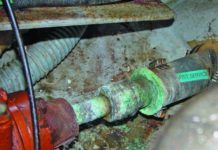









Used Nylon Three-Strand Rope Faces The Ultimate Endurance Test
The nylon three-strand dock lines used for this test had weathered significantly, and chafed noticeably where the lines exited chocks and made contact with cleats. We put these lines under increasing tension in laboratory conditions and tested them to destruction. Our test shows that even when the effects of chafe were eliminated, up to 75-percent of the original tensile strength in our sample ropes was lost. These findings fly in the face of the conventional rhetoric that views nylon as such a strong material that one should always opt for thinner line due to its better elastic effect. To the contrary, within reason, this overly springy, rubberband-like function is a foe rather than a friend. We left the lab realizing the importance of taking a close look at dock lines and other nylon-line applications, noting the last time they had been replaced and why tropical storms and noreasters take such a heavy toll. A new set of dock lines is cheap insurance, and money well spent.
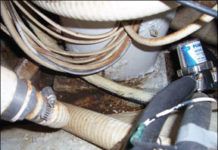
Mast Wire Worries
My Tayana Vancouver 42s mast wires and cables were cut when the keel-stepped mast (63 feet) was removed. The wires include those for a tri-color with strobe, DataMarine 5000, VHF radio, radar, and nav lights. I am thinking of using a terminal box for the connections when the mast is replaced, but Im concerned about bilge moisture over time as well as the multiple wires in the cables. The wires exit the mast just above the step. I tried to leave sufficient wire for a terminal box, but I don't think a box outside the bilge is currently possible without additional wire extensions. Thoughts and recommendations?

For the Grinder
You might recall a February 2007 Chandlery review of the Lewmar OneTouch winch handle. The handles inventer, Don Steiner, has come out with his own, updated, lighter weight version, the Dax OneTouch. Steiner engineered the OneTouch and sold the license to Lewmar for the metal version, but his Dax OneTouch is made of 50 percent fiber-filled nylon, and all metal parts are high-grade aluminum or stainless. It also has a wider grab bar and higher operatng arc than the Lewmar.

Practical Sailor drops, drags, and dissects three flexible potable-water tanks.
Unlike their rigid counterparts, small flexible tanks make adding small stores of drinking water aboard a cruising boat relatively easy. But not all flexible tanks are equal in terms of ability to withstand wear and tear. Practical Sailors testers evaluated popular models from Vetuswww.vetus.com, Nauta Imtra Corp., www.imtra.com, and Plastimo Navimo USA, www.navimousa.com. The Vetus and Nauta tanks are rated to hold 14.5 gallons (55 liters), while the Plastimo tank holds 13.2 gallons. Testers took note of each tanks flexibility, weight, construction, seams, tie-down grommets or straps, valves, exterior and internal materials, capacity, and other characteristics. The smell and taste of the stored water were evaluated. The tanks also faced abrasion, seam strength, and drop tests-and thats what separated the weak from the winners in the water storage arena.
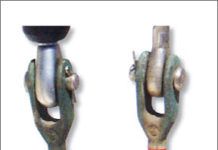
Practical Sailor Test Boat Gets Half a Refit With Powerlite PBO Rigging
Although stainless steel wire and rod rigging are still the traditional, most popular, and economical material of choice for mast rigging, metal is rapidly giving way to a new generation of synthetic rigging material. There are a handful of companies that manufacture standing rigging using ultra lightweight high-modulus synthetic fibers such as Kevlar, PBO (polybenzoxazole), and carbon.There are many advantages of synthetic rigging. Weight savings aloft is the primary benefit, and high-modulus fiber can be up to 50 percent stronger than similar diameter rod or wire rigging, and up to 90 percent lighter. Another touted benefit is greater fatigue resistance. For the average racer-cruiser, there are three big drawbacks to PBO: It is four times as expensive as stainless steel wire, although roughly on par with rod rigging; should its cover fail, it drastically loses strength in direct sunlight; visual inspection and DIY repair is currently impossible. Until recently, the technology for high-modulus, synthetic fiber rigging was only available to deep-pocketed mega-yacht owners. As development advances and competitive pricing is sparked, this type of rigging may one day be an option for average sailors. Under the current state of technology, we can only recommend this product for the serious racer with very deep pockets.
Storm Damaged Boats Reveal the Limits of Fiberglass Hull Construction
An inspection of storm-damaged boats reminded Practical Sailor editors that sailboats are designed, engineered, and built to handle sailing loads, and the point-loading that occurs during collisions or fetching up make all promises of ruggedness and survivability a tenuous crapshoot at best. Fiberglass hulls have many redeeming qualities, and its these positive traits as well as their limitations that boat owners need to understand. One things for sure: Its easier to become a proficient navigator, install a secure storm mooring, or transit to safe shelter before a storm, than it is to build or buy a catastrophe-proof vessel.
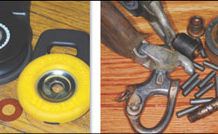
Practical Sailor Reviews Snatch Blocks from Six Makers
The snatch block was developed to be installed and removed from the mid-region of a working line, and it has been loved and cursed by racers and cruisers alike. Snatch block preferences can vary greatly according to particular needs. Race-oriented sailors will want something strong, light, and efficient, while robust construction and reliability rank high for cruisers. Practical Sailors ideal snatch block will be rugged, serviceable, and made of high-grade materials that wont fail in demanding saltwater-sailing conditions. The snap shackle and opening mechanism should be easy and quick to open by hand. The block should rotate and pivot freely so that it provides a fair lead at a wide range of angles.We evaluated products from six manufacturers-Antal, Garhauer, Harken, Lewmar, Schaefer, and Wichard-to find the best snatch block for cruisers and club racers. The blocks working loads ranged from 1,980 pounds (Wichard) to 5,000 pounds (Schaefer). Sheave diameter ranged from 2 inches (Antal and Wichard) to slightly over 3 inches (Garhauer). For historical perspective, we included a collection of similarly sized blocks dating back more than two decades.
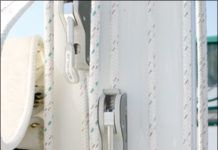
Practical Sailors Guide to Choosing Cost-Efficient Halyard Materials
Sail performance is directly affected by the type and condition of your halyards. Upgrading your halyards to a low-stretch fiber helps ensure youre getting the sails full power, and it can add life your sails. After testing a sampling of lines from New England Ropes, Novatech Braids, Samson Rope, and Yale Cordage, Practical Sailor found that line stretch decreases significantly as cost increases. And while the very-low- to no-stretch high-tech lines often come with through-the-roof prices, there are low-stretch halyard options available for the budget-minded sailor.This article offers a line cost vs. line stretch analysis and an overview of the fibers available. UV resistance and other factors like abrasion resistance and ease of splicing will be the subject of future tests on these halyard materials.
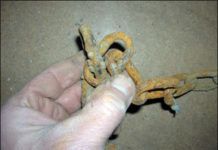
Mooring Chain Check-up at 12 Months
Practical Sailors 12-month results in the mooring chain test gave us no reason to change our previous ratings. Our vote still is for the Acco grade-30 proof coil. Its the best chain for the dollar. If youre made of money, you could set up your mooring with the Suncor stainless. But the dark side of stainless is that after years of cyclical loading, it can break without warning. Corrosion is just one of the factors affecting a chains integrity, and until we start putting these chains under load, and ultimately, testing them for breaking strength, many questions will remain unanswered.
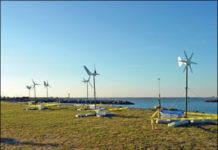
Marine Wind Generator Test
The micro-wind turbines assembled for this comparison include the KISS High Output Wind Generator, the Rutland 913, the Superwind 350, the Ampair 100, and a prototype of the Air Breeze. The four-day test period brought a good mix of light- and strong-wind days, so testers were able to review wind generator output in a variety of conditions. Wind speeds for the 4-day period averaged 12.6 knots, with two blustery days, so were not surprised the high-output, three-bladed wind generators topped the five-bladed ones overall.

Why Is This 46 Foot Sailboat So Cheap? Hunter 460 Review
Is the Hunter 460 really one of the best-value cruising sailboats on the used market? In this video, we take a deep, honest look...


Latest Sailboat Review

Irwin Citation 38 Used Boat Review
As the largest of the Citations, the Irwin Citation 38 is probably the best looking, handling the high-sidedness better than her smaller sisters. The boat has three windows set in the sheer stripe on each side, so they are not very noticeable. Like the other Citations it is distinctly modern-looking not pretty, but not ugly either.