

Watering Batteries
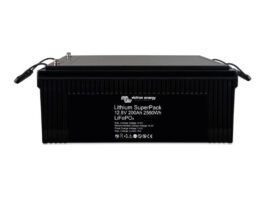
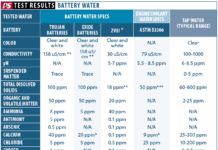
Our May 2015 report on absorbed glass mat (AGM) batteries got us thinking about wet cell-batteries. While it is easy to find distilled water suitable for topping off the battery electrolyte in the U.S., what happens when we are not near a reliable supply? Are there any substitutes? What should we avoid?

Making Sense of Water Filter Certification
Only a few states require National Sanitation Foundation (NSF) certification for water filters, and the requirement applies only to a small number of original equipment manufactured (OEM) products.
Preventing and Treating the Tainted Tank
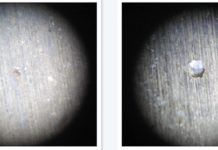
Foul tank water is completely preventable. Here are some dos and don'ts for a healthy water tank. Dont place glycol or other winterizing agents in the tank. Install valves as needed to winterize the pipes only; typically a tee and two valves located near the tank drain work fine.
Water Testing Tools
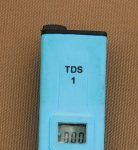
Leave water from any source in a storage tank for a while, and interesting things will start to grow. Only the purest water in an airtight bottle will have a long shelf life. But not all bottled water is what the label says it is. For a cruiser, there are two water-testing tools that are important, and a third tool that is helpful in determining what is going into a tank and managing the quality of fresh water on a long-range cruising boat.

Whats the Voltage for Charging Gel Cells?
I just received the latest Waypoints e-letter about gel batteries, where you state they must be charged at no more than about 14.1 volts. We do not use gel batteries in our boat, but do in our camper van. As I understand, Trojan deep-cycle gels can be charged up to 14.4 volts and East Penn marine gel batteries up to 14.6 volts, so why are you recommending the lower voltage?
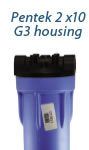
Water Tank Filters
You would think that with all the emphasis cruising sailors put on their boats and equipment, we would pay a little more attention to ensuring a clean and safe supply of water. This is less a concern in developed countries, where dockside water is safely treated or bottled water is affordable and readily available. However, once you begin to expand your horizons, ensuring a clean water supply requires more thought and effort. This is the first report in a three-part series on equipment and practices that no matter where you and your boat are, you can be reasonably sure that your on-board water supply is safe.
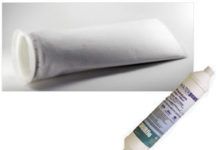
Types of Filter Media
Water filtration isn't rocket science, but some filter media is better suited for the marine environment than others. And, as we found in our test, some cartridge designs are better than others. Here are the most common types.
Filters for Water Tank Vents
Ever find a bug doing the backstroke in your water tank? We have. Would you leave a glass of water sitting uncovered for weeks and then come back to it? Of course not, but many builders either lead the hose to a mushroom-type through-hull fitting, or terminate it inside the cabin, with nothing to keep the ubiquitous critters from seeking shelter, fresh water, or a nesting site.
Fighting Sulfation in AGMs
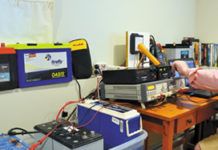
In recent years, the popularity of absorbed glass mat (AGM) batteries has soared, yet few owners truly know how to take care of them. If you want to get your moneys worth out of a new AGM battery or battery bank, it should be installed as a system-not simply dropped in as a replacement for flooded batteries.

Tracking Marine Batteries
Each AGM battery we tested underwent a minimum of five discharge and recharge cycles to a loaded 11.7 volts before being ampere-hour-capacity tested. This cycling ensured that each battery had cycled up to its rated amp-hour (Ah) capacity. If the battery did not cycle up to rated Ah capacity, we ran a few more cycles and tested again.
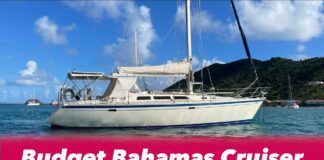
O’Day 40 – A Budget Cruiser for the Bahamas
The O’Day 40 (1986) is one of those cruising sailboats that somehow slipped through the cracks of sailing history. Built during the final years...


Latest Sailboat Review
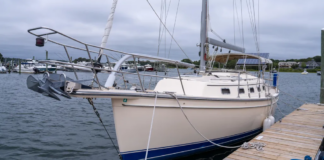
Island Packet Estero Used Boat Review
Florida-based Island Packet targets a relatively narrow niche, so the toughest competitors to its new boats are often older Island Packets. Introduced in 2010, the 36-foot, shoal-draft Estero is the company’s latest attempt to introduce a distinctive model that doesn’t stray too far from the company’s proven formula for success: moderate displacement, full-keel cruisers designed to be lived on, sailed far and in comfort, and endure the bumps, scrapes, and storms that cruising boats inevitably encounter. After sailing the Estero on Florida’s Sarasota Bay and inspecting its interior, construction, and systems, Practical Sailor testers noted that the shoal-water cruiser will appeal strongest to Island Packet fans who’ve been waiting for a shoal-draft, easy-to-sail boat that compares to the IP37 in terms of interior space. These strengths will be most apparent on intracoastal or riverine adventures like the Great Loop.