


New Clear, No-rust Propane Tanks
Unlike aluminum or steel propane tanks, clear composite tanks allow users to see how much fuel remains, a nice feature in an LPG tank.Following our year-long evaluation of Ragasco’s 9-kilogram one-piece blow-molded tank, Practical Sailor tested the American-made Lite Cylinder, a two-piece composite tank. The two tanks have nearly identical dimensions, and may be a challenge to fit in a standard propane locker designed for metal tanks. In fire tests, composite tanks melt rather than “explode” like metal tanks, giving them a slight edge in safety, and the non-metal tanks resist rusting, a common problem of aluminum LPG tanks.
Portable Sailing Tools for Tracking and Tuning Boat Speed
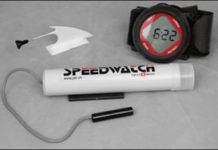
Practical Sailor recently spent a week experimenting with three handheld products geared toward performance sailors. These portable tools are for tracking and improving sailboat speed. Unlike conventional portable GPS units, which have relatively small displays and deliver a wide range of navigational data, these products display large digits that can be read from a distance, and the view options are limited to those that relate exclusively to speed and racing performance. Practical Sailor tested the Speedwatch and two GPS units, Velocitek SC-1 and SpeedPuck. These instruments make good training tools for young sailors and will give all around-the-buoy sailors the ability to quickly quantify performances.
Which is the Best Marine Inverter-charger for Your Boat?
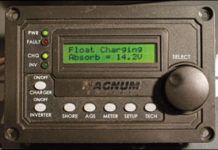
To decide which marine inverter-charger best meets your onboard power demands, first consider how it will used, how and where it will be mounted and what is required to fit with your electrical system. After testing multiple marine inverter-chargers, Practical Sailor offers this report on the units’ inverter capabilities and a follow-up review will report on the units’ charger functions. There are two classes of marine DC inverters: true sine wave (TSW) and modified sine wave (MSW). Each uses a different method to produce AC voltage. Practical Sailor evaluated modified sine wave units from Charles Industries, Magnum Energy, ProMariner, and Tripp Lite, and true sine wave units from Magnum, Mastervolt, ProMariner, and Xantrex.
Practical Sailor Tests 4-horsepower Electric Outboard
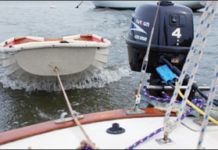
As we did with the Torqeedo electric outboard and Minn Kota trolling motor in past tests, Practical Sailor put the Solid Nav Traveler to work in sea trials on a Cape Dory Typhoon to determine whether it was a viable replacement for a small boats gas-powered outboard. The four-horsepower Traveler electric motor is marketed by Solid Nav and manufactured by Suzhou Parsun Power Machine Co., Chinas largest outboard exporter. Using a brushless 48-volt DC motor made by Mars Electrical Co. of Milwaukee, Wis., the Traveler combines a familiar drive train and an innovative solid magnet electric motor. At first glance, it looks like a small conventional outboard. Available in both long-shaft (20 inches) and short-shaft (15 inches) models, the Traveler is a gasoline outboard alternative best suited for a pocket cruiser (like a Cal 25) or similarly sized weekend cruiser where electric propulsion is desired. However, its required battery entourage limits its portability and affordability, and charging needs limit its practical use on smaller boats.

Mailport: 12/09
I have a Pearson Ensign 1962 now at a slip in New Rochelle, N.Y. This season marked the first time we had the luxury of keeping our boat at a slip. In order to maneuver through the marinas byways without worrying, I bought a 24-volt Minn Kota outboard (80 pounds of thrust) and two 12-volt batteries, which I hook up in series. Not only am I able to stop start, turn, etc., in the marina, but-to my surprise-in the calm sound water, I can nip along at about 3-4 mph with myself, two crew, and the 3,000-pound boat. The result is that Ive only used my 5-horsepower Mercury outboard once this year. My electric outboard doesn't stall; it has variable speed like no ones business; reverses with relative ease, and is less expensive-though more cluttered-than the self-contained electric outboards you recently reviewed. Am I part of a growing trend or just weird? If the former then it might be worthwhile testing electric outboards for boats my size (22.5 feet) and commenting on their applicability.

PS Advisor: Safe Mounting for Radar
I am looking at antenna mounting options for my 2.2-kilowatt radar. I like the idea of keeping the antenna out of the foretriangle and its sail and rigging, but am a little concerned about crew exposure by mounting the antenna aft on a pole or lower on the backstay. The manufacturer (Furuno) mentions nothing about exposure hazards in its installation manual. Does a hazard exist in this configuration?
PS Advisor: Synthetics for Marine Diesels?
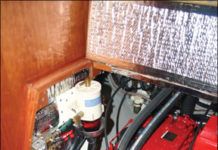
Mobil 1 extended performance oils for automobiles are advertised as providing engine protection and performance at extended intervals of up to 15,000 miles or one year, whichever comes first. Its 5W-40 Turbo Diesel Truck oil meets American Petroleum Institute (API) standards for diesel truck lubrication, and except for the price ($5-$8 per quart, or three times the price of conventional multi-grade oil), would seem to be an attractive option for ocean voyagers who might otherwise have to carry out an oil change at sea. However, the official party line at Mobil 1, as we expected, is that you should defer to your manufacturer’s recommendation on oil type, weight, and service ratings appropriate for your engine. Typically, if an engine maker does certify the use of a high-mileage oil, it is in combination with routine sampling of the oil to determine its condition.
Boat Holding Tank Sensor Long-term Test Update
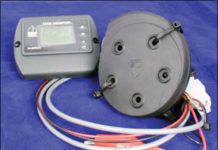
Last year, Practical Sailor installed and tested seven internally mounted liquid-level monitoring kits, including the sensors and their mated remote display panels, in a polyethylene holding tank; the results were reported in the May 2008 issue. The sensors spent the following nine months marinating in the tank, with the occasional sloshing by a tester, before being re-tested to see how well they continued to perform. The test field comprised float sensors, neumatic sensors, and an ultrasonic sender. Float sensors included Sealand TankWatch1, Dometic DTM4, Groco TLM Series, and Wema SHS-8. Air-pressure-fueled sensors included Fireboy-Xintex PTS and Hart Systems Tank Tender. BEP Marines (Marinco) TSI sender uses ultrasonic pulses to measure liquid levels.
Practical Sailor Tillerpilot Test: the Simrad TP10 and the Raymarine ST1000 Plus
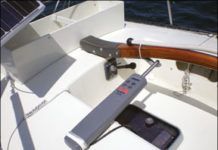
Offshore sailor Skip Allan tested two entry-level tillerpilots, the Simrad TP10 and Raymarine ST1000, aboard his 27-foot sloop during last years Singlehanded Trans-Pac race. The autopilots were used during varying weather conditions and sea states, including gale conditions. The review considers characteristics of the Raymarine tillerpilot and Simrad tillerpilot, including price, power supply, drive thrust, installation ease, user friendliness, construction, and performance.
Conversion Kits that Turn Your Boat’s Ice Box Into a Galley Refrigerator
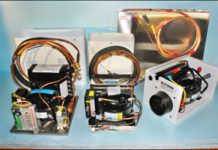
Practical Sailor tested three kits that convert onboard ice boxes into full-fledged refrigeration systems. The three reefer conversion kits in the review-the Waeco-Adler Barbour Cold Machine (CU 100) from Dometic Corp., the Frigoboat Capri 35F by Veco SPA, and the Sea Frost BD-represent a cross-section of whats available on todays refrigeration conversion kit market. Testers looked closely at energy efficiency and the 12-volt units abilities to cool a small ice box with the least amount of amp hours possible. Testers looked at quality, details, reliability, and cooling capacity.

O’Day 40 – A Budget Cruiser for the Bahamas
The O’Day 40 (1986) is one of those cruising sailboats that somehow slipped through the cracks of sailing history. Built during the final years...



Latest Sailboat Review
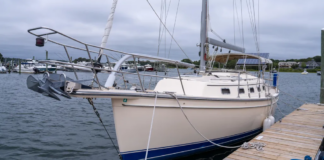
Island Packet Estero Used Boat Review
Florida-based Island Packet targets a relatively narrow niche, so the toughest competitors to its new boats are often older Island Packets. Introduced in 2010, the 36-foot, shoal-draft Estero is the company’s latest attempt to introduce a distinctive model that doesn’t stray too far from the company’s proven formula for success: moderate displacement, full-keel cruisers designed to be lived on, sailed far and in comfort, and endure the bumps, scrapes, and storms that cruising boats inevitably encounter. After sailing the Estero on Florida’s Sarasota Bay and inspecting its interior, construction, and systems, Practical Sailor testers noted that the shoal-water cruiser will appeal strongest to Island Packet fans who’ve been waiting for a shoal-draft, easy-to-sail boat that compares to the IP37 in terms of interior space. These strengths will be most apparent on intracoastal or riverine adventures like the Great Loop.