




Practical Sailor

  • Subscribe
  • Free Waypoints e-letter
  • Customer Service


Forgot Your Password?

  • Home
  • Sailboat Reviews

    Articles

    Boat Review: Marshall 22 Catboat

    The Pros and Cons of a Plumb Bow

    Boat Test: The Last Sabre 34 Mark II

    The San Juan 24

    Used Boat Review: Gulfstar 36

    Seawind 950: Some Assembly Required

    Sailboat Reviews

    Unbiased, detailed reports on dinghies, daysailers, racer-cruisers, cruising sailboats, and multihulls. Insights into boat construction and design. Solid advice on buying a sailboat.

    Sailboat Reviews - Index

  • Marine Electronics

    Articles

    Field Testing Kannad, McMurdo, and Mobilarm MOB Beacons

    Best Mid-priced Marine Stereos

    Garmin BlueCharts Mobile Sea Trail

    Where Credit Is Due: April 2013

    DeLorme inReach vs. Iridium Extreme

    Marine Electronics

    Extensive tests of GPS chartplotters, fishfinders, VHF radios, radar, AIS, navigation software, and handheld gadgets. Professional guidance on installing and operating high-tech sailing gear.

  • Sails, Rigging & Deck Gear

    Articles

    Anchor Tests: Bending More Shanks

    Mainsheet Tackle Bench Test

    Shockles Snubber Test

    Summer Sailing Gear

    Mailport: June 2013

    Sails, Rigging & Deck Gear

    Independent tests of halyards, sheets, furlers, anchors, snatch blocks, shackles, ropes, winches, vangs, cleats, booms, masts, and standing rigging. Expert guidance on choosing a mainsail, jib, or spinnaker.

  • Systems & Propulsion

    Articles

    Fuel-vent Filter Test Resources

    The Fine Art of Sensing the Wind

    DC Watermakers Head-to-head Test

    Stainless-steel Hose Clamps

    Propane-powered Propulsion

    Systems & Propulsion

    Comprehensive comparisons of pumps, batteries, solar panels, wind generators, inverter-chargers, watermakers, propellers, toilets, engines, and other marine systems. Tips on ship-shape installations.

  • Boat Maintenance

    Articles

    Mailport: May 2013

    Dehumidifier Field Tests

    Anti-Mildew Weapons

    Mailport: June 2013

    Where Credit Is Due: May 2013

    Boat Maintenance

    Bottom paints, topside paints, varnishes, waxes, protectants, cleaners, metal polishes. If it comes in a bottle or can, PS has tested it. Proven methods to protecting your floating investment.

  • Belowdecks & Amenities

    Articles

    Dehumidifier Field Tests

    Bends and Breaks: Anchor Shank Strength

    Portable Marine Toilets for Small Boats

    Portable Chairs for Sitting Under Sail

    Belowdecks & Amenities

    Our top picks in galley stoves, cookware, cabin lights, refrigeration, and entertainment systems can help turn your cruising boat into a home. Creative solutions to the challenges of living aboard.

  • Personal Gear & Apparel

    Articles

    Mailport: April 2013

    Kids’ Life Jackets for Active Sailors

    Summer Sailing Gear

    Gift Ideas for the Sailing Family

    Curing the Hardened Sole

    Personal Gear & Apparel

    Thorough test reports on binoculars, boat shoes, foul weather gear, hand-bearing compasses, sailing knives, flashlights, headlamps, sunglasses boots, and anything else that belongs in a skipper's seabag.

  • Safety & Seamanship

    Articles

    Crew Learns Along the Way

    Kids’ Life Jackets for Active Sailors

    Practical Tips for Survival at Sea

    Mailport: June 2013

    The Science of Safety

    Safety & Seamanship

    Our testers evaluate life jackets, flares, life rafts, harnesses, man-overboard strobes, medical kits, seasickness aids, and emergency devices. Tips on marine safety gear, boat-handling, and emergency procedures.

  • Mailport & PS Advisor

    Articles

    Mailport: March 2013

    Anti-Mildew Weapons

    Mailport: June 2013

    Indoor Sailboat Refinishing

    Where Credit is Due: March 2013

    Mailport & PS Advisor

    Insightful letters from sophisticated sailors. Do-it-yourself projects and reader feedback on a wide range of boats, marine manufacturers, and sailing products.

  • Inside Practical
    Sailor Blog

Features

January 2012 Issue

Story Tools

  • Share |
  • E-Mail to a friend
  • E-Mail to the editor
  • Post a Reader comment
  • Printer Friendly

Testers Check Beam Patterns and Illumination

Li-ion batteries top NiMH and lead-acid, but they also push up price.

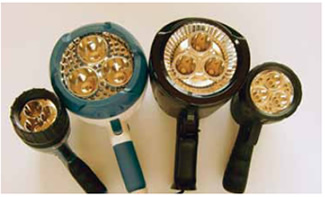
Multi-LED spots varied significantly in size, from left: West Marine SuperSpot, Brinkmann Q-Beam, Coleman (4351-700), and Cyclops.

Testers in this month's spotlight test evaluated a number of spotlight features. Although some points such as ergonomics involved a small degree of subjectivity, features such as brightness carried much heavier weighting in the final ratings. Here is what we looked at:

Ergonomics. Some models merely have an on–off switch; others add one or two controls to change power, or activate a strobe feature, or turn on a red beam. There were, however, as many configurations of use and meaning of the switches as there were spotlights. Testers concentrated on how these are used: Is one–hand operation possible? Are the controls logically placed? Do they snap into position, providing satisfying feedback? Can the light be turned on by accident, possibly leading to a depleted battery?

Beam Patterns. Rated power tells only a partial story: Where is the power radiated—into a spot, as desired? To evaluate beam pattern, we aimed each spotlight at the center of a four–foot-square segment of neutral-colored wall from 6 feet away, and photographed its beam patter to reveal the relative strengths of the spot, corona, flood, and spill portions. For maximum range, all of the light would radiate into the spot alone, and none elsewhere. To coincide with a two-foot–wide object such as a reflective patch on a life raft, at a fifth of a mile distance, a beam would have to start out at the reflector at about 1/10 of a degree wide—orders of magnitude smaller than the LED itself! Of course, none of the tested units could produce a beam this laser-narrow—nor would this be desirable. For spot beams of the same illuminance (lux), the narrowest will shine the same amount of light farther away. All beams, of course, aren’t of the same luminance, so we must also measure beam illuminance.

Beam Illuminance. Light actually reaching the target downrange is what counts, so for our second measurement, we used a Wavetek LM631 digital light meter to measure the lux value of light received from the spotlight at 30 feet. Higher lux values are better, but keep in mind the non–spot regions shown in the beam-pattern photos: They may be reflecting unwanted light back in your eye from lifelines, rigging, mast, boom, sails—anything on your boat between you and where the light leaves the boat.

Next, we turned to long-range performance, the area in which spotlights should really shine.

Beam Effectiveness at Distance. At dusk, a time we thought would challenge our vision more than full night, we set up a reflective target 1/5-mile away. The target was an 8-inch by 8-inch square of 3M Scotchlite SOLAS-A reflective tape (reported on in PS Chandlery, “A Shining Solution,” February 2006). While shining each spotlight on the target, the tester compared the brightness of the reflection in the target.

Service Time. This consisted of two time measurements: how long to half strength and how long to recharge. Our protocol is probably much more severe than the manufacturers’; we explain below. After a full recharge, or in the case of the Waypoint fresh C batteries, we switched the spotlight on at its highest-power setting, and started our timer. Every half an hour. We checked to see whether the light output had fallen to half its original output. When the light level had declined to half the starting value, we noted the elapsed time and terminated the test for that lamp.

We chose half power as a terminal value, not settling for a lower value because spotlights are specialized tools calling for high power, not general-purpose flashlights. Note that, at half power, the brightest spotlights still radiate more light than the low-power group does at initial full power.

After measuring service time, we returned the battery to a full charge and noted the time this took. Cycle times probably reveal something about battery types (there are at least five in this test) as well as individual capacity.

The number, depth, and length of service cycles have a great effect on battery behavior, so expect variations depending on your use.

Flashlight manufacturers reveal little about the batteries in their products, beyond type and (usually scant) charging instructions. In our experience, the lithium-ion batteries provide top performance and conventional lead acid batteries deliver the worst. But that extended life comes at a price. Our advice is to select your spotlight based on performance (light delivered to a distant target), and go with whatever battery type and charging protocol this entails. Because some batteries give no indication when they are reaching the end of their life, long-term cruisers will want to have a back-up or at least one spotlight that will work with the ship’s 12-volt system.

Read More on These Topics
  • Tools & Gadgets
  • Personal Gear & Apparel

Comments (3)

Go the following link to see the whole article: http://www.practical-sailor.com/issues/37_13/features/all_star_led_spotlight_10692-1.html Be sure to enlarge the panels on the right, and take all the links. All the recommendations and choices are there as usual. But you have to go to about 5 links to see it all.

Posted by: DeLavigne K | January 6, 2012 10:07 PM    Report this comment

Rhan: Check out the Value Guide with the main story that accompanied this sidebar on how we tested. It offers the usual ratings: Budget Buy, Best Choice and Recommended: http://www.practical-sailor.com/issues/37_13/features/all_star_led_spotlight_10692-1.html

Posted by: ANN K | January 4, 2012 11:34 AM    Report this comment

This seamed to be a great test but it didn't give results on the ranking of named products. Do I need to buy all these lights to test which one is more apt to fit my needs? Come on gang give us the one that held up best under the testing. Now isn't that what a test is all about?

Posted by: Captain Rhan | January 4, 2012 11:16 AM    Report this comment


Add your comments ...

New to Practical Sailor? Register for Free!

Already Registered? Log in

Forgot your password? Click Here.

Advanced Search

Related Items

Articles

  • Kids’ Life Jackets for Active Sailors
  • Summer Sailing Gear

Current Issue

Cover Image

June 2013

  • Mainsheet Tackle Bench Test
  • Kids’ Life Jackets for Active Sailors
  • Dehumidifier Field Tests
  • Shockles Snubber Test
  • Summer Sailing Gear

Subscribe Today

Back Issue Archive

Resources

  • Practical Sailor Dinghy Survey Results
  • DIY Boatyard Survey
  • Sailboat Reviews - Index
  • DIY Projects
  • Bookstore
  • Issue Archives
  • Other Resources
  • Customer Service
  • About Us
  • Home
  • Subscribe
  • Give a Gift
  • Renew
  • Products
  • Customer Service
  • Privacy Policy
  • About Us
  • FAQs
  • Contact Us
Practical Sailor

© 2013 Belvoir Media Group, LLC. All rights reserved.