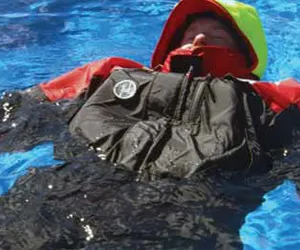
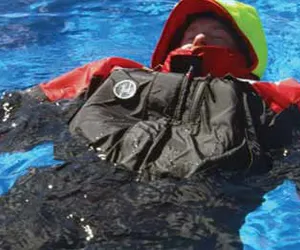
Thank you very much for the excellent review of the Firstwatch Flotation Bomber and Coat (PS, January 2013). I apologize that I did not provide Practical Sailor the design buoyancy of our coats. I provided the 15.5-pounds minimum buoyancy requirement of the USCG Type III standard, but the Firstwatch coats actual production buoyancy ranges from 16 pounds (size small) to 20 pounds (size XXL).
Ross Johnston
General Manager, Firstwatch Gear
Your January 2013 PS Advisor article on holding-tank vent fittings mentions check valves in the caption for the illustration. What check valves do you recommend? I am interested in using them rather than anti-siphon loops.
Brooke Harwood
Via email
The illustration we published with that article is based on a schematic produced by Sealand/Dometic (www.dometic.com). In that system, the check valves are internal components in the discharge pump; there is one on either side of the pump inlet and outlet.
These bicuspid joker valves are not infallible. They can get stiff and stick in an open position, and they need to be replaced at regular intervals. Some cleaning chemicals can also damage the valves-were currently testing this.
The concern, of course, with any overboard discharge pump is seawater back-siphoning into the boat. But with this system, there are two inline valves plus the pump that the water would have to bypass, so it offers a good measure of security; however, we still recommend taking the usual precautions like closing the below-the-waterline through-hull when leaving the boat.
We generally prefer vented loops, because they are cheaper, require no power, and are easier to maintain and visually inspect-although incorporating one usually extends the hose run.
I just had a boatyard recommend PPG ABC3 bottom paint for my fiberglass sailboat. I never heard of it before. Perhaps it should be included in the bottom paint tests? Do you know anything about ABC3?
Reggie Good
Submiy, Cal Cruising 36
Knot Ready, Cal 27 T/2
Lakeside, Mont.
ABC3 is made by PPG Protective and Marine Coatings (www.ppgpmc.com), a global company head-quartered in Pittsburgh, Penn. PPGs products, which include the Amercoat and Sigma lines, are generally marketed for commercial and military ships, not recreational fiberglass boats.
ABC3 is a high-performance, tin-free ablative with controlled self-polishing. One thing to keep in mind with these types of paints (epoxy ester resin mixed with a rosin), which were designed for working commercial ships, is that they tend to crack and flake when theyve been left out of the water for long periods, like during winter storage.
Weve never tested the ABC3 formula, however, Practical Sailor contributors Achim and Erika Ginsberg-Klemmt are carrying out an experiment on their Florida-based aluminum sloop using one of PPG Amercoats other paints, Dimetcote 21-5 (PS, May 2012), which the Ginsberg-Klemmts have been pleased with.
We hadn’t included PPG in our panel tests since they arent marketed to recreational boaters, but well see whether the ABC3 or other Amercoat products would be a good fit.
Your tests of paints and varnishes are very helpful, but you omitted testing an important coating quality: flexibility. A brittle finish may be more durable on a single piece of wood, but will it survive movement across a joint without cracking and allowing the ingress of water? Considering that wooden-boat owners purchase a disproportionate quantity of this goo, and that all wooden boats have joints that need a protective and durable coating, this is a critical attribute for both varnish and paint.
Secondly, my current favorite single-part varnish is Awlspar, which unfortunately was not in your most recent tests. I have found it substantially more durable than the other products in your tests; it brushes well and is fairly flexible.
Peter Gallant
Via email
Weve actually tested the Awlspar varnish in the past (PS, Nov. 15, 2001), and our results mirrored your experience. It wasnt the top pick, but it was in the winners circle with good gloss and color retention.
In regards to coating flexibility: Most of our wood-finish reviews have been based on exposure tests and focused on durability and longevity. But a flexibility test is an interesting prospect; well try to revise the test protocol for the next round of wood finish testing. In general, two-part varnishes will be less flexible than one-part varnishes or alternatives like Cetol, and most manufacturers will offer data on this.
I recently painted my boat with Blue Water Copper Pro SCX 67 Hard, having chosen the paint after reading that it was in the top of the list for several years in Practical Sailors in the water test in Florida. My boat is in the St. Johns River in Jacksonville, Fla., and was launched Oct. 24. I have used the boat at least once a week. [In early December], I noticed slime starting to grow around the waterline. Needless to say, I was disappointed, especially after the PS test indicated no growth for well over a year, if I remember correctly. I thought I would be good at least until next summer.
Robert Porter
Canadian Sailcraft 33
Jacksonville, Fla.
Thanks for your feedback. Our testing takes place in Sarasota, Fla., so it is helpful to hear how the tested paints perform in other waters. Based on our findings, the Copper Pro SCX 67 Hard should repel barnacles for at least 18 months in your area, but you will see some algae growth after the first six months.
In our last test report, (PS, October 2012), we rated the SCX 67 Hard as Good after 20 months. This indicates the test panel had some algae/slime, but no hard growth. We also recommended it for long-term protection against hard growth.
Each published report on bottom paint testing includes an explanation of the rating system: no slime and no hard growth is Excellent; panels with some slime or algae are rated Good or Fair; and any panel with hard growth is rated Poor.
I was prompted to write by a reader comment justifiably critical of 12-volt receptacles. I have replaced mine with the Powerlet-style connectors that are found on BMW motorcycles. The quality is much better; they are weatherproof, and a wide variety of styles are available. You can sometimes find them at Whitehorse Gear (www.whitehorsegear.com).
Steve Wann
Virginia