• Subscribe
  • Free Waypoints e-letter
  • Customer Service


Forgot Your Password?

  • Home
  • Sailboat Reviews

    Articles

    Boat Review: Marshall 22 Catboat

    The Pros and Cons of a Plumb Bow

    Boat Test: The Last Sabre 34 Mark II

    The San Juan 24

    Used Boat Review: Gulfstar 36

    Seawind 950: Some Assembly Required

    Sailboat Reviews

    Unbiased, detailed reports on dinghies, daysailers, racer-cruisers, cruising sailboats, and multihulls. Insights into boat construction and design. Solid advice on buying a sailboat.

    Sailboat Reviews - Index

  • Marine Electronics

    Articles

    Field Testing Kannad, McMurdo, and Mobilarm MOB Beacons

    Best Mid-priced Marine Stereos

    Garmin BlueCharts Mobile Sea Trail

    Where Credit Is Due: April 2013

    DeLorme inReach vs. Iridium Extreme

    Marine Electronics

    Extensive tests of GPS chartplotters, fishfinders, VHF radios, radar, AIS, navigation software, and handheld gadgets. Professional guidance on installing and operating high-tech sailing gear.

  • Sails, Rigging & Deck Gear

    Articles

    Anchor Tests: Bending More Shanks

    Mainsheet Tackle Bench Test

    Shockles Snubber Test

    Summer Sailing Gear

    Mailport: June 2013

    Sails, Rigging & Deck Gear

    Independent tests of halyards, sheets, furlers, anchors, snatch blocks, shackles, ropes, winches, vangs, cleats, booms, masts, and standing rigging. Expert guidance on choosing a mainsail, jib, or spinnaker.

  • Systems & Propulsion

    Articles

    Fuel-vent Filter Test Resources

    The Fine Art of Sensing the Wind

    DC Watermakers Head-to-head Test

    Stainless-steel Hose Clamps

    Propane-powered Propulsion

    Systems & Propulsion

    Comprehensive comparisons of pumps, batteries, solar panels, wind generators, inverter-chargers, watermakers, propellers, toilets, engines, and other marine systems. Tips on ship-shape installations.

  • Boat Maintenance

    Articles

    Mailport: May 2013

    Dehumidifier Field Tests

    Anti-Mildew Weapons

    Mailport: June 2013

    Where Credit Is Due: May 2013

    Boat Maintenance

    Bottom paints, topside paints, varnishes, waxes, protectants, cleaners, metal polishes. If it comes in a bottle or can, PS has tested it. Proven methods to protecting your floating investment.

  • Belowdecks & Amenities

    Articles

    Dehumidifier Field Tests

    Bends and Breaks: Anchor Shank Strength

    Portable Marine Toilets for Small Boats

    Portable Chairs for Sitting Under Sail

    Belowdecks & Amenities

    Our top picks in galley stoves, cookware, cabin lights, refrigeration, and entertainment systems can help turn your cruising boat into a home. Creative solutions to the challenges of living aboard.

  • Personal Gear & Apparel

    Articles

    Mailport: April 2013

    Kids’ Life Jackets for Active Sailors

    Summer Sailing Gear

    Gift Ideas for the Sailing Family

    Curing the Hardened Sole

    Personal Gear & Apparel

    Thorough test reports on binoculars, boat shoes, foul weather gear, hand-bearing compasses, sailing knives, flashlights, headlamps, sunglasses boots, and anything else that belongs in a skipper's seabag.

  • Safety & Seamanship

    Articles

    Crew Learns Along the Way

    Kids’ Life Jackets for Active Sailors

    Practical Tips for Survival at Sea

    Mailport: June 2013

    The Science of Safety

    Safety & Seamanship

    Our testers evaluate life jackets, flares, life rafts, harnesses, man-overboard strobes, medical kits, seasickness aids, and emergency devices. Tips on marine safety gear, boat-handling, and emergency procedures.

  • Mailport & PS Advisor

    Articles

    Mailport: March 2013

    Anti-Mildew Weapons

    Mailport: June 2013

    Indoor Sailboat Refinishing

    Where Credit is Due: March 2013

    Mailport & PS Advisor

    Insightful letters from sophisticated sailors. Do-it-yourself projects and reader feedback on a wide range of boats, marine manufacturers, and sailing products.

  • Inside Practical
    Sailor Blog

Safety At Sea

March 2013 Issue

Story Tools

  • Share |
  • E-Mail to a friend
  • E-Mail to the editor
  • Post a Reader comment
  • Printer Friendly

Practical Sailor PFD Research Looks at Capsizes

After a series of tragic accidents involving sailors in organized sailing events and training programs in 2011 and 2012, Practical Sailor initiated research into safety equipment in use during the time of these accidents. Our current ongoing tests deal specifically with personal flotation devices (PFDs), safety harnesses, and combination inflatable PFDs and safety harnesses. Ultimately, we hope to come up with recommendations similar to those we made for infant PFDs in June 2007, when we published a prototype of what our ideal infant PFD would look like.

Ralph Naranjo
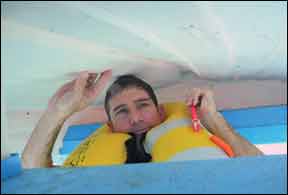
PS Editor Darrell Nicholson deflates an auto-inflated PFD underneath a capsized dinghy.

In response to our request for improvements to existing PFD and harness designs, dozens of readers have sent us their own ideas. One of the most common suggestions was a better “dump valve” similar to those that divers use to quickly release air from their buoyancy compensators. Many suggested that this feature would make it easier for a sailor to deflate an auto-inflating PFD if he were trapped under a boat.

Concern over sailors being trapped under a capsized boat isn’t new, but the topic has recently gained renewed attention—particularly in the small-boat arena. The 2012 US Sailing report about an Annapolis, Md., teenager drowning when the 420 she was sailing inverted, was soon followed by the deaths of two crew in the Chicago-Mackinac Race.

Survivors of the Chicago accident described how the auto-inflated PFD bladders and attached tethers impeded their escape. Advice from the crew of the 100-foot race boat Rambler, after it shed its keel and turned turtle in the 2011 Fastnet Race, carried more dire warnings about how an auto-inflating PFD can hamper one’s ability to get clear of an overturned hull. (See PS, September 2011, March 2012, April 2012, May 2012.)

In our first round of research into just what happens when such situations arise, Practical Sailor Editor Darrell Nicholson and Technical Editor Ralph Naranjo tested the role of buoyancy during a capsize situation. They greatly simplified the challenge by using an inverted dinghy in a swimming pool as their test boat. The tested life jackets ranged from a basic vest-style Type III life jacket from Mustang Survival to top-of-the-line inflatable PFD/harnesses from Revere Supply Co. and West Marine. While it was a foregone conclusion that the PFDs would impede testers’ ability to escape, what they did not expect was the degree to which some of the PFDs seriously interfered with one’s ability to simply get oriented under the boat. Add a wide deck, running rigging, lifelines, and even a mild swell into the equation, and it became quite obvious how a life jacket can turn into a trap.
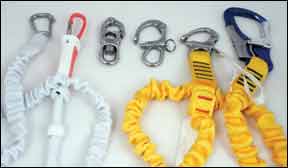
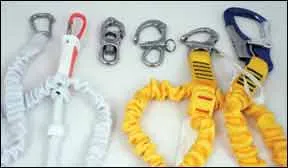
Other PS tests are looking at various tether quick releases, including (from left) a Nash kiteboard tether, Tylaska T8 snap shackle, Ronstan RF 6200, and the West Marine snap shackle that was subject to a voluntary recall in 2010. (See PS, September 2011.)

In other sports, participants recognize how essential gear can become a hazard, and they are trained how to respond in that event. Scuba diving courses teach beginners how to don and doff their tanks and buoyancy compensators. Sailors need the same kind of awareness and need to recognize the importance of being able to quickly release a tether or PFD. Some years ago, Type III life jackets had a drawstring that could be knotted, making quick release all but impossible. Today, there are harness-tethers attached to inflatable PFDs that lack a quick-release clip. They must be cut to affect an escape. In our opinion, this is as much of a potential hazard, and all PFDs should be easy to release.

One of the most important observations made during this initial round of testing was how important it is to practice bleeding air from the PFD bladders. All it takes is a pinky finger press on the Schrader-like valve in the oral inflation tube, but without practice and during an emergency, the task can be tricky—particularly if you are wearing gloves or have large fingers. Re-inflation using the same tube was easier, but is also worth practicing.

In the second phase of this test, we’ll be looking at specific gear and evaluating factors such as the ease with which each can be put on and removed.  We’ll evaluate the likelihood of tethers and thigh straps tangling with rigging and hardware and how the equipment behaves when a crew attempts to scurry back on board, swim to a life raft, or reach a flotation device. We will also be looking at several different types of quick-release shackles for use in tethers—including some shackles currently being used by the U.S. military and action sports like kite boarding. We continue to invite reader input on this topic.

Read More on These Topics
  • Lifejackets and Harnesses
  • Personal Gear & Apparel
  • Safety & Seamanship

Comments (0)

Be the first to comment on this post using the section below.


Add your comments ...

New to Practical Sailor? Register for Free!

Already Registered? Log in

Forgot your password? Click Here.

Advanced Search

Related Items

Articles

  • Mailport: June 2013
  • Kids’ Life Jackets for Active Sailors

Current Issue

Cover Image

June 2013

  • Mainsheet Tackle Bench Test
  • Kids’ Life Jackets for Active Sailors
  • Dehumidifier Field Tests
  • Shockles Snubber Test
  • Summer Sailing Gear

Subscribe Today

Back Issue Archive

Resources

  • Practical Sailor Dinghy Survey Results
  • DIY Boatyard Survey
  • Sailboat Reviews - Index
  • DIY Projects
  • Bookstore
  • Issue Archives
  • Other Resources
  • Customer Service
  • About Us
  • Home
  • Subscribe
  • Give a Gift
  • Renew
  • Products
  • Customer Service
  • Privacy Policy
  • About Us
  • FAQs
  • Contact Us
Practical Sailor

© 2013 Belvoir Media Group, LLC. All rights reserved.