


A Homemade Tiller Tender
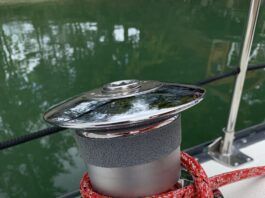
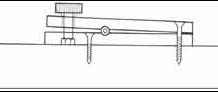
On my Catalina 22 I have a tiller tender which has served me well for many years — and it didn't cost a cent. On top of the tiller are two pieces of 3/8" x 3/4" hardwood about 5" long. The two pieces are drilled horizontally, at the joint line, about 2" from the end to accommodate a 3" length of split neoprene which has an inside diameter slightly less than the diameter of the braided line which runs to the coamings. Two holes drilled vertically near the ends are used to fasten the device to the tiller.

Lay New Nonskid to Restore Worn Decks
We don't really know what the life expectancy of a fiberglass boat may be. There are lots of them out there that are more than 20 years old, still going strong. We do know, however, that no matter how longlived fiberglass may be as a structural material, over time the gelcoat surface commonly used in finishing fiberglass becomes porous and chalky, and has the unfortunate tendency to crack and craze. Gelcoat, in other words, weathers just as a painted surface will over time. With topsides, a tired gelcoat surface can be restored to better than new condition through the use of polyurethane paints, which can retain color and gloss for years. Decks, however, are another story.

Adjust Your Own Compass
With a little care, boatowners can do a perfectly adequate job of compensating their own compasses. The objective in compass adjusting is to neutralize the boat's magnetism, not to make the compass point in any particular direction. You can determine the effect of the boat's magnetic field on any compass bearing by simply turning the boat 180 for the amount that the compass overshoots or under‑shoots a 180' change is always just twice the effect of the boat's field on that heading.
Proper Fastenings: Don’t Screw Up
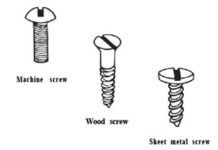
The ultimate in trivial significance is probably Richard III's lament about losing a battle for lack of a nail. By contrast, use a nail in a fiberglass boat and it's likely the boat will be lost. Nails as well as wood screws have little application on a modern boat. The reason is simple: almost any fastener will do a better job than either. In this day and age the most practical fastener material is stainless…
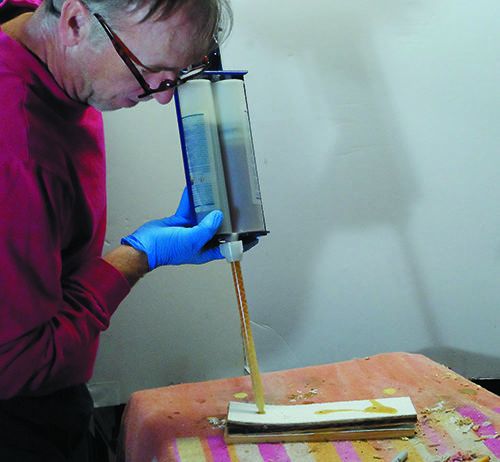
Replacing Teak Decks, the DIY-er’s Way
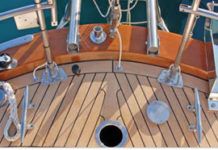
Practical Sailor contributor and world cruiser Joe Minick details the steps he and his wife took to replace the wornout teak deck aboard their Mason 43, Southern Cross. Minick breaks down the major tasks of the three-month project and explains how they saved a lot of money by doing some of the work themselves. The article looks at the pros and cons of a do-it-yourself teak deck refit; planning and budgeting; step-by-step removal of hardware and the old deck; and the detailed installation process of the new deck.

Winterizing the Engine: Maintenance that Is Truly Preventive
Winterizing an inboard engine installation means a lot more than filling the cooling system with antifreeze and stuffing a rag in the exhaust outlet. It means taking care of the exhaust system, the fuel system, the engine controls, and other components of the drive train, such as the shaft and prop. If you want to do these things yourself — none of them is difficult, only time consuming — plan on a long day of work, or perhaps a leisurely weekend. It's work that will pay off, however, both in improved understanding of your boat's propulsion system, and in money saved. At $25 per hour, the simple projects described here will save you about $200. Few special tools are required, and the only skill necessary is a modicum of common sense.

Where Credit is Due: June 2011
Letters to Practical Sailor, June 2011. This month's letters cover subjects such as: Precision Boat Works, Groco, and More!

Chandlery: June 2011
Although the ease and convenience of electronic chartplotters has ensured their place aboard most every vessel these days, the punch-and-go navigation that makes them so popular has also spawned a generation of slack-jawed zombies when it comes to even the most rudimentary of navigational skills. Prudent mariners continue to carry paper charts, both as backup to chartplotters (and their “one diode away from disaster” nature) and to have the big picture view that a plotter just can’t match.
PS Advisor: Rotten to the Core
Do you have any suggestions on a book or manual that explains how to replace a cored deck where most of it is soaking wet? I replaced a 1.5-square-foot area and was surprised to see that it was so wet and rotten that I could grab the wood core and squeeze it like a sponge.
Laid Teak Decks: Hallmark of Quality
There was a time when laid decks — teak, yellow pine, or fir — were the hallmark of a true yacht. The bare wood gave secure footing, easy maintenance, and reasonable protection from leaks. Since the advent of fiberglass, those same laid decks, almost universally of teak, have continued to represent that hallmark. However, they have become at least as much a cosmetic feature as a functional one. Teak decks, cockpit seats, cockpit sole, hatchtops, and cabin sole all lend themselves to being planked (or sheathed) in a traditional manner Almost no project can do more to "dress up" a boat than some laid decking, and it is a job the average boatowner can do himself. This article describes a simple method for laying decking, one we have used ourselves.

O’Day 40 – A Budget Cruiser for the Bahamas
The O’Day 40 (1986) is one of those cruising sailboats that somehow slipped through the cracks of sailing history. Built during the final years...



Latest Sailboat Review
Caliber 33 Used Boat Review
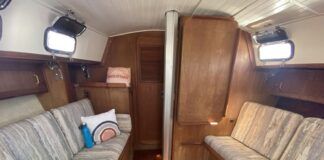
The Caliber is a peculiar blend of tradition and innovation, of security and performance, of practicality and pizzazz. All of the owners we heard from were "satisfied." One called the 33 his favorite boat over six decades of sailing.