

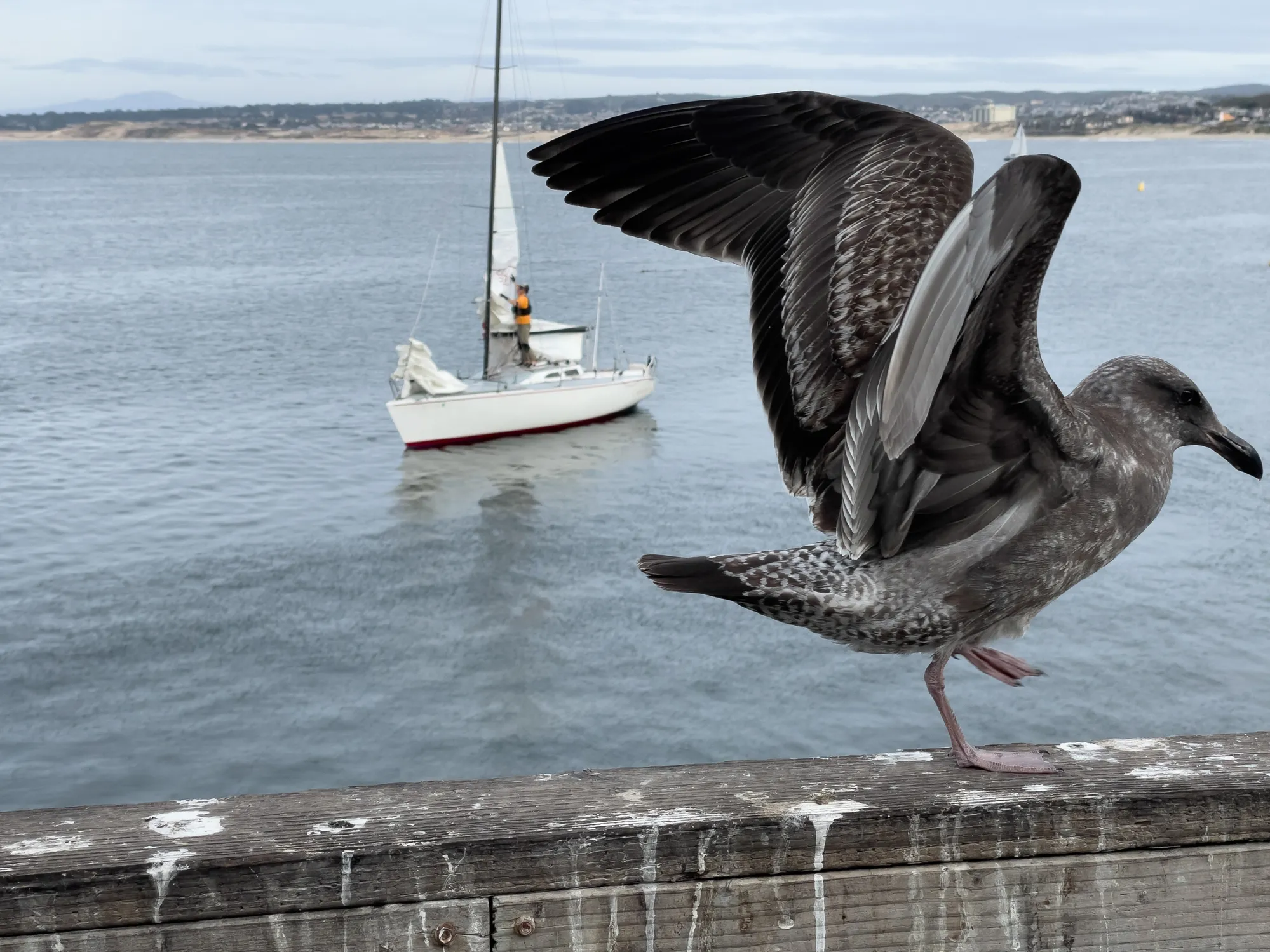
Guano and other bird scat can cause maintenance headaches and can be damaging to boats, particularly those left unattended. Most readers are familiar with these problems, and—as we’ve found—nearly every boat owner has a story about their battle with the birds.
Why so much fuss about a little poo you might ask? Well, despite the negative connotations of the term “bird brain,” it turns out that birds can be resolute foes in the battle to keep your boat clean. Experts assert that birds adjust quickly to uniform movements or noise patterns, so visual and aural devices will affect them only temporarily. And, it’s proven that if there’s a food source near a boat’s berth—fish, oysters, shrimp, crabs—most birds will endure significant hardship simply to feed. Further, birds feeding will very likely attract other birds, compounding the problem.
Practical Sailor set out to conduct a test of different bird repellents to determine which methods prove most effective for keeping these fouling fowl off boats. Though there are only a handful of manufacturers making such devices in the U.S., there are dozens of products marketed as bird deterrents. And, unfortunately, this array doesn’t lend itself to easy comparison. The situation is beyond apples and oranges; it’s more like an entire fruit bowl.
A Little Context
Bird repellents fit into four basic categories: acoustical repellents, visual repellents, biochemical repellents and those that use physical exclusion. We chose to focus primarily on visual devices as these are the type most common on sailboats, and in many cases, they’re the easiest and most economical to obtain and install.
Many marinas and waterfront businesses often rely on strung monofilament fishing line to deter birds from roosting or frequenting their premises (an instance of physical exclusion). Without question, this is the most economical approach. But, for sailors, setting up and taking down yards and yards of fishing line every time you use your boat can be cumbersome.
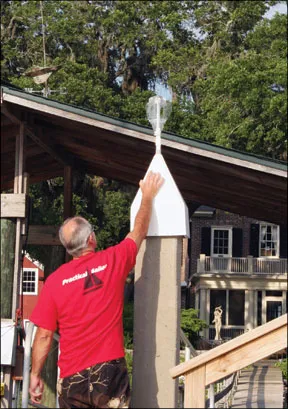
Within each basic category is a variety of product styles, and there’s good reason for this. Many experts on the topic agree that bird deterrence is most effective when different methods are used in combination. One type of device, say a physical exclusion apparatus like a panel of spikes, may work well along a boat’s boom, but will be largely ineffective on a broad deck or cabinhouse. An inflatable balloon device with reflective eyes might keep the foredeck clear if suspended between the mast and forestay, but it will have little effect on birds that perch on the spreaders, masthead or stern pulpit.
These realities made it difficult for us to devise a test that would equitably evaluate each type of device. And, early into our six-month test, it became apparent that the most useful information we could offer readers would be a rundown on the principal kinds of devices coupled with observations and anecdotes about the applications in which they’re most effective.
What We Tested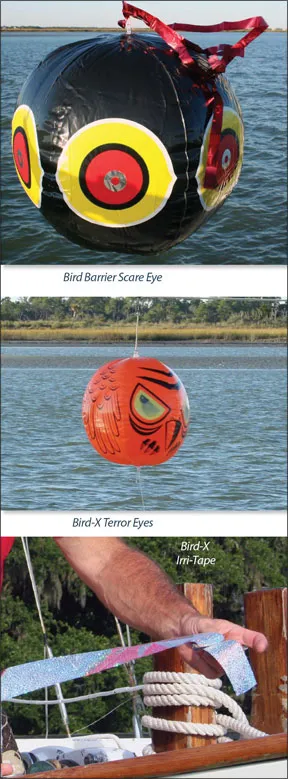
- Bird Barrier’s Scare Eye: A bright yellow or black vinyl balloon that measures 24 inches in diameter. It has multiple large eyes with reflective pupils and is designed to be suspended.
- Bird-X’s Terror Eyes: A bright orange vinyl balloon with holographic decals in the shape of owl eyes. It measures 24 inches in diameter and has attachment points at both the top and the bottom.
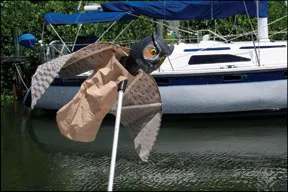
- Bird-X’s Prowler Owl: A life-size replica of a great horned owl that mounts on a pole. Its head is molded from hard plastic, and its wings and tail are made of robust paper. The entire device is designed to rotate relative to the wind direction.
- Bird-X’s Irri-Tape: 2-in.-wide iridescent foil tape printed with a holographic pattern. Designed to use sight and sound (it rustles) to deter birds, it also can be strung to form a physical barrier. It comes with metal wire mounts.
Physical Exclusion Devices
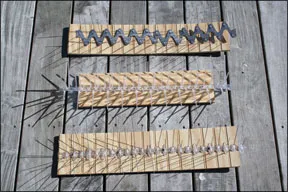
- Bird Barrier’s Polly-Spike: Clear plastic spikes fabricated in interlocking, 2-ft. lengths with spikes set every half-inch. The spikes are 5-in. long, and panels come in various widths with two to five spikes.
- Bird Barrier’s Bird-Flight: 5-in. metal spikes mounted to a narrow polycarbonate base. Spikes are 5-in. long; panels come in 1-ft. lengths and span 3 or 6 inches.
- Fly Bye’s Stainless Steel Wide Spike: 4-in., stainless steel spikes clipped to a stainless base, these come in 1-ft. lengths.
- Fly Bye’s Bird Umbrella: Fourteen 24-in., stainless-steel rods extend from a flat stainless base, which mounts with screws or can be tied down.
- Bird Barrier’s Daddi Long Legs: 12 thin, stainless rods mounted on a rotating Delrin base (comes with adhesive neoprene gasket and optional sandbag base); rods have weighted tips. It comes in 4-, 6-, and 8-ft. diameters.
- Bird-B-Gone’s Bird Spider: 12 stainless rods protrude from a central polycarbonate base (in 4- or 8-ft. diameters). Antennae ends are bent in a loop and covered with a hard plastic that allows them to move with the wind.
- BirdOff’s Bird Off: 50-lb. monofilament line runs through a series of plastic rail-mounting clips sized for 1-in. tubular rails. It comes in one length, suitable for protecting 45 ft. of railing.
Rotating Devices
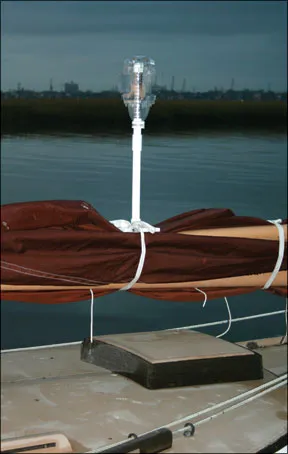
- WhirlyBird Repeller: Clear plastic jug-shaped device that rotates around a central PVC mounting post with the wind. It’s designed to resemble a bird of prey with small, dark eyes. It makes some noise when spinning and has reflective tape inside that refracts through the clear plastic even when its still. See “Whirlie Bird Anti-Fowlant.”
- Gull Sweep: A 6-ft. anodized aluminum arm with small stiff panels at each end. The arm rotates around a central stainless pin when the wind blows. It can be mounted in numerous ways.
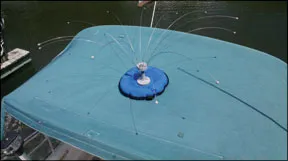
- Bird-B-Gone’s Solar Bird Repeller: Two antennae rotate steadily around a central plastic base powered by the sun via a 16-in. square, adjustable photovoltaic panel. Antennae are adjustable up to a 5-ft. diameter. Several mounting options are possible, and the device works on any angle as well as in low-light conditions. (Two AA batteries can be added to extend operation.)
How We Tested
We conducted our test at Sunset Cay Marina near Charleston, S.C. This site sits on the marsh-lined Folly River in protected waters, roughly a quarter-mile from the beach. The manager verified that gulls and pelicans are the most frequent nuisance for his customers, but he also told us that other birds frequent the docks and boats there. During our multiple visits to the test site, we witnessed various species of herons, cormorants, black skimmers and pigeons.
For six months, the devices were deployed on little-used portions of two floating finger piers. We spaced them out in an equitable fashion, grouping like products. We returned intermittently to record and assess the functionality of the test devices. (At the manager’s request, the Prowler Owl was deployed on the marina office’s second-story balcony to deter pigeons from roosting beneath it.) During the test period, the devices endured storms with plenty of wind, blazing sun and temperatures that ranged from near-freezing to 86 F.
Our Findings
It is customary for bird deterrent marketers to make claims about the amount of space protected by their devices. Among the physical exclusion devices, the spiked products protected the smallest area. Our testers found bird droppings fewer than 10 inches from each of the spiked panels. These might be effective along the top of a boom or other narrow surface, but you’d need an unwieldy number of them to protect a cockpit, deck or cabintop.
Spider-Like Devices
The three spider-like devices performed similarly. Practical Sailor testers regularly found deposits of bird poo near the outer periphery of each. On two occasions, several of the rod arms on Fly Bye’s Bird Umbrella were found tangled, causing them to be less effective as they projected over a smaller area.
Though the performances of the spider devices were similar, we deemed Bird Barriers Daddi Long Legs the best of the three because its base allows the device to rotate, the weighted ends of the rod arms accentuate any motion, and it can be mounted on decks, biminis, booms or rails.
Spaced properly, these devices should adequately protect a foredeck space, a cabintop or a cockpit, as well as a boom or canopy, but our testers found no easy application for using them in a rig.
Monofilament Line Systems
BirdOff’s Bird Off would seem to have the most versatile application. Unlike the spider-like deterrents, the Bird Off isn’t designed to move, but it can be strung along lifelines, rails, or spreaders, above booms and across cockpits or decks to dissuade birds from perching. You just have to allow time for coiling up all the monofilament line and gathering the clips when you’re ready to set sail.
Visual Deterrents
We didn’t have much luck with two of the visual deterrents from Bird-X. The sections of Irri-Tape that we had tied to a folded bimini were gone in less than a month. Designed to rustle in the wind, the tape did just that, but tore at the knots and fluttered away.
The Irri-Tape did make noise in the breeze and did reflect the light. Had our testers been able to mount it using the wire brackets provided by Bird-X, the product likely would have fared better. We found the Bird-X Terror Eyes deflated and in the water after just three weeks with a tear in one upper seam. The early demise likely resulted from the fact that testers mounted the balloon using both the top and bottom attachment points, which evidently restricted its motion too much.
In contrast, Bird Barrier’s Scare Eye comes with just one attachment point on top, and it was still swinging in the wind after that first month, though it blew away some time during the following 30 days. During the time that they were on station, both the Scare Eye and the Terror Eyes appear to have succeeded in deterring birds from sullying their areas.
The Prowler Owl had little effect on the pigeons, but it did keep the gulls from roosting nearby. After two weeks in the elements, a rivet on its left wing broke, leaving the owl asymmetrical, but still moving in the wind. After 10 weeks on station, the device blew off its pole mount during a storm and was never found. We recommend a set screw for mounting.
Rotating Devices
Of the three rotating devices tested, the WhirlyBird Repeller seems the most versatile. It makes a small amount of noise when rotating, and the holographic tape on its central post refracts through the clear plastic. However, after a few months of use, the test WhirlyBird stopped rotating. The inventor explained that this was a result of grit clogging the Delrin bearing and suggested rinsing it with fresh water regularly to keep this from happening. On our final visit, the WhirlyBird was missing the bearing and rotated infrequently.
The Gull Sweep continued to rotate throughout the test, but it didn’t prove any more of a deterrent than the WhirlyBird Repeller or Bird-B-Gone’s solar-powered Bird Deterrent. The latter rotated impressively, with the solar panel providing sufficient juice even on cloudy days. Practical Sailor testers found it stopped during only one visit, but the telescoping antennae are prone to rust and one snapped off when testers attempted to remove the rust by retracting the antenna.
Sonic Methods
One Bird-X product that we received did not fit the test platform, so it wasn’t tested. But the approach seems promising for boats kept at a dock where access to power isn’t an issue. The X-peller Pro, a 110-volt electronic device, emits sound to deter birds and retails for $398.
Conclusions
Successful bird deterrence is a complex business. One device may work well for seagulls and pelicans, but not so well for cormorants and osprey. Another might protect your deck, but not your lifelines or your rigging. And most devices might dissuade waterfowl from roosting for a few days, but if your boat is inactive for much longer, the birds will grow accustomed to most devices, and sooner or later, they’ll be onboard wreaking havoc. For these reasons, the most successful defense requires combining different approaches and products. However, the devices are only valuable if they continue to work, and that means they must be durable and stand up to the rigors of the marine environment.
Though our test findings aren’t conclusive, they do indicate specific issues to be aware of with several of these products.
- Bird-B-Gone’s solar-powered Bird Repeller was impressive because it continued to rotate throughout six months, but be advised that the extendable antennae are prone to rust. You’ll want to lubricate them regularly to avoid rust build-up.
- The WhirlyBird Repeller should be mounted above head height and rinsed occasionally with fresh water for best results.
- The Irri-Tape might seem a good bet as it can provide visual and auditory deterrence as well as physical exclusion, but you’ll want to explore alternate means for securing it to your boat. Bird-X stipulates tying it off or clamping the ends securely. (We recommend the use of packaging tape.) Also, the same shiny quality that spooks birds will make Irri-Tape look like food to underwater animals if it becomes litter in the waterway.
Choosing a Mix of Deterrents
Ultimately, if you want your boat to remain clean, the best approach will involve some mixture of devices. Mark Thorsell of Bird Barrier, concurs. “A combination of products is definitely better,” he told us. Among sailboat owners, said Thorsell, the Daddi Long Legs is his company’s most popular product.
In our opinion, coupled with either a Scare Eye or a Terror Eye in the foretriangle and near the backstay, several Daddi Long Legs should protect most areas of your boat if properly attended to from time to time.
Durability and Maintenance
And that’s the rub. Over the span of six months, essentially every product we evaluated except for the three spike panels exhibited some degradation. With the exception of those panels, you’ll likely have to replace all of these products inside of a year unless you take the time to maintain them.
So, what’s the solution? Figure out which combination of devices best suits your boat’s configuration and location, and then plan on checking in on the setup regularly to adjust the positioning of the products and maintain them.
This article was published on 16 March 2010 and has been updated.








I moor my boat to a buoy 24/7/365, its not in a marina. I have been reasonably successful in keeping birds off my boom canvas after installing a stern arch with solar panels…now all I have to do is find out how to keep them off the solar panels without disturbing the charging.
I use a Davis shiny gold radar reflector (cardboard one) suspended from my boom right over the cockpit. It moves with wind and water surface disturbance and keeps large birds from settling into the cockpit to get out of the wind. I use a fake rattle snake on top of the cabin entrance and a tightly strung “bird line” over the top of my boom canvas to keep the small blackbirds from lining up on the canvass. All this is not perfect but helps.
You missed the newest and most productive bird deterrent for boats, on the market. The “Shuubird”.
Visit the website at SHUUBIRD.COM and review the devise for sail and power boats that has a 95% success rate in New England, Florida, California, the Bahamas, and Australia.
The Shuubird was patented last year, is easy to install, and easy to store went your boat is in use.
Many good references from boat owners are available.
Visit SHUUBIRD.COM and scroll “MORE” for deployments.
95% sucess rate – total rubbish!!
I have been using a single monofilament line from my bow eye to the highest point on my mast that I can reach to my davit in the rear and I am always amazed that the birds stay off the boat. Adjacent boats are sometimes covered in poop and my boat has only one or two spots.
While managing Crandon Marina and Pelican Harbor marina in Miami we had problems with Pelicans and Cormorants. The use of monofilament was not allowed to be use in the marina because the damage done to the birds. Ever see a dead bird tangled in a monofilament line hanging for over a week.
With the help from a cormorant researcher at the Univ. of Miami we found that making what looks like a cheerleader pompom out of red plastic construction tape on a dowel and run it up the mast kept the pelicans and cormorants away. Red is the only color that works. Blue attracted them.
We tried an owl but a pelican befriended him and sat with him.
been using it for years here in the Carolinas. Never seen it catch one bird or see a bird hit it the whole time I was a Dock master one of the largest Marinas in the state. It works well and is bird friendly as long as it 200lb plus. The birds don’t hit it, they see it.
Thanks for your tips on how to deter birds from your dock. My father just bought a boat and is planning to get a dock construction company to build a dock near our lakehouse. Since I expect he’ll be telling me to clean up his dock whenever birds poop on it like he makes me do with his boat, I thought it’d be a good idea to look up how to repel them instead. I’m a big fan of simply adding spikes to the spots where birds choose to hang out. That sounds simple enough for me to do myself, and once the dock gets built I’ll have to try building that on my own.
I live in a rural farming community and periodically I come across dead owls and hawks. I clean the birds, air out the bodies, then fill with foam beads. Hang from rigging. It works.
I had the misfortune of being in a marina for the tail end of last season that was notorious for its “birds” and the redecorating they do to the decks and anything else they can perch on with their poop.
2 weeks after arriving my boat was not spared. It was blanketed from nose to tail with that white spackle. Oddly enough it was most prevalent on my bimini, dodger and sail cover (all blue) – the open space of the rest of my top side was not too bad.
One person I ran into at the marina suggested I use an inflatable German Shepard (found on Amazon for around $6). I was skeptical – but really when you see your boat covered in poop, what do you have to lose by spending $6 to try?
So I bought 2 and after a good cleaning (that took me 2-3hours of scrubbing and power washing) I attached one to my boom and the other to my backstay as it passed through my bimini. Back to the mooring ball I went.
When I cam back 2 weeks later, amazingly enough there was very little in the way of new additions. I am not saying it prevented any of it from re-appearing, but considering what I cleaned off relative to what was added, the German Shepards did their work diligently! I wouldn’t leave them unattended for 6 months (I earn no cheap inflatable toy will last that long) but for $12 I think they did the job pretty well!