




The Old Salt’s Solution to Chafe Prevention
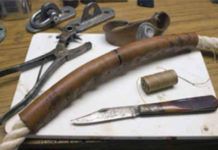
Our approach to chafe protection for the upcoming storm season was straight out of the old-salt playbook. Using a sharp knife and metal straight edge, we lopped off the size of leather we needed. Holes were punched opposite each other at 1/2-inch intervals, and for temporary use, we zigzagged small cord the length of the leather. For a more permanent installation, we hand-stitched the leather in place, tucking locking stitches into the rope at each end. Holes were made with a pliers-like hole punch, and we fashioned our chafe strips to be long enough to cover the hard points, adding an additional 25 percent to the length to handle stretch and any minor slippage.

Bottom Paint Removal Decision Time
However you choose to use your scarce time, we’ll wager that you’d rather not spend it removing bottom paint. If you are an owner of an older boat with a decade of accumulated hard bottom paint that is flaking and cracking, now is a good time to start weighing your options for removing the old paint. Should you do it yourself, or hire the professionals—or a bit of both? Our experts break down the different approaches to removing old antifouling and the compare the estimated costs of each.

Homemade Mildew Preventers That Really Work
If youre getting ready for sailing this summer and feel like you are still losing the battle against mildew, then youll probably be interested in some of the cheap and easy mildew "cures" we've come upon in our testing. PS tester Drew Frye made a pleasant little discovery when he was researching and testing various anti-mildew protectants. Two inexpensive homemade concoctions did as well as or better than retail formulas that are 20 to 100 times more expensive.
A Practical Approach to Cabin Sole Finish
The challenge with finishing a veneer-and-plywood sole is finding a product that offers long-lasting protection for the wood and gives a secure footing when the cabin sole is wet. Varnishes suitable for protection and durability do not have intrinsically good nonskid characteristics. We recommend using a satin-finish, one-part polyurethane varnish to protect the thin veneer and plywood, and adding some nonskid aggregate to the final coats to reduce the slippery-when-wet effect.

The Penny Pincher’s Guide to Discount Sailmakers
There are a number of details to consider when ordering a sail. Cloth types and weights should correspond to the kind of sailing you do as well as your expectations for the sail's longevity. For the mainsail, there are questions regarding the number of reefs you want, and where to put them. Genoas will need to have the appropriately-sized luff tape to fit an existing roller furling unit (or the right size hanks). Another option specific to furling units is whether to have a foam luff sewn into the sail.

Paint Brushes for Boat Projects
Brush choice depends on what the brush’s job will be (transferring paint, smoothing paint, etc.), the user’s preferences, and the project budget. The best brush isn’t necessarily the best brush for the project. You wouldn’t use a $40 brush that requires meticulous cleaning to paint the bilge or apply bottom paint, just as you wouldn’t use a throw-away chip brush to lay a final coat of varnish on the toerail—at least we wouldn’t.

Keel Bolt Inspection and Repair
Despite advances in imaging technology, keel bolts are still very difficult to fully inspect without a bit of surgery. Fortunately, some hints of trouble are obvious, like large gaps in the keel-stub joint, weeping rust stains near the keel-stub joint or crumbling bolt-ends in the bilge. A typical problem that many owners face is the ever-widening gap between the keel and stub, often referred to as a smile, since it usually appears at the bow of the boat and assumes the sardonic curve of a slack tightrope.
Can Copper Antifouling Paint Be Kind?
For those who care about reducing their impact on the ocean, the annual ritual of applying bottom paint this raises a question: If we want to stick with time-tested copper biocide in our paint (as opposed to copper-free antifouling), which type of paint-hard or ablative-is easier on the environment?
Don’t Let Refit Pitfalls Derail Your Cruising Plans
After the challenges of the past couple of years, it's no surprise that many new sailors are regarding the cruising life away as an antidote to the madness ashore. We seem to have reached an interesting period in history when a retirement boom, a surplus of fixer-upper sailboats, the normalization of remote work, and a generation that celebrates the unconventional life is making cruising sailing—an endeavor once reserved to adventurers stricken by South Seas fantasies—seem like a perfectly logical path. While there is no shortage of books that tell you what you need to do to go cruising, but very few seem to caution about what not to do or what to avoid. Here are a few things that I found get in the way of a long-term sailing escape.
PS Seeking Reports of 3M 4000 UV Failure
Six years ago (“Marine Sealant Adhesion Tests,” published November 2016) Practical Sailor began exposing samples of marine sealants to weather and sunlight to compare...

Morgan 382 – The $30K Boat Nobody Talks About
The Morgan 382 might be one of the most overlooked cruising sailboats ever built. Designed by legendary naval architect Ted Brewer and produced between...



Latest Sailboat Review

Caliber 33 Used Boat Review
The Caliber is a peculiar blend of tradition and innovation, of security and performance, of practicality and pizzazz. All of the owners we heard from were "satisfied." One called the 33 his favorite boat over six decades of sailing.