

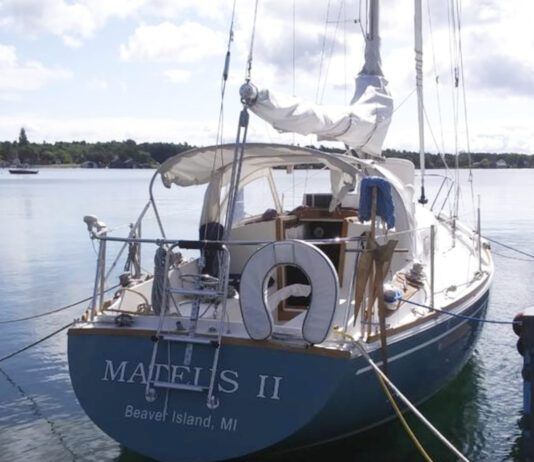
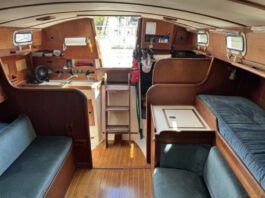
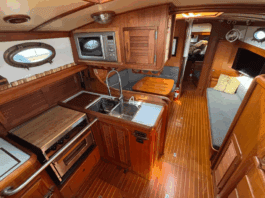
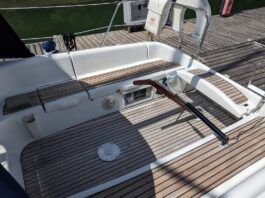
Island Packet 440
Light-wind performance aside, the IP 440 is built to go places.
Catalina 22 Used Boat Review
In its 10th anniversary issue in 1980, Sail magazine named the Catalina 22 the boat that had represented the "breakthrough" in "trailer/cruisers" in those 10 years. We might quibble with its selection over more out-and-out trailerable boats such as the Ventures, but there is no denying the popularity of the Catalina: more than 10,000 have been built and sales continue to be strong.For many buyers the Catalina 22 is their first "big" boat and an introduction to the Catalina line. Many remain with Catalina and buy up within that line.
Beneteau 46 Used Boat Review
At last winter’s Paris Boat Show, Beneteau Groupe debuted a four-boat line intended to capitalize on its “design advantage.” Light and space were emphasized. “Ease of handling” and “intimacy with the elements” were buzzwords. The Beneteau 46 is a performance cruiser—long, low, and streamlined. Although it may look too racy to be a cruising boat, it is unique, attractive, and easy to handle. Its lowered center of gravity and elevated freeboard give it more initial stability than previous designs, and its mega-beam and firm bilges give it the power to carry sail well up the wind range. The 46 couples the naval architecture of Jean Berret and Olivier Racoupeau with an interior designed by Massimo Gino and Mario Pedol of Milan’s Nauto Yachts. Pros on deck include wide sidedecks, twin wheels that provide good visibility from the helm, adequate ventilation for warm climates, and a divided anchor locker. At sea with 10 knots of breeze, testers found that the Beneteau 46 helm remained light and the boat tacked through 90 degrees with minimal fuss. They noted a balanced helm and easy steering under both sail and power.

Caliber 40 LRC Used Boat Review
This well-built cruising boat, Caliber 40 LRC with an attractive wood interior has loads of room but sails marginally to windward and has a few problems with its tanks.
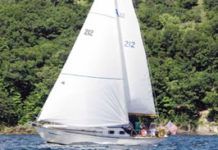
Alberg 35 Offers Classic Escape
The Alberg 35 dates back to the dawn of big-time fiberglass sailboat building. Its production began in 1961, just a year after Hinckley stopped building production wooden sailboats. Two years earlier, in 1959, Pearson built the first Triton, the boat that was the prototype of the inexpensive, small family, fiberglass cruising sailboat. The Tritons big selling point was a low-maintenance hull that Mom and Pop and the kids didnt have to spend all spring in the boatyard, getting it ready for the summer.
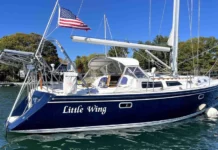
Catalina 42 Mk I and Mk II
One of the most successful large boats ever built, the Catalina 42 offers good looks, comfortable accommodations, and decent sailing ability at a low price.
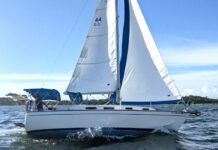
Pearson 303 Used Boat Review
The Pearson 303 is a big 30-footer, intended for safe coastal cruising. She admirably succeeds in doing what she was designed to do. The only risk accrues to those who mistake her for something she is not -- an offshore, passage-making boat. While it’s easy to overlook the Pearson 303 as another member of a fleet that looks depressingly similar and lacking in pizzazz, the 303 is a wholesome family cruiser with a workable, traditional interior, acceptable performance and above average construction. Hey, what’s not to like?

Grampian 26 Used Boat Review
The first fiberglass auxiliary sailboats were built in the late 1950s. The burgeoning industry reached full bloom in the early 1970s, but the 1960s saw a rapid increase in the number of builders hoping to cash in on the new miracle material of fiberglass. No seams, no rot, no water absorption...or so we thought. Still, the claims were largely accurate, and even though the ad agencies were quick with hyperbole, the public bought it. By 1961, a handful of European builders were also working with woven glass fibers and polyester resin, laying up hulls in female molds. In Canada, one of the first was Grampian Marine Limited of Oakville, Ontario.
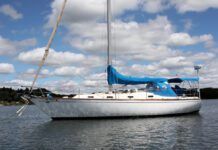
Tartan 37 Used Boat Review
The Tartan 37 is a moderately high performance, shoal-draft cruiser built between 1967 and 1988 by Tartan Marine, a company that helped usher in the fiberglass era under Charlie Britton in the 1960s. At the time of the Tartan 37s introduction, the company had its headquarters in Grand River, Ohio, and a factory in Hamlet, N.C.
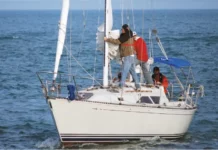
C&C 33 Mark II Used Boat Review
When the C&C company shut down operations in 1986, it was big news in the North American boating community. Since the companys formation in 1969, it had been a stalwart of the industry-the leading Canadian builder, by far, and one of the major brands wherever fiberglass sailboats raced or cruised.
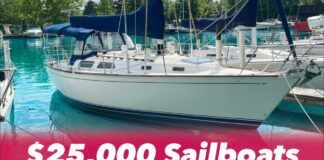
Affordable AND Good? Sabre 34 Mk II Review
Can you buy a good sailboat for $25,000? In this video we take a deep dive into the Sabre 34 Mk II, a proven...



Latest Sailboat Review
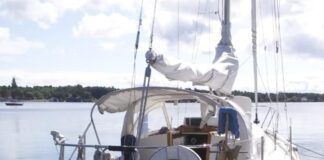
Tartan 30: An Affordable Classic
The early 1970s was the heyday of the Tartan 30' racer/cruiser. In all, no less than two dozen boats of a similar size and type were introduced in just three years, many of them to become highly successful among sailors eager for the performance and amenities of big boats at a modest price. Among the most noteworthy and enduring of the 30-footers from this era has been the Tartan 30.