

The Morgan 41 sloop is arguably one of the best looking of many lovely dual-purpose sailboats that the Cruising Club of America handicap rating system engendered. One owner described his boat as a Bermuda 40 for a regular Joe, only prettier. Morgan, who strove hard to erase sailings elitist reputation, would no doubt be pleased by the analogy—he died in 2023. Designer Charley Morgan traces the cruiser-racer’s heritage, particularly below the waterline, back to Olin Stephens’ famous Finisterre, and Comanche, a 40-foot centerboarder built by Wirth Munroe, son of famed sharpie designer and South Florida pioneer “Commodore” Ralph Munroe.
History
In 1966, long before Charley Morgan’s well-known Out Island 41 took the Caribbean charterboat scene by storm, the “other” Morgan 41 emerged from then-nascent Morgan Yachts in St. Petersburg, Florida. Not yet 37 years old, Morgan was well on his way to becoming one of the most recognizable names in fiberglass boat design. The cruiser/racer Morgan 41 embodied many aspects of two of Morgan’s most successful custom designs at that time, Paper Tiger, which won back-to-back Southern Ocean Racing Conference races in 1960 and 1961, and Sabre, which went on to become the Columbia 40.
“I had sailed on a sistership too, so I knew what it could do, and I had crossed the Gulf Stream on one,” recalled Morgan, who confided that his own susceptibility to seasickness was a driving force behind his designs. “I was so impressed with the stability and seakeeping ability of that boat that I knew this was the right direction to go with a cruiser/racer. Finisterre had a pie-shaped centerboard that came up into the cabin, but Wirth had it right with his jacknife centerboard. It was more efficient, and angled back so you could adjust the helm as needed.”
“It didn’t matter if it was blowing 7 knots or 18 knots, you could leave the helm, go get a cold drink below, come back, and find the boat just as you’d left her.”
Design
Although Morgan was already launching boats with detached rudders and skegs (in the Morgan 24), the Morgan 41’s rudder is attached to a long keel a sensible approach for Morgan’s home waters of Southwest Florida. Its keel gently emerges from the curve of the stem, reaching its maximum depth of 4 ft., 2 in. just forward the well-protected rudder.
The centerboard extends another 5 ft., 3 in., giving the boat a maximum draft of nearly 9.5 ft. Most owners said they seldom used the board, unless they wanted more stability in a cross sea, or to “spank some hotshot” to windward.
“I’m a big believer in shoal-draft boats,” said Morgan. “Not only does it open up more areas to cruising, its very important for seeking shelter or reaching hurricane holes.”
Based on a design Morgan had previously tank tested, the 41’s hull has modest overhangs at the ends, adequate deadrise at the bow, and a broad bilge but no long, flat sections, as is common today. The 30 ft. of waterline quickly increases as the boat assumes sailing trim. Its well-proportioned, 11-ft., 3-in. beam was considered broad in its time.
All of the boat’s 9,000 lb. of ballast is in the fixed keel, so that even with the centerboard up, the 41 is a very stable boat. The board lifts by a cable and sheaves, a design that would be the bane for future owners. See “Construction Details.”
The rig is typical of the era, with an overlapping genoa providing much of the sail area. (A 150-percent genoa is the standard headsail in South Florida.) Despite fairly conservative design ratios, the 41 is not lacking for horsepower. A couple of owners reported they had mainsails that were actually cut shorter than the original and were quite content with performance.
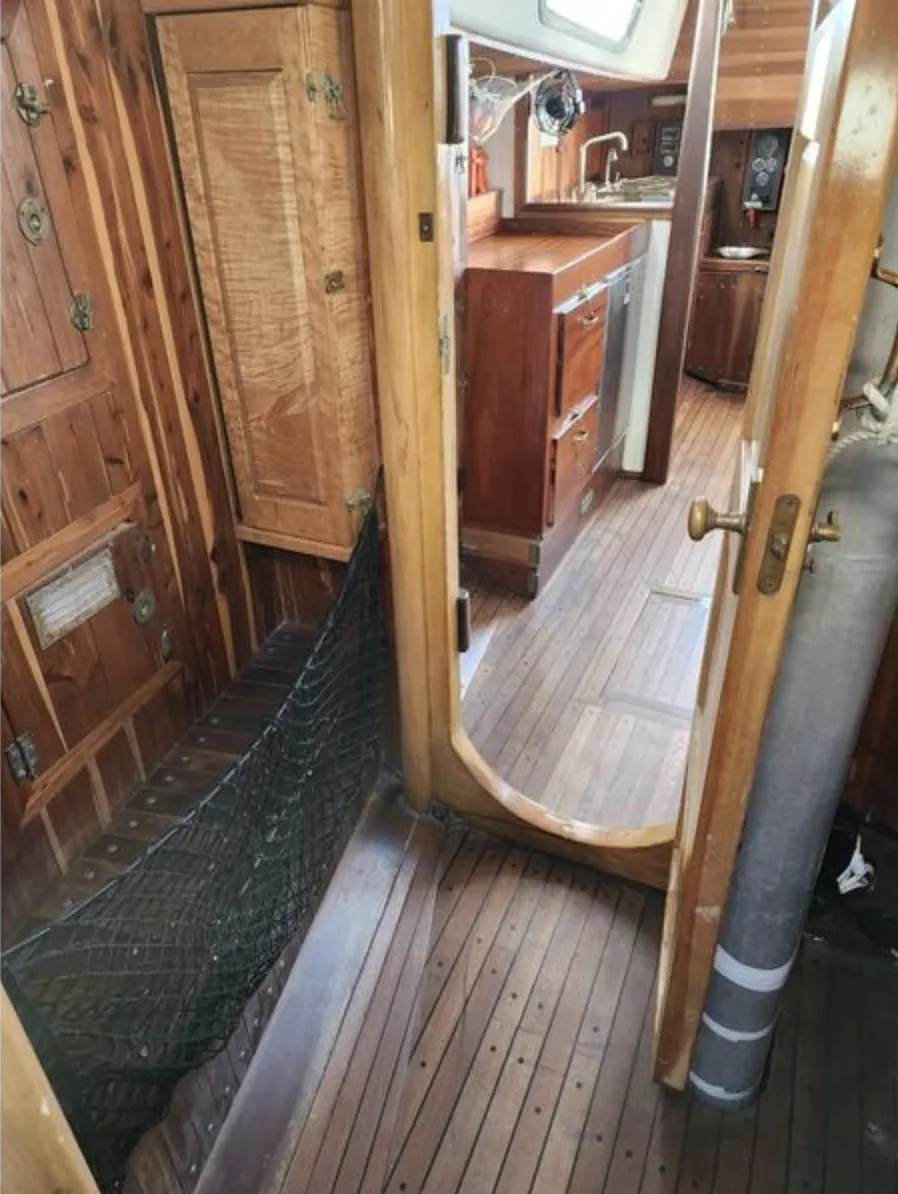
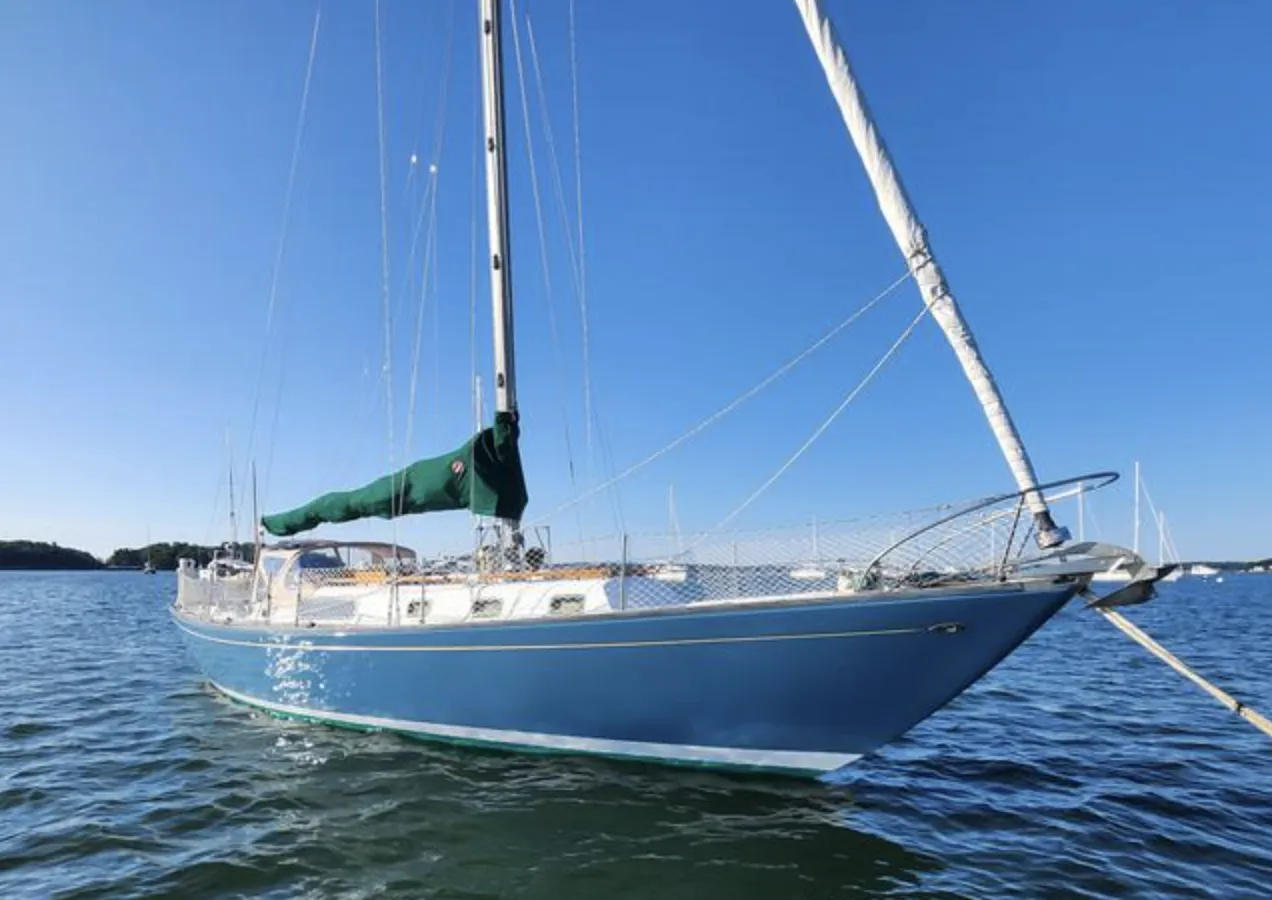
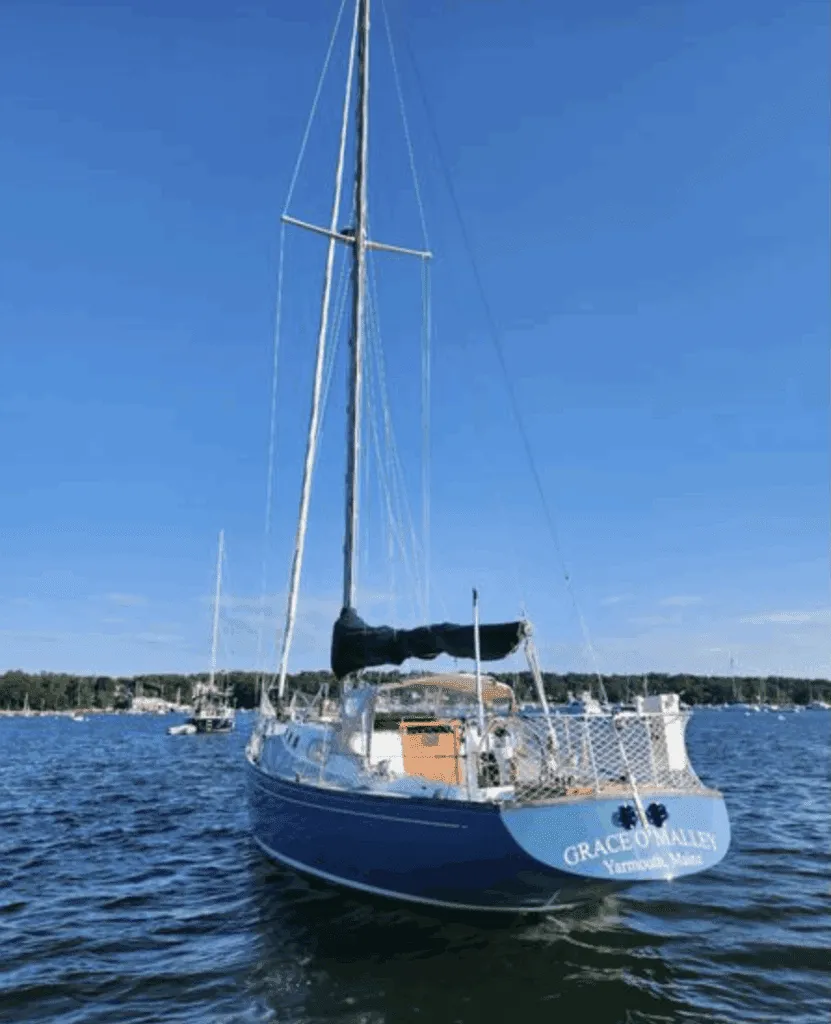
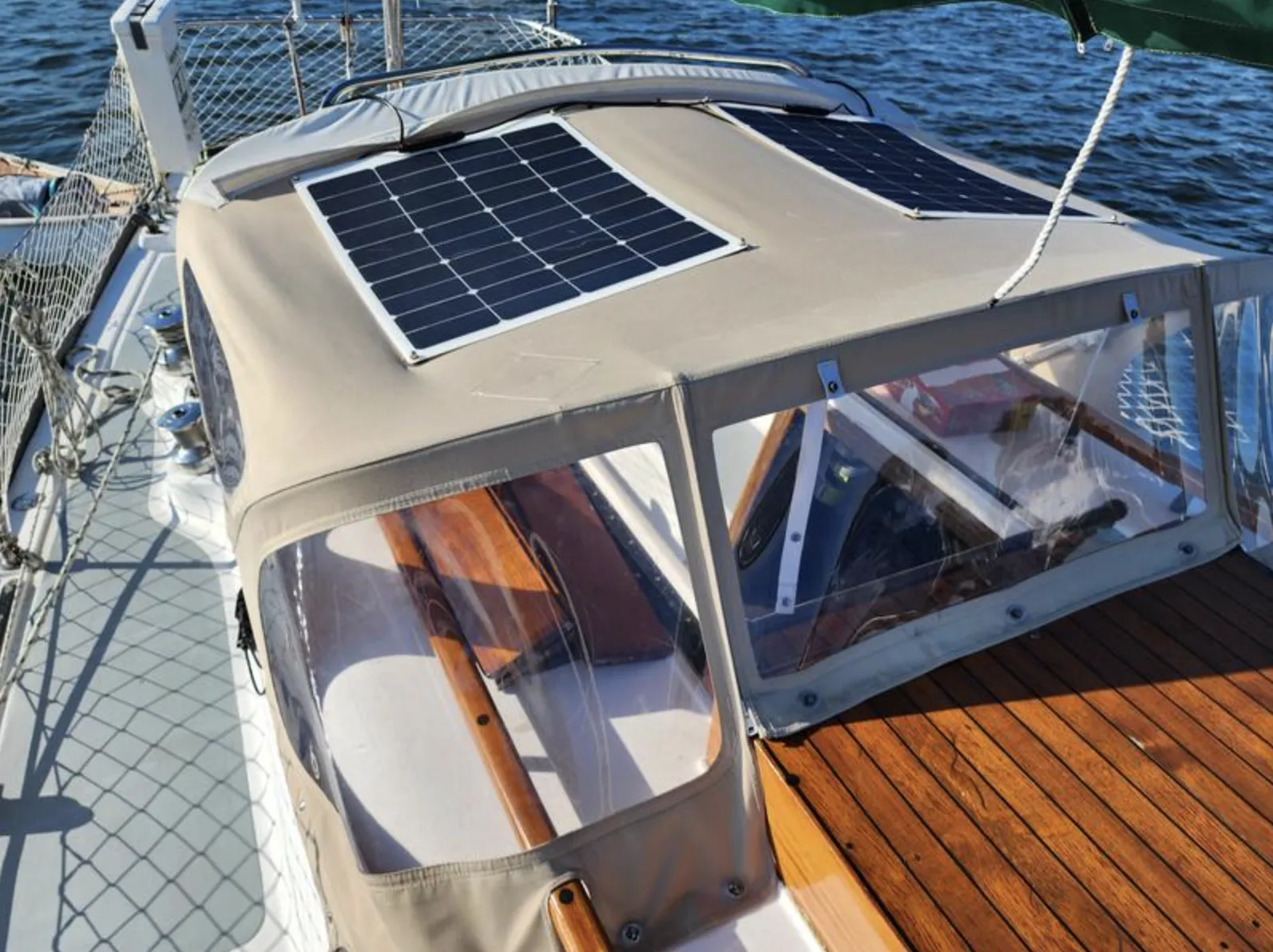
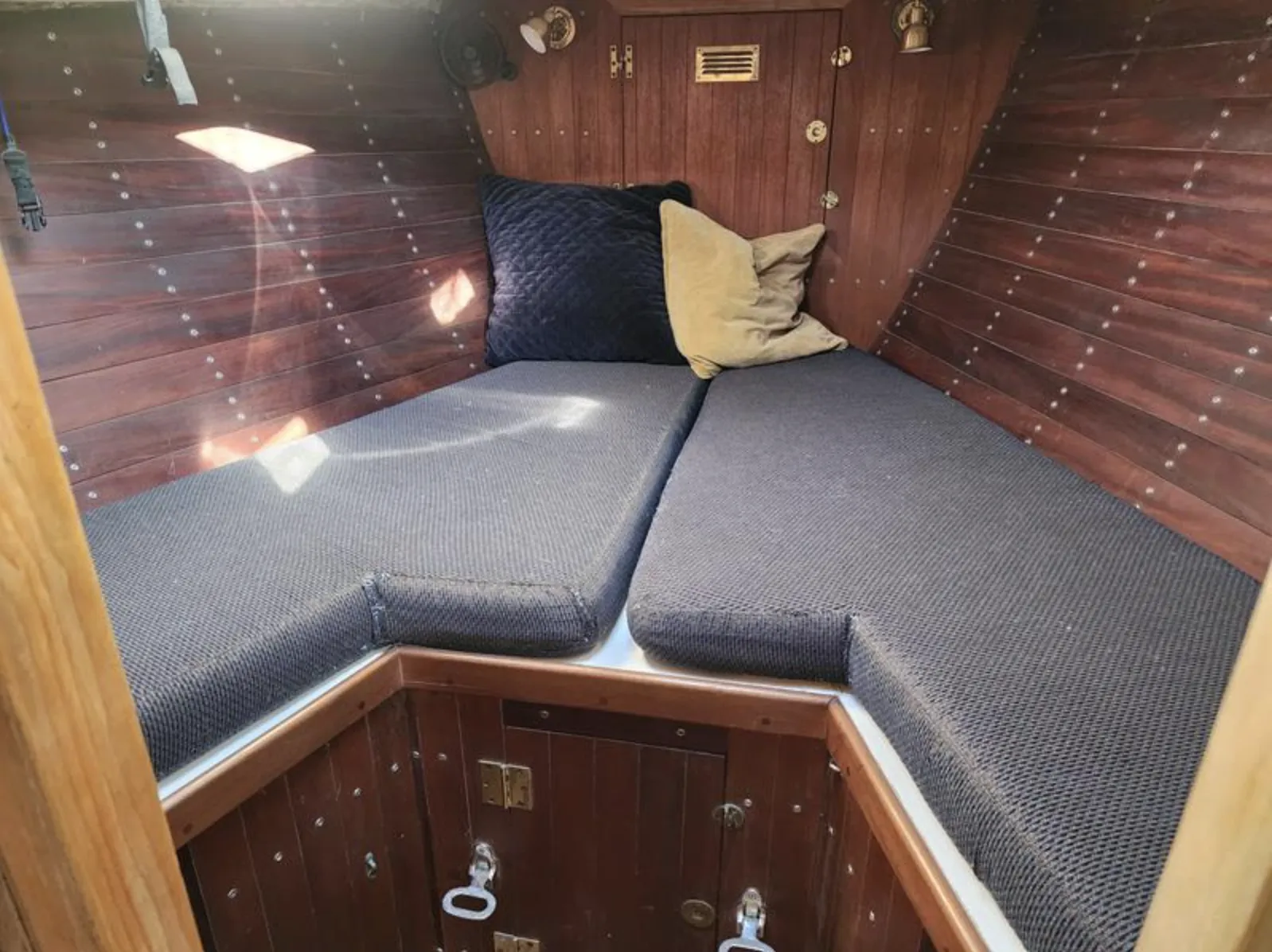
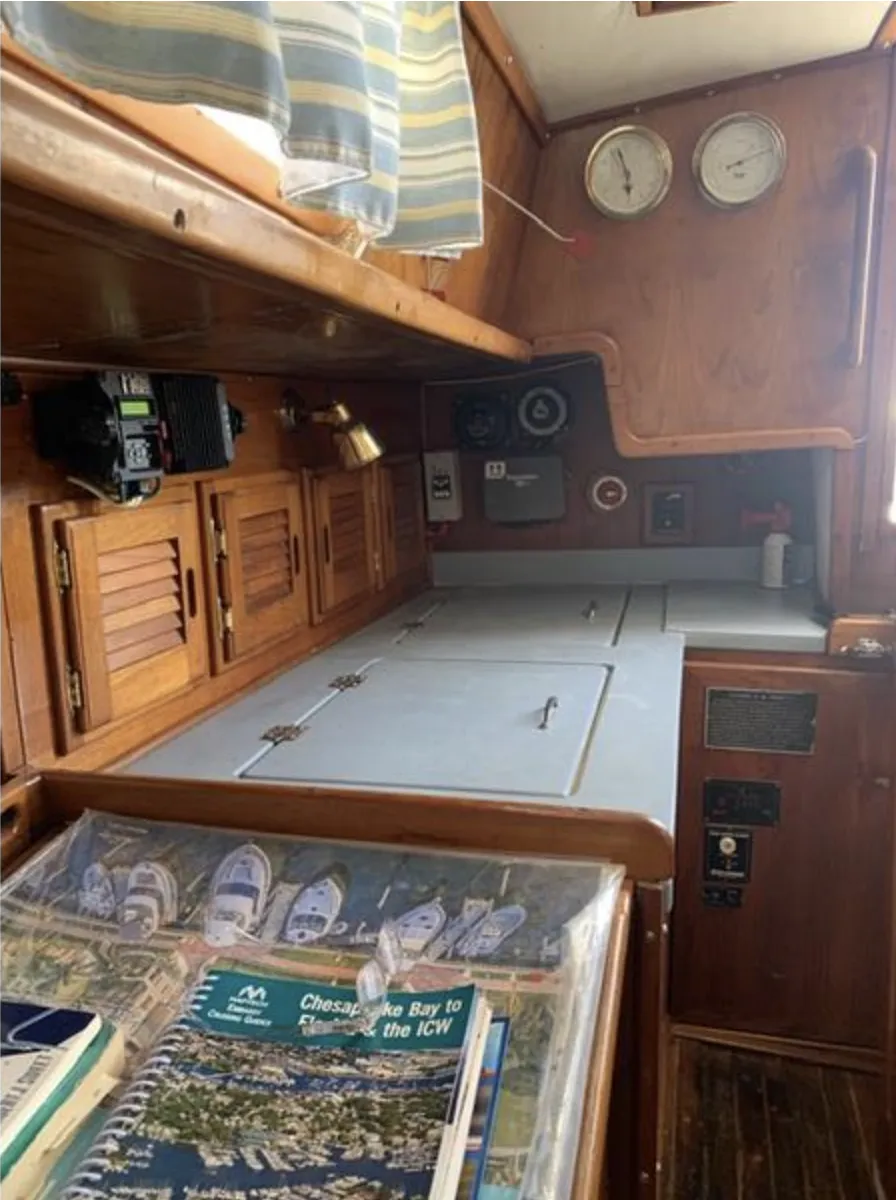
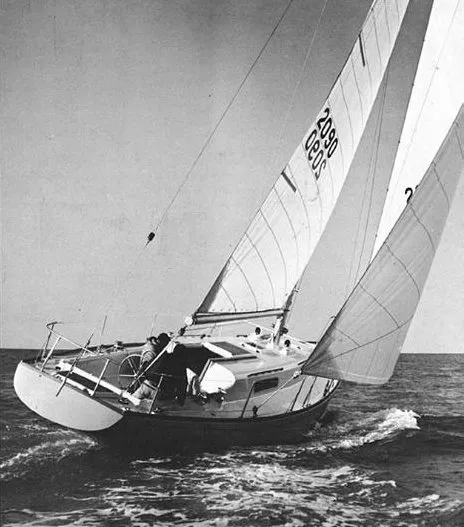
A survey of the deck reveals a long, I-shaped cockpit, wide sidedecks, and an uncluttered foredeck. The cockpit suits sailing with guests or sleeping under the stars, but will keep your feet wet in a steep following sea. Several owners said they have enlarged the cockpit drains. On the boat we sailed, the binnacle and 27-in. standard destroyer wheel were so far aft that it was a tight squeeze at the helm. In fair weather, the favored helm spot is on the leeward rail, where the view is intoxicating. During tight maneuvers under power, the shin-high throttle controls give the skipper the unflattering appearance of a farm hen, hunting and pecking as they shift. The standard running rigging provides a good framework for improvement. Leading to a traveler just aft of the helm, the mainsheet is at the end of an antiquated roller-furling boom whose popularity, though short-lived, we are still at a loss to explain. A simple slab reefing system suffices. The jib sheets lead aft to primary and secondary winches mounted on winch pads at the coamings, making winch upgrade a relatively simple affair. Race-ready boats have two genoa tracks, one on the rail and an optional inboard track. There is a hawsepipe leading to the anchor locker (also accessible from below), but most boats were not originally equipped with a bow roller. Most owners have managed with some off-the-shelf varieties. Although there were other optional layouts to the “stick-built” interior, most boats followed the plan in the specs diagram above. Aft to port is a quarter-berth/nav station, with the galley to starboard. In the main saloon, which has 6 ft., 4 in. of headroom, there’s a U-shaped settee to port that converts to a double berth. Facing that is a settee/sea berth, with a pilot berth, above. Moving forward, you’ll find a separate head to port across from a very large hanging locker, which one owner neatly converted into storage and a small workbench. The V-berth is about 6 ft., 11 in. long and well-ventilated through a large forward hatch. Another hatch opens in the main saloon. Three small ports (one of them opening) and one large, fixed port allow light below. Most owners convert the small saloon deadlights to opening ports, and many have painted or covered over the standard walnut mica finish to lighten the interior. The galley is lacking by today’s standards, with a sink below the companionway and little useable counterspace for meal-making underway. A pressure alcohol stove was standard, so a conversion to propane requires finding, or making, a safe place to store the fuel. The standard icebox is big enough to allow for additional insulation and a new inside liner. The boat’s tight propeller aperture limits prop size, so a three-bladed prop is usual. Many boats came with a 30-horsepower Atomic 4 gas engine. Westerbeke 55As and Perkins 4-108s (our test boat had the Perkins) are common today. Under power, the boat cooperates in both forward and reverse, though some owners like to drop the board a bit for better control in tight corners or in a crosswind. We sailed the boat in 12 to 15 knots on Biscayne Bay in Miami, Florida. Seas were a light chop. Winds gusted higher in two squalls that rolled through. The boat was equipped with a fairly new, 150 genoa on roller furling, but an aging mainsail handicapped windward performance. Even so, we easily tacked through 90 degrees with the board partially down and exceeded 7 knots while reaching, always with fingertip control. Indeed, impeccable balance is the boats hallmark. The boat clearly hits its stride about 65 degrees off the true wind, and owners regularly speak of making double-digit speeds while reaching during long ocean races. We sailed most of the time with the board about three-quarters of the way down, and the only time we could truly notice its effect was going to windward, when it reduced the amount of leeway. The overlapping headsail makes short-tacking a pain, but the boat is surprisingly nimble when tacking in light air. The Morgan 41 is a good upgrade candidate for someone who is handy and determined. The boats are typically well-loved, much of the essential work has usually been done (replacing gate valves with proper seacocks, for example). They are proven offshore cruisers, but key spots need careful attention. Any boat with the original centerboard system will need revamping. To bring the boat into the 21st century, much of the gear belowdecks and above decks will need upgrading or replacement. A well-restored Morgan 41 can shine next to some of the most highly regarded classics on the waterfront, so their owners are typically loathe to part with them. If one does land on the market, expect to pay anywhere from $30,000-$60,000 or more, depending on the condition. Should you decide to part with it down the road, you should not have a hard time finding a buyer. This article was published on 20 February 2007 and has been updated. 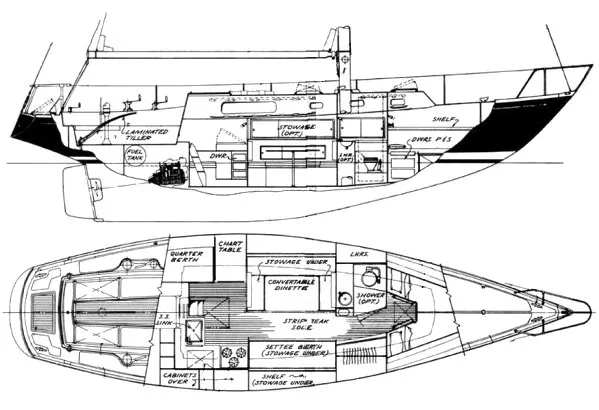
Sailboat Specifications Courtesy of Sailboatdata.com
Hull Type: Keel/Cbrd.
Rigging Type: Masthead Sloop
LOA: 41.00 ft / 12.50 m
LWL: 30.00 ft / 9.14 m
S.A. (reported): 774.00 ft² / 71.91 m²
Beam: 11.25 ft / 3.43 m
Displacement: 19,500.00 lb / 8,845 kg
Ballast: 9,000.00 lb / 4,082 kg
Max Draft: 9.42 ft / 2.87 m
Min Draft: 4.17 ft / 1.27 m
Construction: FG
Ballast Type: Lead
First Built: 1967
Last Built: 1972
# Built: 350
Builder: Morgan Yachts (USA)
Designer: Charles Morgan
Make: Universal
Model: Atomic 4
Type: Diesel
HP: 20
Fuel: 40 gals / 151 L
Water: 70 gals / 265 L
S.A. / Displ.: 17.16
Bal. / Displ.: 46.15
Disp: / Len: 322.42
Comfort Ratio: 36.03
Capsize Screening Formula: 1.68
S#: 1.59
Hull Speed: 7.34 kn
Pounds/Inch Immersion: 1,205.92 pounds/inch
I: 49.50 ft / 15.09 m
J: 15.90 ft / 4.85 m
P: 43.50 ft / 13.26 m
E: 17.50 ft / 5.33 m
S.A. Fore: 393.53 ft² / 36.56 m²
S.A. Main: 380.63 ft² / 35.36 m²
S.A. Total (100% Fore + Main Triangles): 774.16 ft² / 71.92 m²
S.A./Displ. (calc.): 17.16
Est. Forestay Length: 51.99 ft / 15.85 m
Deck Details
Accommodations
Performance
Conclusion
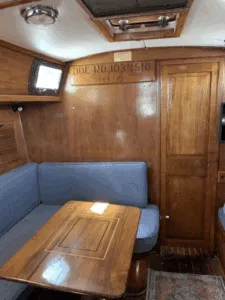
Market Scan Contact
1969 Morgan 41 Private seller
$39,000 USD 207-233-5085
Yarmouth, Maine Sailboat Listings
1969 Morgan 41 Private seller
$54,900 USD 949-456-6297
Safe Cove Boat Storage, Florida Sailboat Listings
1969 Morgan 41 Private seller
$39,000 USD 910-742-5167
Carolina Beach, North Carolina Sailboat Listings




We have a 1968 morgan 41. Do you know the prop size and pitch on your morgan??
Hi Chris,
We have a 1968 Morgan M41 as well. I am not sure the pitch but our prop is a 15” LH. We have the Westerbeke 4107 engine. Where are you located? We are in St Pete.
Chris,
We also have a 1968 Morgan 41. We recently repowered with a Yanmar (had a Perkins 4107). Located in Long Island NY. I believe ours is a 16” Prop.
I, too, have a 1968 Morgan 41, Banshee, on Long Island Sound. I keep her in Port Washington. I have a Westerbeke 4.108 rated at 37 hp. I have 15 1/2 – 12 prop. I feel I’m under-propped. I would like to re-prop with a 16” or 17” to expose more blade beyond the deadwood.
Agree a larger prop would be helpful, esp in a head sea. You might try a 16″ but the aperture is only approx 17″ so limits the prop dia. You could try a 16″ adjustable one to maximize your pitch, I’ve been thinking of this myself.
The beautiful 1969 Morgan 38, is still one of my favorite boats.