


Laid Teak Decks: Hallmark of Quality
There was a time when laid decks — teak, yellow pine, or fir — were the hallmark of a true yacht. The bare wood gave secure footing, easy maintenance, and reasonable protection from leaks. Since the advent of fiberglass, those same laid decks, almost universally of teak, have continued to represent that hallmark. However, they have become at least as much a cosmetic feature as a functional one. Teak decks, cockpit seats, cockpit sole, hatchtops, and cabin sole all lend themselves to being planked (or sheathed) in a traditional manner Almost no project can do more to "dress up" a boat than some laid decking, and it is a job the average boatowner can do himself. This article describes a simple method for laying decking, one we have used ourselves.

Sparkling Brightwork: Careful Attention to the Details
It takes practice to produce a perfect, mirror finish on varnished wood, but it is not so much a difficult task as an exacting one, where attention to detail and no short cuts are the secrets to success. Whether you are finishing new wood, refinishing old wood, or maintaining a finish in good condition, the basics are the same. Tools and materials required are sandpaper, vacuum cleaner or dusting brush, tack rag, brushes, and of course varnish and thinner If you are working from bare wood you may require stain or filler or a combination filler-stain. In cases where old wood has become discolored you will probably want to use a bleaching agent.
A Better Way to Mount Hardware
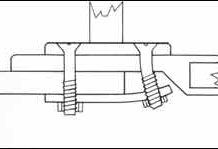
Improperly mounted stanchion and pulpit bases are a major cause of gelcoat cracks in the deck radiating from the attached hardware. The cracks are usually the result of unequally stressed mounting fastenings or inadequate underdeck distribution of hardware loads. Frequently, a boat is received from the builder with local cracks already developed. Once the deck gets dirty enough, these minute cracks start to show up as tiny spider webs slightly darker than the surrounding deck gelcoat While repairing these cracks is a fairly difficult cosmetic fix, the underlying problem — poor mounting — is fairly easy to correct in most cases.

Caring for Clear Plastics on Your Boat
There are three basic types of transparent plastics used on boats: clear vinyls, acrylics (the best known is Plexiglas), and polycarbonates (the marine standard is Lexan). Each has advantages and disadvantages, which is why most boats include some of each. Vinyl is actually plasticized, stabilized polyvinyl chloride (PVC). It’s the plastic of choice for any window or clear screen that rolls, folds, stretches or needs to be sewn to fabrics.
Professional Advice for Do It Yourself Boat Blister Repairs
Earlier this year, reader and occasional contributor Fred Hatch found himself facing a quandary common among boat owners. The topsides of his 32-foot sloop were well faded, and small blisters were beginning to show along the waterline. Would he be in for an ambitious haulout and big yard fees, or might there be other remedies?
Sparkling Brightwork: Careful Attention to the Details
It takes practice to produce a perfect, mirror finish on varnished wood, but it is not so much a difficult task as an exacting one, where attention to detail and no short cuts are the secrets to success. Whether you are finishing new wood, refinishing old wood, or maintaining a finish in good condition, the basics are the same.
Do-It-Yourself Fender Boards
Fender boards are practically a necessity when lying along side pilings. They are designed to ride outboard of two fenders, protecting a larger section of the topsides than the two fenders could provide alone.
Checking and Replacing: Keelbolts, Part 1
The largest fasteners in any sailboat with outside ballast are likely to be the bolts holding the ballast keel to the hull. As a rule, designers specify keelbolts by a tremendous factor, on the order of ten to one or more. Nevertheless, this safety margin does not guarantee eternal life for keelbolts. Corrosion takes its toll, sometimes more quickly than you might think.
Boat Clinic: Minor Repair to Cored Decks
A fairly common ailment with cored decks is the presence of soft spots where the outer skin has delaminated from the core material. Typically these areas are found around the mast and on the foredeck where heavy-footed spinnaker handlers have trod, but they are candidates to occur anywhere in a relatively large, flat span of unsupported deck.
Maintenance of Interior Teak
For the last decade or so, the majority of all production boats built in the U.S. have been trimmed above and belowdecks with teak. Teak makes abundant sense on deck. With resistance to weathering as its primary virtue, however, teak makes less sense for use as trim below.

Morgan 382 – The $30K Boat Nobody Talks About
The Morgan 382 might be one of the most overlooked cruising sailboats ever built. Designed by legendary naval architect Ted Brewer and produced between...



Latest Sailboat Review

Jeanneau 55 Boat Review
This recent sailboat from Jeanneau may as well be a spaceship. They’ve taken all the time-honored designs of a monohull aft cockpit and turned...