

Beneteau Oceanis 41 Used Boat Review
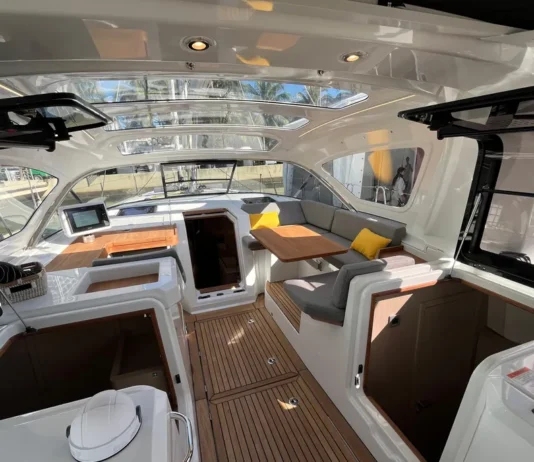
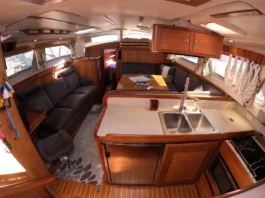
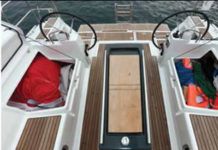
Beneteau’s new Oceanis 41 features a unique hull shape and a new cruising perspective, with a design that focuses on style, comfort, and ease of operation. After sailing the boat, Practical Sailor editors walked away impressed with the wide-body sloop. French naval architects Finot-Conq skillfully distributed the boat’s volume, placed the rig and foils exactly where they belong and revised the deck layout. A chine-like edge— affectionately known as the “kink”—interrupts the smooth curve of the topsides. Other new features on the Oceanis 41 include a transformable transom-swim platform and convertible cabin furniture.
Dufour 44 Used Boat Review
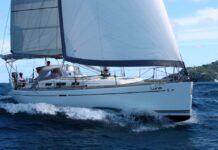
Fast passages and Franco-Italian flair
Maine Cat 41 Used Boat Review
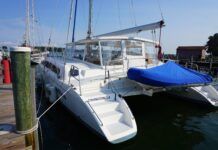
Eighteen knots? Maybe not, but theres plenty to like about this cat.
Hinckley 49 Used Boat Review
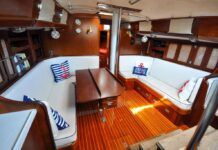
A proven builder of boats for others, Henry Hinckley envisioned the Hinckley 49 as a comfortable cruiser for his own family. He saw the H49 as more motorsailer than racing sailboat. The big, beamy (for the era), shoal-draft centerboard ketch is a capable cruiser, at home in Maines cooler waters or while meandering the near-tropical conditions of the Bahamas. And for those so inclined, the H49 also lives up to the demands of around-the-world voyaging. Most of the center-cockpit 49s were rigged as ketches, but later retrofits of most included switch-overs to furling sails and power winches, which make sail handling even easier.
Hallberg-Rassy 42 Used Boat Review
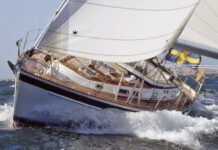
A top-quality production boat, proven as an offshore passagemaker - with a few bits and pieces that cause concern.
Cal 2-46: A Venerable Lapworth Design Brought Up to Date
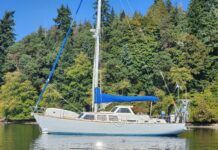
What kind of blue-water cruising sailboat should you consider when your thoughts turn offshore? We posed that question to Practical Sailor readers, and Puget...
Do You Really Need a Bigger Boat?
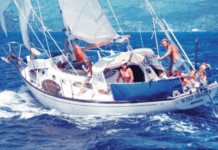
Questions arise at cruising seminars and it’s always encouraging when attendees provide the answers. In one such case, a young couple asked how much...

Leadership 44 is Strong, Stiff, and Lightweight
The Leadership 44 is built in Morris Yachts’ factory on Mt. Desert Isle, Maine, using advanced building materials and construction. Known for its precision semi-custom boat building, the company was launched in 1972 by the late Tom Morris. His son, Cuyler, is now the president and chief development officer.
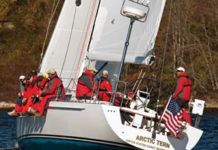
New Boat Review: A Look Inside the New Leadership 44
The U.S. Coast Guard Academy recently received its newest sail training boat: the Leadership 44. Built by Morris Yachts, a company best known for high-end, custom sailboats, the Leadership 44 was designed by David Pedrick, whose resume includes America’s Cup boats and many capable cruisers. The Leadership 44 has all the necessary features of a 24/7 underway workboat—offshore sleeping berths, ventilation in rough weather, a galley and head that work well underway, and a sail plan that’s efficient and easy to handle. With a displacement of 26,000 pounds, the L44 is strong and stiff, yet reasonably lightweight for a boat of that size. Civilian versions of the design will be making their way to the market soon and would be worth considering for bluewater cruising duty.

Velux Race Boats Showcase Alternative Energy Options
In the recent Velux 5 Oceans Race, four solo sailors piloted their 60-foot boats some 30,000 miles around the globe, putting a number of innovative products to the test. The race required each boat to be equipped with at least three means of power generation, and two had to be alternative forms of energy. Racers Brad Van Liew and Zbigniew Gutkowski each supplemented power from their auxiliary engines, solar panels, wind generators, with two new Watt & Sea hydrogenerators. Because of the reported efficiency of these transom-hung devices, the singlehand sailors enjoyed the rare phenomenon of surplus power. Two other racers, Chris Stanmore-Major and Derek Hatfield, relied on more traditional alternative energy sources: wind gens and solar panels. All four were enthusiastic about the example they might be setting for other sailors, but are emerging technologies like hydro-power generation practical for the typical cruising boat?
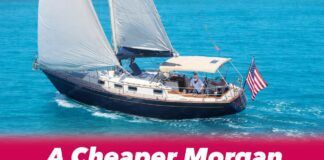
Morgan 382 – The $30K Boat Nobody Talks About
The Morgan 382 might be one of the most overlooked cruising sailboats ever built. Designed by legendary naval architect Ted Brewer and produced between...


Latest Sailboat Review

Jeanneau 55 Boat Review
This recent sailboat from Jeanneau may as well be a spaceship. They’ve taken all the time-honored designs of a monohull aft cockpit and turned...