


Do You Want to Go Sailing?
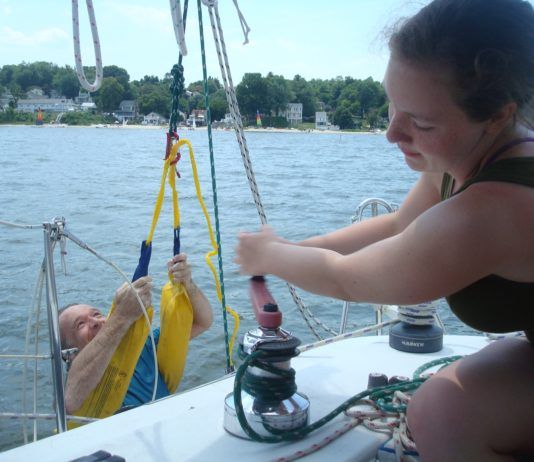
Its hard to describe the curiosity I felt when I first saw the above photograph on the cover of the 2017 catalog for Defender Marine. The man reminded me of my late grandfather, Howard Nicholson, someone Id never expect to see on the cover of anything related to boating.

Practical Sailor 2016 Index
Practical Sailor 2016 Index

Risk Management and Renting Adventure
Oceans may interconnect the planet, but they also act as a barrier, isolating the sailors on opposite shores. Some cruisers and racers bridge the gap, while most keep track of international sailing events and incidents online. Well-run international regattas, around-the-world yacht races, and the globalization of the boatbuilding industry help to spread the word, but-despite such publicity-not all sailing trends reach the opposite shore. Thats why the crew at Practical Sailor does its best to note whats trending. Usually, its a new boat design or piece of hardware that draws our attention, but in this article, we focus on a seafaring controversy: the growing inclination toward renting adventure.

Cruising Guides
Since our last review of cruising guides for the Atlantic Intracoastal Waterway and the Bahamas, weve come across a few more resources worth adding to the list, and one of our top-pick cruising and anchoring guides has ceased publication. Heres the latest on cruising guides and resources.
How Much Drag is in a Drogue?
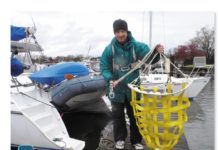
Weve long been interested in drogues, devices specifically designed to be towed behind a boat to reduce speed and to produce directional stability in heavy weather. Our last major drogue test was in 2009, when noted marine writers and circumnavigators Evans Starzinger and Beth Leonard shared their storm tactics (see Heavy Weather Sailing Tactics". Another relevant article, Sea Anchors and Drogues, compared a variety of drag devices. If you are interested in purchasing a drogue, we recommend reading the archive articles along with this report.
Field Testing Drag, Behavior
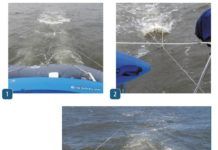
We did not test every drogue that appears in the accompanying table, PS Value Guide: Drogues. However, we collected a huge amount of test data and observations from model testing and from multiple sources, including Victor Shanes Drag Device Database (www.dragdevicedb.com), and incorporated these into our test findings.

Havana Perspectives
Do they check your boat when you go back to America?
They do, I said, though I had no idea if anyone did. And I think the Cuban customs officials bring dogs on board, before we leave, to make sure no one is hiding on the boat. I didnt know this either. It was something in a cruising guide Id read-probably out of date.
They do, I said, though I had no idea if anyone did. And I think the Cuban customs officials bring dogs on board, before we leave, to make sure no one is hiding on the boat. I didnt know this either. It was something in a cruising guide Id read-probably out of date.
Spring Lines for Storm Preparedness
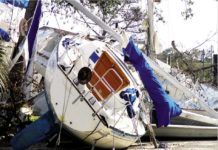
A well-secured boat in the best-designed marina can't be expected to survive a direct hit from a hurricane. Major boat-insurance companies recommend hauling out and tying down your boat, but that isn't always an option, nor is it any guarantee.
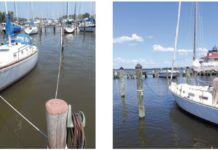
Tips for Riding Out the Storm in Your Marina
Practical Sailor has covered storm preparation on several occasions. The two most extensive articles appeared in July 2008 Gear for Battening Down Ahead of Storms, and Tropical Storms Dos and Donts, from November 2011. We also have an online article How to Help Your Boat Survive a Major Storm. What follows are just a few tips relevant to securing your boat in a marina when you have exhausted all other safer alternatives.
Raising the Bar on Lifelines
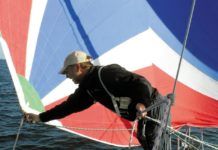
Lifelines are often disparaged as nothing more than tripping hazards, mounted so far below our center of gravity that they are more likely to launch a sailor over the side than to save him. While larger boats occasionally fit taller stanchions and solid-tube railings, the vast majority follow the International Sailing Federations (ISAF) offshore regulations, which require lifelines to be no less than 24 inches high on boats 28 feet or longer. This is effectively the bare minimum developed for racing on fully crewed boats where higher lines interfere with deck-sweeping genoas, and crew lost overboard has a reasonable hope for recovery. Cruisers have different priorities.
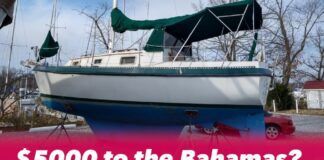
Bahamas for $5000? The Watkins 27 foot Sailboat
Is the Watkins 27 the ultimate small cruising sailboat? In this video, we take a deep dive into the Watkins 27 — a classic...



Latest Sailboat Review

Jeanneau 55 Boat Review
This recent sailboat from Jeanneau may as well be a spaceship. They’ve taken all the time-honored designs of a monohull aft cockpit and turned...