


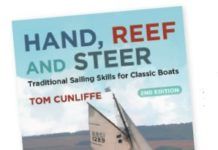
Summer Sailor Reading List
The question were often asked as we set out on our summer cruise is, What do you do with all that free time you have? There is a general misconception that cruising sailors do little more than sit around all summer watching ripples on the water and enjoying the spoils of slackerdom. Truth is, there is almost always some work to be done, but theres still time for a good book. If youre still searching for summer reading material, heres Practical Sailors semiannual list for 2017.

Boating Eyewear Guarantee
One of the reason we pay premium for brand-name products is the expectation that if something goes wrong, wed get outstanding support. Some U.S. companies (think Buck knives) have built their reputations on their lifetime warranties. But in the global economy, when brands are sold and resold, it is getting harder and harder to obtain good warranty support.

Look for UV protection, fit, impact resistance
The ideal pair of sunglasses will vary among individuals. Fair-eyed people, for example, often prefer darker lenses. Our list of must-haves include UV protection, polarization, impact-resistant lenses, and good fit.
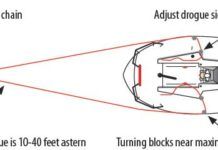
Ideal Drogue setup will require experiments
For maximum maneuverability, the control lines-one port, one starboard-should attach at the widest part of the boat. This maximizes leverage and places the effort close to the center pivot point. On a catamaran, closer to the transom works because of the wide beam, but for monohulls, attaching near the pivot point at the keel will be more responsive. For maximum responsiveness, the drogue should be as close to the transom as practical-this results in more responsive steering and minimal drag. We found the best compromise to be around 65-80 percent of the way aft, where there is still enough beam, but less risk of the control lines fouling.
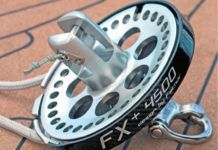
Product Update: Facnor FX+ Furler, Caframo Scirocco II, and More!
With lighter summer breezes soon upon us, a retrofit to a furling light-air asymmetrical sail grows tempting. Facnor, maker of one of our top-rated gennaker furlers in 2009 and 2011 (Foil-less Furler Test, PS April 2011 online) has introduced its new FX+ range of high performance continuous line furlers for free-flying sails. The new furlers incorporate a lightweight carbon fiber drum housing, exclusive quick release attachment system for easy use, and a new ratchet type lock, which prevents the drum from unwinding while the sail is furled.Designed to be highly adaptable, the FX+ range works well with almost any free flying sailing sail-ranging from a Code Zero, staysail or storm jib. They can all be quickly converted to a top-down style furler using Facnors optional Fast Swivel system. Facnors push-spring release system allows for simple snap-on attachment, as well as one-handed removal activation. The FX+ range includes sizes and models to fit boats from 21 to 70 feet.
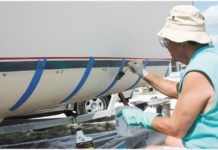
The One-Bucket Cleaning Kit
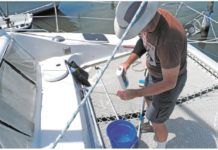
Bright, shiny and new looking. That was what we wanted when were shopping for our dream boat, and that is the impression our new-used PDQ catamaran gave. What was behind that spit-shine on a used boat? Besides the obvious hours of labor by the previous owner, it took two baskets of cleaning products, all stuffed in the stern lockers.
A Generic Approach to Specific Stains
For general deck cleaning, unless there is a specific stain, always start with a relatively mild, biodegradeable surfactant. Not strong enough to remove wax or corrode metal, but enough to loosen what the birds left, hard water spots, and atmospheric dirt. One possible remedy is a little spot cleaning with biodegradable laundry detergent. Today, most detergents are biodegradable.
Boat Spring Cleaning
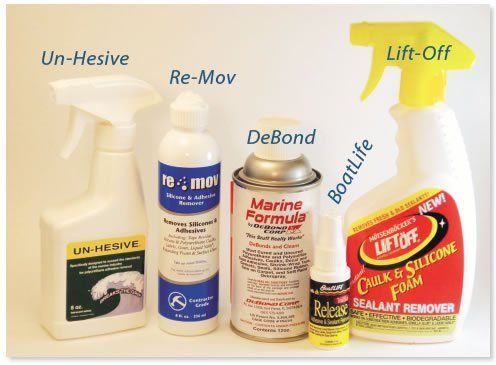
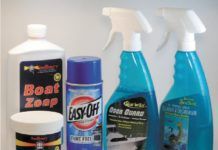
We frequently receive suggestions for new cleaners from our readers. Here are a few suggested products that came over the transom that we havent reported on before.
Mailport: Whats Up with Synthetic Lifelines?
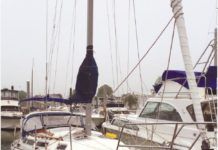
Its been almost five years since your original article on synthetic lifelines (Long-term test Evaluates Synthetic Lifelines, Practical Sailor, September 2012). Since my coated lifelines are due for replacement, Im curious about long-term observations. That said, I plan on going up a size or two from the recommended numbers for an extra safety margin: 6 millimeters rather than 5 millimeters. Im still looking into manufacturers and products because I just learned how easy splicing 12-strand can be, but Im pretty sure almost any of them will be better than the plastic-covered stainless-steel wire, of unknown vintage, thats on the boat now.

Marine Weather Forecasting
Over the last few decades, theres been exponential growth in the availability of accurate weather forecasts and the net result is safer voyaging. Government spending on weather data gathering and forecast development has soared. Satellites and data buoys have filled in some of the oceanic gaps caused by an absence of weather balloon sampling at sea. State of the art, algorithm-driven, model data and ensemble-based forecasting have turned electronic guesswork into a better understanding of atmospheric volatility. The net result is an increase in the validity and reliability of marine forecasts and a trend that has stretched 24-hour forecast accuracy into 48- and 96-hour time frames. So, if anything deserves the label don't leave homeport without it, it is todays, better than ever, marine weather forecast.
Lithium Batteries on Sailboats: The 3 Mistakes Everyone Makes
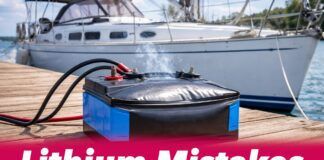
Lithium batteries are one of the most popular sailboat upgrades today—but they’re also one of the most misunderstood. In this Practical Sailor Saturday episode,...



Latest Sailboat Review
Island Packet Estero Used Boat Review
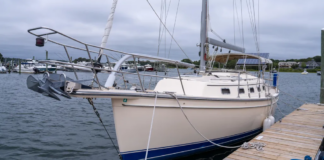
Florida-based Island Packet targets a relatively narrow niche, so the toughest competitors to its new boats are often older Island Packets. Introduced in 2010, the 36-foot, shoal-draft Estero is the company’s latest attempt to introduce a distinctive model that doesn’t stray too far from the company’s proven formula for success: moderate displacement, full-keel cruisers designed to be lived on, sailed far and in comfort, and endure the bumps, scrapes, and storms that cruising boats inevitably encounter. After sailing the Estero on Florida’s Sarasota Bay and inspecting its interior, construction, and systems, Practical Sailor testers noted that the shoal-water cruiser will appeal strongest to Island Packet fans who’ve been waiting for a shoal-draft, easy-to-sail boat that compares to the IP37 in terms of interior space. These strengths will be most apparent on intracoastal or riverine adventures like the Great Loop.