

















Hobie Mirage: Paddle, Pedal, Power, or Sail
The Hobie Mirage Tandem Island, a mouthful we’ll refer to as the HMTI, is the latest incarnation of Hobie’s capable and creative engineering team. This triple-play trimaran can be paddled, pedaled, and sailed using dozens of Hobie’s in-house designed parts. A specialized Torqeedo electric outboard (www.torqeedo.com), which can be dropped into a drive slot, adds a forth dimension to this multi-tasking multihull.

Sailboat Design Conference Part I
Beyond the text and photos contained in a sailboat manufacturing company’s brochures, and the words of a dealer or salesperson, and absent an understanding of yacht design, discerning the actual capabilities of today’s production boats is a major task. Gone are the days of Herreschoff et. al., when the conventional wisdom held that a long, deep keel was the best method of producing good tracking, displacement produced a seakindly ride, and performance (straightforward speed) was a simple matter of adding sail area. Prior to the age of fiberglass, most yachts used similar raw materials (wood and metal), and construction methods, so those variables were not generally a consideration.
Sailboat Design Conference Part II
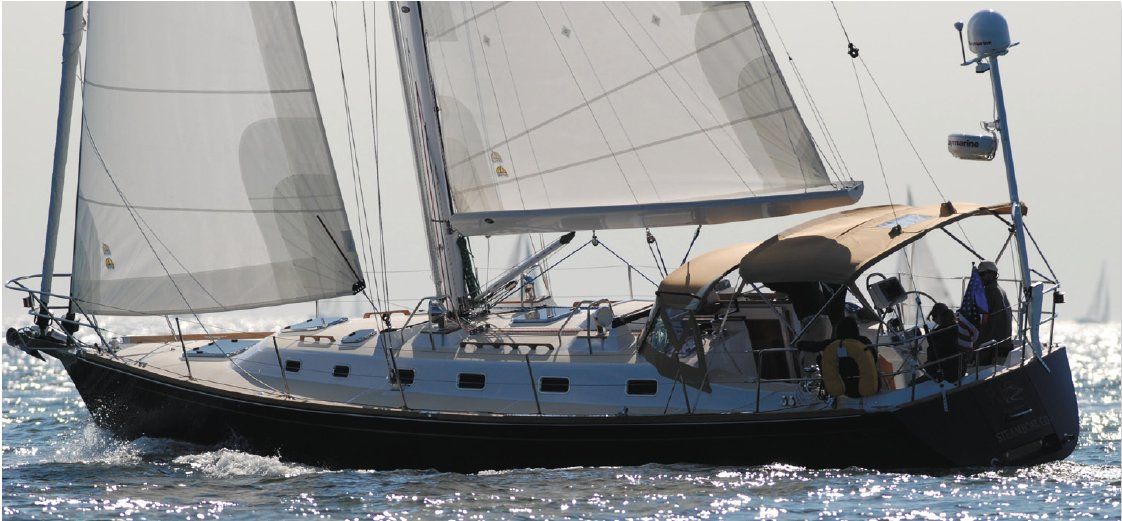
Take a cursory glance at a new 35-footer and you might easily conclude that, except for cosmetic changes, the boat is essentially unchanged from those that made their debut in 1995. But that is not the case. In contemporary designs, modifications to deck layouts, the design of creature comforts, and boathandling systems, all reflect the market's desire for easy use, as evinced by below-deck sheeting systems (X Yachts), electrically controlled stern platforms (C&C), and removable traveler systems (Etap), for instance.
In-Boom Furling: Five Systems
There's no perfect solution to boom furling. It's not an easy bit of engineering. Still, all the systems on the market continue to mature. Schaefer's new offering looks like a good bet for medium-sized boats.
Mainsail Track Hardware
The systems used to attach a mainsail to its mast have come a long way since the time of hoops and parrels, and the variety of options now available for retrofitting plays to the advantage of the consumer.
Do You Want a Headsail Luff-groove Device?
Unless the boat was equipped with two headstays, which adds considerable windage, the headsail change drill meant releasing the lowest hanks on the headsail in use, tacking down the new sail, hanking it on below the head-sail already up, taking a deep breath, letting the jib halyard run, then going like mad to get the hanks open on the old jib, all the time listening to the skipper scream to hurry up.
User Report: Lasdrop Shaft Seal
On my 40’ wood boat Daybreak I had a stuffing box problem. The gland leaked worse and worse, especially when motoring. It is very inaccessible, and could not be further tightened. The stuffing box needed to be repacked, but this couldn’t be done without major effort because of insufficient space between the gland and the shaft coupling at the transmission. The Lasdrop shaft seal looked like it might solve several problems at the same time.
The Multifarious Mainsheet
The mainsail is a big part of the motive power of almost every sailboat. The art of mainsail control, however, is a relatively modern one. One tool that greatly facilitates mainsail control is the traveler.
Checking and Replacing: Keelbolts, Part 1
The largest fasteners in any sailboat with outside ballast are likely to be the bolts holding the ballast keel to the hull. As a rule, designers specify keelbolts by a tremendous factor, on the order of ten to one or more. Nevertheless, this safety margin does not guarantee eternal life for keelbolts. Corrosion takes its toll, sometimes more quickly than you might think.
Boat Clinic: Minor Repair to Cored Decks
A fairly common ailment with cored decks is the presence of soft spots where the outer skin has delaminated from the core material. Typically these areas are found around the mast and on the foredeck where heavy-footed spinnaker handlers have trod, but they are candidates to occur anywhere in a relatively large, flat span of unsupported deck.

STOP Buying These 4 Products! The Practical Sailor Warning That Saves...
STOP wasting money on faulty boat gear! In this exclusive deep-dive, Practical Sailor reveals the 4 worst products and maintenance mistakes that routinely fail...


Latest Sailboat Review

Catalina Morgan 440 Used Boat Review
The Catalina Morgan 440 is a massive ocean-capable design from the drafting board of Gerry Douglas, a prolific designer for Catalina Yachts for over...