


Gas Vs. Electric Outboards: Consider Your Total Sailing Carbon Footprint
If you own or intend to buy an electric outboard because it is clean and quiet, read no further. Today’s four-stroke outboards are much...
Worship Your Universal M-Series Diesel With the Marinized Kubota Block
The Universal name resonates with many of us as one of the best sailboat engines available. Despite Universal Motor Corp. no longer being in...
Buyer’s Guide: 10 Gas Outboards For Cruising Sailboats
Plenty of day sailors and dingy owners are sold on the appeal of clean, quiet electric outboards, but do they make sense for cruising...

Prop and Shaft Check
A vessels drive train is typically defined as the components between the engine transmission coupling and the bitter end of the propeller shaft. For traditional drive trains, this includes the propeller, shaft, cutless bearing and packing gland, although the list could also be expanded to encompass ancillary items such as the rudder, engine mounts, and engine bedworks. Heres a look at two major drive train components you should know and what to look for when inspecting each. Next month well look at the components inside the boat-stuffing box, shaft, and coupler.

Determining a Fuel-efficient Engine RPM
My boat is a Hans Christian 41T, with a waterline length of 36 feet and a displacement of 38,000 pounds. The engine is a Volvo Penta TMD-30A rated at 90 horsepower. The prop is a Maxprop, three-blade, 20-inch prop with 12-inch pitch. A table illustrating speed at various RPMs shows that there is a linear increase of speed with RPM up to about 6 knots (2,600 RPM), but then the speed tapers off with increased RPM. Based on this, I presume that motoring at about 2,600 RPM is optimal fuel burn and speed. Is this correct?

A Guide to Buying Your First Sailboat
So, you’re in the market for your first boat. Having just purchased my own vessel, the thrill and anxiety of the process are both...
Breaking Point: What Can Go Wrong With Your Yanmar?
If you want to know more about the little Yanmar chugging away in your sailboat, it helps to learn about this iconic engine maker’s...

DIY Soundproofing for the Engine Compartment
As sailors, once we’ve cleared the outer markers of our club, marina or harbor, we look forward to raising our sails and we enjoy...

Fair Through Hull Fittings: Essential to a Smooth Bottom
In light air, a major portion of the total resistance of a sailboat derives from skin friction. To oversimplify, the smoother the boat's "skin" — the submerged part of the vessel — the less power is required to drive it to a given speed. Put another way, given two boats identical in every way, including sail area, the boat with the smoother bottom will be slightly faster than a boat with a rough bottom in light air. Most racing sailors have learned the value of a smooth bottom. Ironically, cruising sailors can benefit at least as much from the creation of a low-resistance bottom as racing sailors, although you rarely see a cruising or daysailing boat with a bottom to match that of a good racing boat.
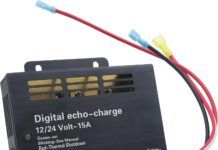
Digital Echo-Charge: DIY Dual Battery Bank Charging
I like to think and believe that for most sailors, keeping an eye on our environmental footprint is somewhat important. It certainly is for...

Bahamas for $5000? The Watkins 27 foot Sailboat
Is the Watkins 27 the ultimate small cruising sailboat? In this video, we take a deep dive into the Watkins 27 — a classic...



Latest Sailboat Review

Tartan 30: An Affordable Classic
The early 1970s was the heyday of the Tartan 30' racer/cruiser. In all, no less than two dozen boats of a similar size and type were introduced in just three years, many of them to become highly successful among sailors eager for the performance and amenities of big boats at a modest price. Among the most noteworthy and enduring of the 30-footers from this era has been the Tartan 30.