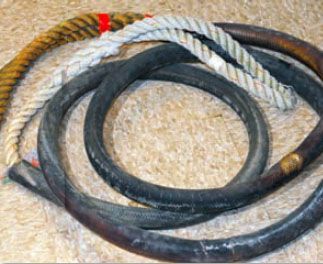
Anti-chafe efforts must be carefully considered. Prior studies have noted that many boats have broken mooring or dock lines that had been carefully covered with heavy PVC hose. It is presumed that despite the abrasion abatement afforded by such anti-chafe gear, it actually hastens the line’s demise by allowing inter-filament heat to build up more quickly. Rather than being abraded by the chock or rail, the line actually melts due to friction generated between the filaments as the rope is repeatedly tensioned.
Interestingly, the spliced rope, at left, did not fail where it was covered by plastic. This could be because the PVC provided some UV protection, but more likely this was because the failure points (at or near the splices) were local stress risers. In our view, PVC hose is not the ideal chafe gear. Traditional leather chafe guards with an open, laced top stitched to and around the line at key points of contact offer superior protection and allow heat to dissipate better than PVC.