



Alberg 37 Used Boat Review
Do you remember the August 1979 Fastnet Race when a worse-than-expected European windstorm wreaked havoc on the 303 yachts that started the biennial race?...
C&C Landfall 38 Used Boat Review
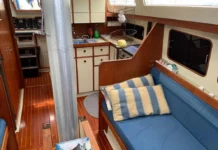
Unlike other C&Cs, whose interior and deck layouts are designed for racing as well as cruising, the Landfalls are geared toward cruising, with more comfort, a slightly higher degree of finish detail, and deck layout concessions to the cruising couple.
The $100K Cruiser Showdown: How the Catalina 380 Stacks Up
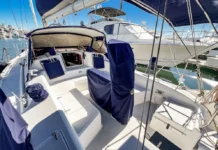
Are you in the market for a 35 to 40 foot sailboat under $100,000? Are you considering a Catalina 380? Have you seen a...
Rethinking Sailboat Structure
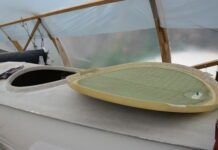
When it comes to describing a sailboats most valuable attribute, its surprising how varied opinions can be. Staying afloat should be our first priority, and although you seldom read or hear much about it at boat shows, the structural elements that hold a sailboat together are an all-important consideration.
Jeanneau Sun Odyssey 32 Used Boat Review
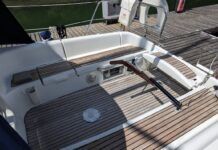
The Sun Odyssey 32 and Sun Fast 32i are two versions of the same boat, designed by Philippe Briand. The attractive combination may well capture a good share of the market in this size slot.
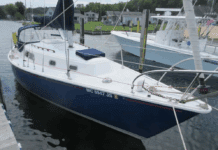
Pearson 30 Used Boat Review
The Pearson 30 was designed as a family cruiser and daysailer with a good turn of speed. The boat is actively raced throughout the country, however, with some holding IOR certificates, and many more racing in PHRF, MORC, and one-design fleets.
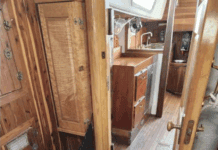
Morgan 41 Used Boat Review
The Morgan 41 sloop is arguably one of the best looking of many lovely dual-purpose sailboats that the Cruising Club of America handicap rating system engendered. One owner described his boat as a Bermuda 40 for a regular Joe, only prettier. Designer Charley Morgan traces the cruiser-racers heritage, particularly below the waterline, back to Olin Stephens famous Finisterre, and Comanche, a 40-foot centerboarder built by Wirth Munroe, son of famed sharpie designer and South Florida pioneer Commodore Ralph Munroe.
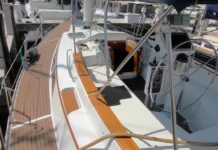
Freedom 45 CC Used Boat Review
When I received a message about surveying a 1989 Freedom 45CC, I knew there was something unique about this sailboat, but I couldn’t remember...
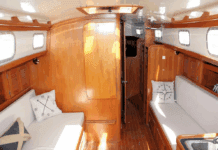
Bristol 39/40 Used Boat Review
The Bristol 39 and Bristol 40 are basically the same boat, even though the specifications state that the Bristol 40 is nearly a foot longer than the Bristol 39. If you like traditional yachts, you'll find the Bristol 40 appealing. The boat has the long overhangs, lovely sheerline, low freeboard, narrow cabin trunk, undistorted hull shape, and narrow beam we associate with the beautiful yachts of the past. The trade-off for these traditional good looks is a boat with a small interior compared to today's 40-footers.

Is U.S. Sailboat Manufacturing Facing Extinction?
2025 has not been a good year for U.S. sailboat manufacturing. Com Pac Yachts closed its doors in May and, as explained in this...
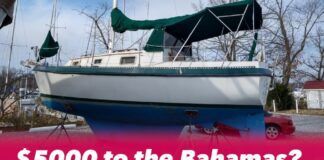
Bahamas for $5000? The Watkins 27 foot Sailboat
Is the Watkins 27 the ultimate small cruising sailboat? In this video, we take a deep dive into the Watkins 27 — a classic...



Latest Sailboat Review

Tartan 30: An Affordable Classic
The early 1970s was the heyday of the Tartan 30' racer/cruiser. In all, no less than two dozen boats of a similar size and type were introduced in just three years, many of them to become highly successful among sailors eager for the performance and amenities of big boats at a modest price. Among the most noteworthy and enduring of the 30-footers from this era has been the Tartan 30.