


















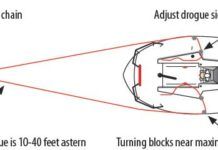
Ideal Drogue setup will require experiments
For maximum maneuverability, the control lines-one port, one starboard-should attach at the widest part of the boat. This maximizes leverage and places the effort close to the center pivot point. On a catamaran, closer to the transom works because of the wide beam, but for monohulls, attaching near the pivot point at the keel will be more responsive. For maximum responsiveness, the drogue should be as close to the transom as practical-this results in more responsive steering and minimal drag. We found the best compromise to be around 65-80 percent of the way aft, where there is still enough beam, but less risk of the control lines fouling.

Snap shackles not advisable for snubbers.
In regard to your ongoing investigations of snubber hooks (Snubber Chain Hooks Revisited, February 2017), I want to add another idea to the mix. Our boat uses a fixed eye snap shackle spliced onto the end of a three-strand nylon snubber. Our shackle is similar to this Wichards 2 -inch fixed eye snap shackle (part #2472).
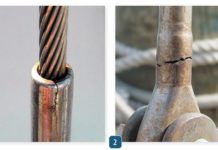
DIY Rig Check
Here are two good examples showing the problems associated with the lower or deck level use of swage terminals for your standing rigging. Swaging is a process where tubular stainless steel fittings are essentially crimped onto rigging wire under high pressure.

Rope-to-Chain Splice Test
If youve ever struggled to retrieve a balky rope-to-chain back splice with your windlass, youve probably wondered if there wasnt a better approach. The problem becomes especially acute if youve upgraded to higher tensile chain and want to use nylon rode with the same approximate tensile strength.
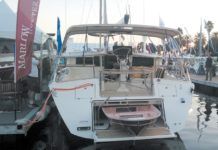
The Pros and Cons of the Rigid, Fiberglass Dinghy
Dinghies are the Rodney Dangerfields of cruising. They get no respect, or at least not as much as they deserve. The little boat that will see nearly as many sea miles as the mother ship is often an afterthought.
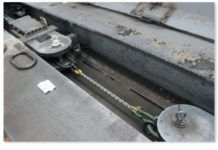
Snubber Chain Hooks Revisited
Last spring we reported on tests of chain hooks (see Testing the Effects of Chain Hooks, PS March 2016). Those tests found that some hooks reduced the strength and seriously damaged the retained chain. The maker of one of the hooks, Mantus, criticized our methods because the chain size we used did not match their specs for the hook, so we repeated the tests using different chain. (For a complete discussion of this matter, see the Inside PS blog post Can a Snubber Hook Weaken Your Chain?) We also looked at newer products that had been introduced in the interim.

An Inquiry into Anchor Angles
Designers of boat anchors deal in a handful of variables. The holding capacity of an anchor derives from its fluke, particularly the flukes size, shape, and the angle it makes with the shank. Other parts of the anchor-shank, roll bar, and stock-allow the fluke to set and hold as the designer intended. Based on the shapes and relationships between these components, an anchor fits into one of several broad categories: fluke (Danforth, Fortress, Manson Racer), plow (CQR, Delta, Kobra, SARCA Excel), claw (Bruce, Lewmar Claw, Manson Ray, Super Max), or fisherman (Luke).
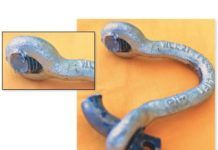
Anchor Shackle Re-Test Modifies Initial Findings
In the August 2015 and October 2016 issues, we reported the preliminary results of our anchor-shackle tests. However, more recent testing has raised questions about the conclusions-most notably our Best Choice designation of the Peer-Lift brand anchor shackles, sold by Peerless.

Winches Part 2
In our second look at sailboat winches, we put the deck hardware into action, sea trialing traditional winches that have stood the test of time as well as the newest trends in winch design. Our goal was to hone in on the operational aspects of each winch, scrutinizing how each drum handled line loads and noting which drum shapes were less prone to overrides. Testers also compared the effectiveness of self-tailing systems and the various drum surface finishes used to keep the line from slipping.

Winches: Ratios and Reality
When comparing winches, its important to understand how input and output interface. The winch handle is a rotary lever that is the first stage of power amplification. The ratio of drum radius-to-handle length is the first force multiplier. An 8-inch handle and a 2-inch radius drum, therefore, deliver a 4-to-1 boost in pulling power and a 4-to-1 decrease in line-hauling speed.

Beneteau 42CC The Center Cockpit Comeback That Didn’t Catch On… But...
If you’ve ever wondered what happened to center-cockpit cruising sailboats—and why they disappeared from mainstream production—today’s review takes you right into the heart of...


Latest Sailboat Review

Catalina Morgan 440 Used Boat Review
The Catalina Morgan 440 is a massive ocean-capable design from the drafting board of Gerry Douglas, a prolific designer for Catalina Yachts for over...