














Hunter 23.5
The 23.5 was designed as a trailerable family cruiser for entry-level sailors. Like most Hunters, the boat offers lots of space in the cockpit and down below, and comes with the famous Cruise Pac, which provides just about anything a customer needs, including sails, motor, trailer, lifelines, anchor, life jackets, flares and a copy of Chapman's Piloting, Seamanship and Small Boat Handling.
Hunter 25
By the mid '80s, after only ten years in business, Hunter Marine had become one of the two leaders (with Catalina Yachts) in the volume of auxiliary-sized sailboats on the US market. And, like Catalina, the corporate philosophy at Hunter was to mass produce low priced boats with as few changes in tooling, hence design, as possible.
Pearson 35
The Pearson 35 was introduced in 1968 and remained in production for the next 14 years. In all, 514 P35s were built, almost all for East Coast and Great Lakes owners attracted by the 35's shoal draft (3' 9" with centerboard up) and "classic" proportions. Even the popular Pearson 30, usually heralded as the enduring boat from a builder otherwise noted for its frequent introductions of new boats and short production runs, remained in production only 10 years, albeit with almost 1,200 boats built.
Pearson Triton
The Triton is vintage Alberg--skinny, long overhangs, low freeboard, large mainsail and small foretriangle. Typical of boats designed to the CCA (Cruising Club of America) rule. Alberg was born in Sweden where people love skinny keelboats with long overhangs, such as the Folkboat. It is easy to trace the Triton's lineage to such designs. Credit is also due to Tom Potter, of Jamestown, Rhode Island, who brought the project idea to the Pearsons, and had a hand in its development.
Pearson Vanguard
The Vanguard, designed by Philip Rhodes in 1962, remained in production until 1967, totalling 404 hulls. It was preceded by the Invicta, Alberg 35, Bounty II, Ariel, Rhodes 41, and of course the Triton. This line of fiberglass cruisers and sometime racers gave Pearson a strong position in the market. The pedigree of the designers was odorless, and construction quality was good for that particular moment in the timetable of plastic boatbuilding technology.
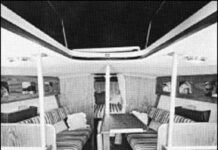
Tartan Ten
While we wouldn't consider the Tartan Ten to be one of the better-built racers, she doesn't have to be. Since she is primarily intended to race against her sisters, consistency between boats is perhaps more important than superior (and hence, more expensive) construction. The major construction criterion she must meet is to be sufficiently seaworthy to endure an occasional short offshore race. She meets this criterion, although, like too many production boats, she barely makes it.
Tartan 27
The Tartan 27 went into production in 1961 with fiberglass boatbuilding in its toddler stage; production ceased in 1980, after 19 years interrupted only by a fire in 1972 that resulted in no 27s being built that year. The greatest number of 27s built in one year is 85; the year was 1964. In all, 712 Tartan 27s were built, including a dozen boats under license in California. Remarkably few significant changes were made to the boat until near the end of the long production run, after hull #650.
Tartan 33
In 1978, Tartan brought out the Tartan Ten, a 33', fairly light, fractionally-rigged "offshore one design." The boat was a huge success: fast, easy to sail, and unencumbered by the design limitations of a rating rule. But the Tartan Ten had one big problem: limited accommodations with stooping headroom, an interior most kindly described as spartan. A hardy crew could take the Tartan Ten on a multi-day race such as the Mackinac, and you might even coax your family aboard for a weekend of camping out. But cruising or extended racing in comfort? Forget it!
Tartan 34
More than 500 Tartan 34s were built between 1968 and 1978. By 1978 the CCA rule was long gone, PHRF racing was beginning to surge, and the MHS (now IMS) was in its infancy. The Tartan 34 had passed from a racer/cruiser to a cruiser, not because the boat had changed, but because sailboat racing had changed. The Tartan 34 was succeeded by the larger, more modern Tartan 37, a boat of exactly the same concept.
Albin Vega
Like a lot of people, our first recollection of the Albin Vega was an advertisement in the sailing magazines. In the early 1970s, a time when California production coastal cruisers dominated the American market, this little Swedish import was hyped as a serious offshore cruiser.

Why This $1M+ Sailboat Might Be The Best Bluewater Cruiser in...
The Bluewater 56 is one of the most misunderstood offshore cruisers in the sailing world — and today we’re diving deep into what makes...


Latest Sailboat Review

The $100K Cruiser Showdown: How the Catalina 380 Stacks Up
Are you in the market for a 35 to 40 foot sailboat under $100,000? Are you considering a Catalina 380? Have you seen a...