




















Mailport: May 2016
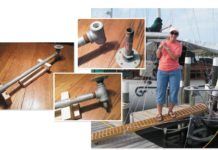
In your February 2016 issue, you had an article about boarding steps. As the freeboard is getting higher and higher on modern boats, there is a need for a practical solution to easily getting on and off the boat. I thought the Edson One-Step (www.edsonmarine.com) that you reviewed was a good solution, so I bought one. Overall, I found it worked pretty well; however, it has a narrow profile that makes the step fairly small. So I came up with my own custom adaptation to that problem (see accompanying photos). Basically, I added a teak step to the Edson frame. It works great. The only real downside is storage.

Seeking Input on Color-blind-friendly Design
Reader Harry Grossman recently wrote Practical Sailor with an interesting question that we had never really considered before. Grossman wrote, I am red-green color blind, as are a fair number of other males. Am I the only one who has difficulty seeing your Value Guide marks when they are placed in the colored background?

Applying Dielectric Grease
Im confused about how to apply dielectric silicone compound or LPS-3 (spray) to electrical connections. These are dielectric substances (i.e., insulators), which would suggest that if you apply either one to the electrical terminals and then assemble the connection, you would increase the resistance, defeating your intentions. So should you just spray or spread it over a terminal block and consider it protected? Or does the compound get squeezed out sufficiently so that a good electrical connection is made?
Mailport: April 2016
The hatch cover project you reported on in the March 2016 review of the Outland Hatch Covers offered a right nifty approach to making your own covers. Could we see more details on the cover backside and buttons? Also, how did you keep the holesaw from dancing around without the center bit to pilot off of?

Too Much of a Good Thing?
I read the September 2015 article about algae control and thought the Clorox Pool and Spa Algae Eliminator would be just the thing to clean an old North Norlam sail (Mylar/polyester laminate) that came with my boat and is very discolored with mold. I used a two-gallon pump sprayer and soaked both sides of the sail with the articles suggested 2-percent solution. I noted that the bottle did not make as much solution as I expected; I determined that the posted dilution was incorrect. It should actually have been 0.2 percent, which PS later confirmed.

Mailport: Penetrating Oils, Coppercoat, and More!
In regard to your article on freeing seized hardware (see PS January 2016 online), Ive found Kano Kroil (www.kanolabs.com) to be very effective, and I keep it on the boat. In a Practical Machinist website post (www.practicalmachinist.com) on penetrating oils, Kroil was reportedly the second best solution, after a homebrew mix of automatic transmission fluid (ATF) and acetone. Theres also a good discussion on penetrating oils in the Cruisers Forum (www.cruisersforum.com) titled Penetrating oil for old bolts/studs on exhaust manifold. I recommend readers interested in penetrating oils also check these out.
Water-lift Muffler Advice
I want to build a stainless-steel water-lift muffler for my boat. The muffler will have a 2-inch inlet/outlet for a 15-horsepower OMC saildrive. What should the distance be from the bottom inside floor to the bottom of the outlet exhaust pipe?

Mailport: Fuel Overfill Protection, Fuel Additive Feedback, and More!
In response to your December 2015 article on fuel overfill prevention devices: After my own frustrating experiences with fuel spills when using jerry cans at sea and at anchor, I have been using a shaker siphon for several years. However, the handling of the siphon afterwards always resulted in some dripping, and the twistiness of the tubing added to the problem.
Maker Feedback Prompts Faux Teak Re-test
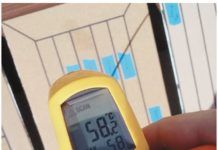
Our recent report on synthetic-teak decking options (see PS December 2015) raised a bit of a ruckus among the contenders in what is an extremely competitive market. The main bone of contention was our reported temperatures of the various materials after they were left in the sun. Several manufacturers reported that the temperatures we listed in the table accompanying the article were not consistent with their own findings.

Bluetooth VHF Streaming
There are VHFs on the market that use Bluetooth to pair with compatible headsets, but we don't know whether they use the same Bluetooth protocol as the Oticon streaming device that you have. A call to Oticon likely would confirm. The only Bluetooth-ready VHFs weve come across are the Standard Horizons fixed-mount Quantum GX5500S (PS Best Choice, October 2009) and its HX760S handheld (PS July 2009), which has been discontinued.

Why This $1M+ Sailboat Might Be The Best Bluewater Cruiser in...
The Bluewater 56 is one of the most misunderstood offshore cruisers in the sailing world — and today we’re diving deep into what makes...


Latest Sailboat Review

The $100K Cruiser Showdown: How the Catalina 380 Stacks Up
Are you in the market for a 35 to 40 foot sailboat under $100,000? Are you considering a Catalina 380? Have you seen a...